← The Wingmakers Ways · Astronomy & Exoplanets
Archived page · Checkable
2M1207b
2M1207b.html · captured from wingmakers.co.nz
Planetary Body : 2M1207 b 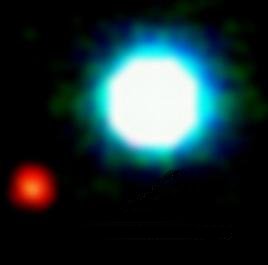
Composite image of the brown dwarf object 2M1207 (center) and the fainter object seen near it that may be an extrasolar planet candidate. The photo is based on three near-infrared exposures (in the H, K and L' wavebands) with the NACO adaptive-optics facility at the 8.2-m VLT Yepun telescope at the ESO Paranal Observatory. The discovery designated 2MASSWJ1207334-393254, 2M1207, was made with the adaptive-optics supported NACO facility at the 8.2-meter VLT Yepun telescope at the ESO Paranal Observatory (Chile).In April of this year, a team of European and American astronomers detected a faint and very red point of light very near a brown-dwarf object. Also known as "2M1207", this is a "failed star", i.e. a body too small for major nuclear fusion processes to have ignited in its interior and now producing energy by contraction. It is a member of the TW Hydrae (known as the 'Water Snake') stellar association located at a distance of about 230 light-years.
The feeble object is more than 100 times fainter than 2M1207 and its near-infrared spectrum was obtained with great efforts in June 2004 by NACO, at the technical limit of the powerful facility. This spectrum shows the signatures of water molecules and confirms that the object must be comparatively small and light. Most brown dwarfs are located by infrared instruments, which detect the heat generated by the faded star.
None of the available observations contradict that it may be an exoplanet in orbit around 2M1207. Taking into account the infrared colours and the spectral data, evolutionary model calculations point to a 5 Jupiter-mass planet in orbit around 2M1207. Still, they do not yet allow a clear-cut decision about the real nature of this intriguing object. Thus, the astronomers refer to it as a "Giant Planet Candidate Companion (GPCC)".
Observations will now be made to ascertain whether the motion in the sky of GPCC is compatible with that of a planet orbiting 2M1207. This should become evident within 1-2 years at the most.
Since 1998, a team of European and American astronomers have studied the environment of young, nearby "stellar associations", i.e., large conglomerates of mostly young stars and the dust and gas clouds from which they were recently formed.
The stars in these associations are ideal targets for the direct imaging of sub-stellar companions (planets or brown dwarf objects). The leader of the team, ESO astronomer Gael Chauvin notes that "whatever their nature, sub-stellar objects are much hotter and brighter when young - tens of millions of years - and therefore can be more easily detected than older objects of similar mass".
System Components
(Mass in Multiples of Jupiter's Mass) 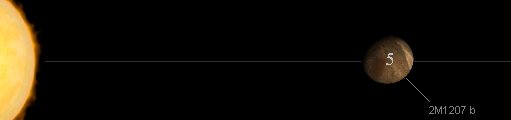
Discovered By: CHAUVIN G., LAGRANGE A.-M., DUMAS C., ZUCKERMAN B.,
MOUILLET D., SONG I., BEUZIT J.-L. & LOWRANCE P.
Year Discovered: 2004 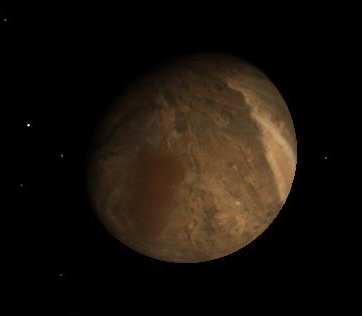
Photographed in 2004 using adaptive optics in the near infrared, 2M1207 b is 100 times fainter than its companion brown dwarf. Spectral analysis indicates that the object is similar to a brown dwarf, and it's brightness indicates low mass, both of which would be indicative of a young giant planet. Given the spectral analysis, it is unlikely this is a background star or galaxy, although it is possible that the object is a more massive background brown dwarf. Further observations will be needed of this object's motion relative to 2M1207 over the next few years to determine if it really is an orbiting planet.
If 2M1207 b is indeed a young giant planet, then it would be the first exoplanet ever photographed directly. More information on this object can be found at http://www.eso.org/outreach/press-rel/pr-2004/pr-23-04.html.
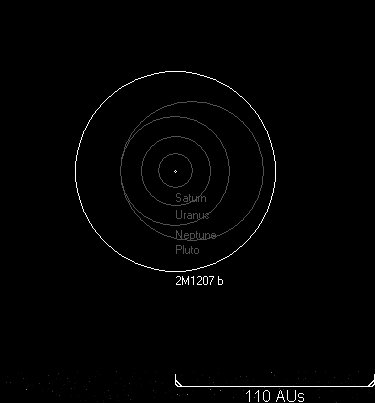
Planetary Orbit