← The Wingmakers Ways · not in the site's own index
Archived page · Asserted
Aries
ANDROMEDA_Con.html · captured from wingmakers.co.nz
Andromeda 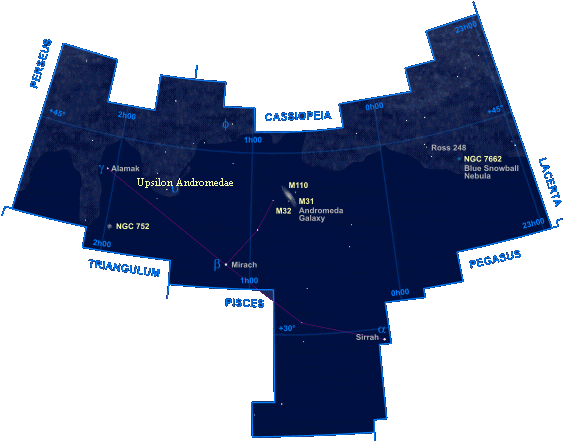
The constellation of Andromeda is a heroine in a grand Greek myth of the ancient Ethiopean dynasty. Almost all fields in autumn skies are occupied by characters in this story, Andromeda, Cassiopeia, Perseus, Pegasus, Cepheus, and Cetus.
The asterism consists of several bright stars with magnitudes of about 2, and there is a splendid galaxy of M31, The Andromeda Galaxy, at the side of Princess Andromeda. It could be said that the galaxy makes the name of this constellation popular.
I think you know at least the name of this Galaxy even if you don't gaze at stars habitually, it's a Messier's object representative of the night sky in autumn. M31 is only one celestial body recognized as a non-stellar object before the telescope was invented.
M31 has a size of 190' x 60', it's larger than six times of that of the Moon. The Galaxy lies at about a fifteen-degree angle from being edge-on, and it has a bright oval nucleus, a dust lane become visible in medium-sized telescopes. Its distance is approximately 2.3 million light years.
The brighter and closer elliptical companion of the Andromeda galaxy, also known as NGC 221. This is the inner half of a V-band CCD image taken in twilight (15 seconds' exposure) at the prime focus of the 4-meter Mayall telescope of Kitt Peak National Observatory. North is at the top and east to the left, for direct comparison with a chart or eyepiece view. The center of M31 is to the north. This area subtends 7.3 arcminutes, and is shown with a logarithmic intensity mapping. Even so, the bright nucleus of M32 (probably the highest stellar density known in the entire Local Group) saturates the display.
This picture of the Andromeda Galaxy's companion Messier 110 is a color composite of CCD images from the 0.9-meter telescope of the Kitt Peak National Observatory, near Tucson, Arizona. The peculiar dark structures, very probably dust clouds, are clearly visible in this short exposure image; due to these structures, M110 is often classified as E5p or E6p. Because of its small (linear) size, this galaxy is usually counted as a dwarf spheroidal or dwarf elliptical rather than a normal elliptical galaxy.
NGC752 is a very scattered open cluster found around the left leg of Princess Andromeda. The cluster is positioned near the boundary on Triangulum, can be easily detected only with the naked eyes looks like a dimmed nebula.
The cluster has an apparent diameter of 45 arc minutes, so telescopes aren't suitable for appreciating this object. You'll be fascinated with the cluster by using of binoculars that shows you plenty of fine stars appeared on the dimmed light.
NGC752 has formed a vast triangle in the autumnal night skies with the Andromeda Galaxy (M31) and M33 in Triangulum. You shouldn't forget to appreciate NGC752 after enjoying these splendid galaxies.
NGC891 is a small galaxy in Andromeda, positioned at about 4 degrees east of gamma Andromedae. The galaxy is being edge-on with clearly distinguished dust-lane in large telescopes. NGC891 has a length of 13-arc minutes and visual magnitude of about 10, it's fairly hard to detect its spindle shape with naked eyes.
The galaxy can hardly be paid attention because the constellation has a representative object of The Andromeda galaxy (M31) in autumn skies.
NGC7662 is a small planetary nebula in northern region of Andromeda. You can find out it about 3 degrees west of iota Andromedae, which forms the tip of her right arm. The nebula has a diameter of about 30 arc seconds and a visual brightness of about 9th magnitude.
NGC7662 has a round shape, but this image shows you the nebula has non-even brightness. The beautiful bluish color is one of characteristics of NGC7662, and the nebula has an unique nickname of "The Blue Snowball". A good seeing condition will allow you to appreciate the impressive bluish shape through medium-sized telescopes. It's estimated that the nebula is about 1800 light years away.
Upsilon Andromedae Planetary System
Astronomers recently announced the detection of three large planets orbiting the star Upsilon Andromedae - the first planetary system known to orbit a normal star other than our Sun. These planets were not directly photographed but found through a Doppler technique developed to use large telescopes to search nearby stars for wobbling planetary signatures. However, Upsilon And itself is visible to the unaided eye shining in Earth's sky in the northern constellation Andromeda at about 4th magnitude.
MAPPING TECHNIQUE
VISUAL EXERCISE : Two Person Exercise.
DESTINATION : Your Choice
STEP ONE
Traveller : Get comfortable and relax.
STEP TWO
Traveller : Charge your physical body with light energy.
STEP THREE
Traveller : See your visual body standing in front of your physical body and prepare your visual body for interstellar travel with a Interstellar Protection Shield.
STEP FOUR
Traveller : See your visual body filling with light energy.
STEP FIVE
Traveller : Focus your mind on teleporting your visual body to the Your Destination.
STEP SIX
Traveller : Then see your visual body teleporting to the Your Destination.
STEP SEVEN
Traveller : When you arrive in the destination Look around can you see any planets or moons in the System? If not use the Interstellar Planetary Detection Rapid and see if you can detect any planets or moons in that system.
STEP EIGHT
Traveller : If you can see or detect a planet or moon using Telekinesis or Teleportation move towards the planetary body.
STEP NINE
Traveller : When you arrive at the outer atmosphere of the planet or moon stop and ask your spiritual guide to tell you the name of this planet or moon.
Traveller : Tell the mapper the name of the planet or moon. Also tell the mapper all you can about the planet or moon.
STEP TEN
Then us the Core Comparison Crystal Technique to perform a core reading on this planet or moon and give the mapper your reading on this planet or moon
STEP ELEVEN
Traveller : Then levitate or Teleport your visual body to the surface of the planet or moon.
STEP TWELVE
Mapper : When the traveller arrives on the surface ask the following questions.
Is there any plant life or water on the surface of the planet or moon that you can see? Is there an atmosphere around this planet or moon? Is the atmosphere an match with earths atmosphere?
Mapper : Write down the answers to these questions.
PLANETARY DATA FILE 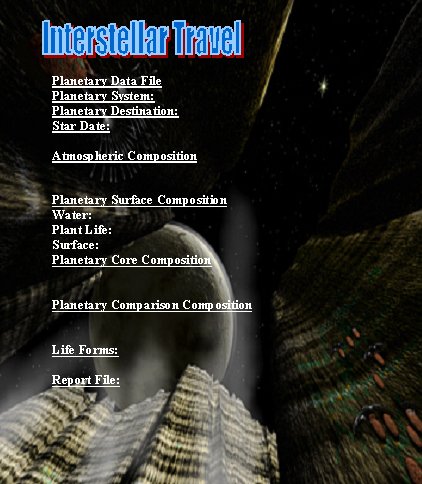
STEP THIRTEEN
Traveller : When you are finished on the surface teleport your visual body to the nearest planetary body that you can see in that Galaxy.
STEP FOURTEEN
Traveller and Mapper : Follow steps nine through to twelve again till you have mapped out the whole Galaxy.
STEP FIFTEEN
Traveller : When you have finished mapping the Galaxy teleport your visual body back to your physical body back on earth.
REMEMBER
When you are travelling if you come across an alien race that you think may be friendly feel free to make contact with that alien race.
IMPORTANT
When you are contacting alien races always be ready to teleport if there is trouble.
MAPPER
Make a note of any planets or moons with an atmospheric match with earths. That way you both know which planets can support human life forms.
MAPPER & TRAVELLER
To check that your mapping of that Galaxy is correct by changing roles and do this exercise again. Also remember to check for life force energy around the planets or moons that you visit on your journeys. Because if you can feel life force energy that means the planet or moons is a real planet or moon.