← The Wingmakers Ways · Astronomy & Exoplanets
Archived page · Checkable
Antila Constellation
Antila.html · captured from wingmakers.co.nz
Antila 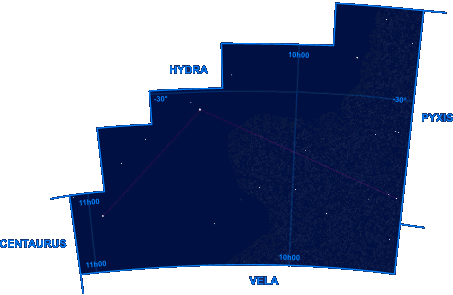
The Air Pump Myth
Nicolas-Louis de Lacaille named this constellation the air pump in honor of the invention by Robert Boyle. Boyle was a rather distinguished scientist. Born in 1627 in Ireland, he was raised in wealth as the 14th child of his family. He was educated in Eaton and then tutored in Switzerland. From 1645 he lived in Dorset (in England), engaging in a number of experiments and writing essays on a wide variety of subjects. One of his essays inspired Jonathan Swift to write Gulliver's Travels.
From 1665 to 1668 he lived in Oxford, and he worked with his assistant Robert Hooke to invent the air pump. He also studied the behavior of gases in some detail. This resulted in what we now call Boyle's Law: It states that at a given temperature, the pressure of a gas will vary inversely to the gas' volume.
In other accomplishments, he established that matter is made of a series of primary particles that combine to form corpuscles. Today, after a little more development, we call these things atoms and molecules.
Later in life, he continued his work, while living with his sister. He grew quite famous, and received many foreign visitors. He declined the presidency of the Royal Society of London in 1680. He endowed a series of lectures (called the Boyle Lectures, which continue to this day) with the goal of "proving the Christian Religion against notorious Infidels." By this, he meant the Roman Catholics. Boyle died in 1691 in London.
NGC2997 (Bennett 41b, the spiral galaxy at the bottom of the image) is one of Dreyer's remarkable objects. Described as very faint (mag. 10), very large (4'), it has a pronounced central condensation. Larger scopes should see knots in the spiral arms. Several galaxies hover around it, the brightest being NGC3001 (at the top, or north end, of the picture). It shines at mag. 12.3. The galaxy just to the north-west of NGC3001 is the 14.6 mag. ESO434-34.
The disc of NGC 2997 is inclined at about 45 degrees to our line of sight, revealing its internal structure and giving the galaxy an oval appearance. Seen face-on, NGC 2997 would look rather like Messier 83. Like most spirals, the galaxy has two prominent spiral arms, which appear to originate in the yellow nucleus, are peppered with bright red blobs of ionised hydrogen which are similar to regions of star formation in our own Milky Way. Within these gas clouds are produced the hot blue stars which generate most of the light in the arms of the galaxy. A much older population of yellowish stars are concentrated around the nucleus. This wide angle view emphasises that this beautiful galaxy is seen through the stars of our own galaxy, the Milky Way.
MAPPING TECHNIQUE
VISUAL EXERCISE : Two Person Exercise.
DESTINATION : Your Choice
STEP ONE
Traveller : Get comfortable and relax.
STEP TWO
Traveller : Charge your physical body with light energy.
STEP THREE
Traveller : See your visual body standing in front of your physical body and prepare your visual body for interstellar travel with a Interstellar Protection Shield.
STEP FOUR
Traveller : See your visual body filling with light energy.
STEP FIVE
Traveller : Focus your mind on teleporting your visual body to the Your Destination.
STEP SIX
Traveller : Then see your visual body teleporting to the Your Destination.
STEP SEVEN
Traveller : When you arrive in the destination Look around can you see any planets or moons in the System? If not use the Interstellar Planetary Detection Rapid and see if you can detect any planets or moons in that system.
STEP EIGHT
Traveller : If you can see or detect a planet or moon using Telekinesis or Teleportation move towards the planetary body.
STEP NINE
Traveller : When you arrive at the outer atmosphere of the planet or moon stop and ask your spiritual guide to tell you the name of this planet or moon.
Traveller : Tell the mapper the name of the planet or moon. Also tell the mapper all you can about the planet or moon.
STEP TEN
Then us the Core Comparison Crystal Technique to perform a core reading on this planet or moon and give the mapper your reading on this planet or moon
STEP ELEVEN
Traveller : Then levitate or Teleport your visual body to the surface of the planet or moon.
STEP TWELVE
Mapper : When the traveller arrives on the surface ask the following questions.
Is there any plant life or water on the surface of the planet or moon that you can see? Is there an atmosphere around this planet or moon? Is the atmosphere an match with earths atmosphere?
Mapper : Write down the answers to these questions.
PLANETARY DATA FILE 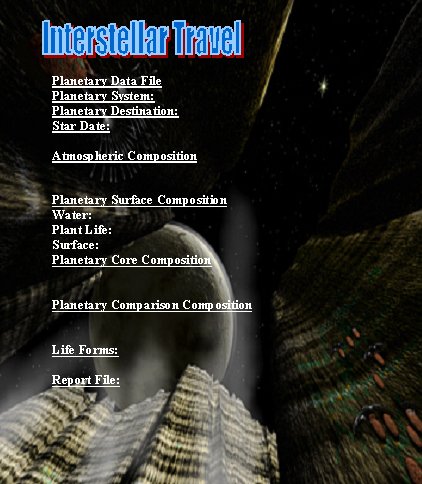
STEP THIRTEEN
Traveller : When you are finished on the surface teleport your visual body to the nearest planetary body that you can see in that Galaxy.
STEP FOURTEEN
Traveller and Mapper : Follow steps nine through to twelve again till you have mapped out the whole Galaxy.
STEP FIFTEEN
Traveller : When you have finished mapping the Galaxy teleport your visual body back to your physical body back on earth.
REMEMBER
When you are travelling if you come across an alien race that you think may be friendly feel free to make contact with that alien race.
IMPORTANT
When you are contacting alien races always be ready to teleport if there is trouble.
MAPPER
Make a note of any planets or moons with an atmospheric match with earths. That way you both know which planets can support human life forms.
MAPPER & TRAVELLER
To check that your mapping of that Galaxy is correct by changing roles and do this exercise again. Also remember to check for life force energy around the planets or moons that you visit on your journeys. Because if you can feel life force energy that means the planet or moons is a real planet or moon.