← The Wingmakers Ways · Astronomy & Exoplanets
Archived page · Checkable
Aquarius
Aquarius.html · captured from wingmakers.co.nz
AQUARIUS 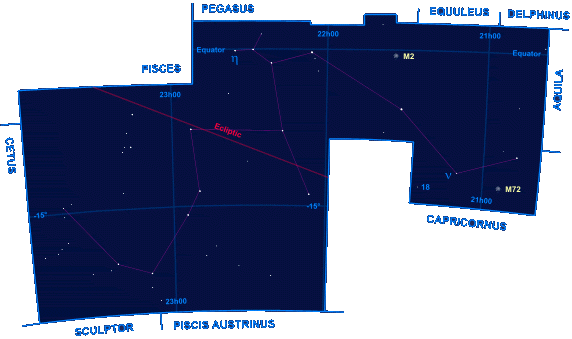
Aquarius is the tenth largest constellation in skies, be found at southwest of the Great Square of Pegasus.
The constellation is formed by faint stars with mostly third or fourth magnitude, and is one of the most difficult constellations to make its figure. But a tiny asterism formed by four stars with fourth magnitude looks like a shape of reversed "Y" is only good mark to identify the constellation. It makes a jar held by Ganymede.
Seventh Cosmic Ray : Linking Through The Moon
"A need to materialise on earth all that exists above, by making realities out of other men's dreams, motivates these subjects. Therefore, they act as they think, feel and will. They are extremely aware of the separateness of each thing, and function naturally as a complete, self-sufficient unity. This makes them very independent and earthy with the capacity to do without other people entirely. This independence, unlike the first ray subject's freedom from restrictions, indicates complete attachment to material surroundings. Through their unity of being and detachment from others they can become self-centred and find it difficult not to use other people for their own purposes. They are materially minded and sow seeds solely that they can gather the fruit - always expecting a return from their investment and favours. These subjects have to be the dominant in their relationships with others and may develop a tendency to treat everybody as either possessions or servants.
At the moderate latitude in the autumn's south sky, you can see the largest planetary nebula of NGC7293 in the skies only with binoculars. Its shape has given the name of "The Helix Nebula", it's resemble the DNA double helix on photographs. The nebula is located about 10 degrees NW of Fomalhaut, alpha PsA, it's easy to use the star as a mark to search the nebula rather than stars in Aquarius. The nebula has an extraordinary vast size, about same diameter with the half of that of full moon, and is unexpectedly faint, it's fairly difficult to see in naked eyes.
The nebula has formed by a central white dwarf discharged the gaseous matter, and is expanding outward at the rate of about 25km (16 miles) per second. It's said that the sun should be destined to follow the same way with a dwarf in this nebula about 5 billion years later.
M2 (NGC7089) is a compact globular cluster under the head of Pegasus, belonged to the field of Aquarius. The cluster has an apparent diameter of 13 arc minutes and 6th magnitude, fairly noticeable because there aren't so many bright stars around this field. You'll be easily able to find M2 to follow a line to west about 8 degrees from alpha Aqr.
The globular cluster is fairly densed, so you'll be needed medium-sized telescopes to resolve the individual stars around the edge. The cluster will show you like a dimmed nebula unless you have very clear and good seeing night.
There is an another globular cluster of M15 about 13 degrees north looks just like M2. It's interesting to compare these two globulars in the autumn skies. The distance to M2 is estimated about 52 thousand light years.
M72 is a globular cluster with an apparent diameter of 6 arc minutes and about 9th magnitude. It hardly can be distinguished with normal stars through finder scopes so you may miss it without very cared searching. The cluster is positioned at 3.5 degrees SSE of epsilon Aqr.
M73 is lying at 1.3 degrees east of M72. This Messier's object is registered as an open cluster, but the cluster has only four 11th magnitude fine stars. It's very delicate whether M73 can be regarded as an astronomical open cluster. You can appreciate the asterism like a very compact cluster through telescopes with a low magnifying power. It may be no wonder that Messier recognized the cluster as an open cluster.
MAPPING TECHNIQUE
VISUAL EXERCISE : Two Person Exercise.
DESTINATION : Your Choice
STEP ONE
Traveller : Get comfortable and relax.
STEP TWO
Traveller : Charge your physical body with light energy.
STEP THREE
Traveller : See your visual body standing in front of your physical body and prepare your visual body for interstellar travel with a Interstellar Protection Shield.
STEP FOUR
Traveller : See your visual body filling with light energy.
STEP FIVE
Traveller : Focus your mind on teleporting your visual body to the Your Destination.
STEP SIX
Traveller : Then see your visual body teleporting to the Your Destination.
STEP SEVEN
Traveller : When you arrive in the destination Look around can you see any planets or moons in the System? If not use the Interstellar Planetary Detection Rapid and see if you can detect any planets or moons in that system.
STEP EIGHT
Traveller : If you can see or detect a planet or moon using Telekinesis or Teleportation move towards the planetary body.
STEP NINE
Traveller : When you arrive at the outer atmosphere of the planet or moon stop and ask your spiritual guide to tell you the name of this planet or moon.
Traveller : Tell the mapper the name of the planet or moon. Also tell the mapper all you can about the planet or moon.
STEP TEN
Then us the Core Comparison Crystal Technique to perform a core reading on this planet or moon and give the mapper your reading on this planet or moon
STEP ELEVEN
Traveller : Then levitate or Teleport your visual body to the surface of the planet or moon.
STEP TWELVE
Mapper : When the traveller arrives on the surface ask the following questions.
Is there any plant life or water on the surface of the planet or moon that you can see? Is there an atmosphere around this planet or moon? Is the atmosphere an match with earths atmosphere?
Mapper : Write down the answers to these questions.
PLANETARY DATA FILE 
STEP THIRTEEN
Traveller : When you are finished on the surface teleport your visual body to the nearest planetary body that you can see in that Galaxy.
STEP FOURTEEN
Traveller and Mapper : Follow steps nine through to twelve again till you have mapped out the whole Galaxy.
STEP FIFTEEN
Traveller : When you have finished mapping the Galaxy teleport your visual body back to your physical body back on earth.
REMEMBER
When you are travelling if you come across an alien race that you think may be friendly feel free to make contact with that alien race.
IMPORTANT
When you are contacting alien races always be ready to teleport if there is trouble.
MAPPER
Make a note of any planets or moons with an atmospheric match with earths. That way you both know which planets can support human life forms.
MAPPER & TRAVELLER
To check that your mapping of that Galaxy is correct by changing roles and do this exercise again. Also remember to check for life force energy around the planets or moons that you visit on your journeys. Because if you can feel life force energy that means the planet or moons is a real planet or moon.