← The Wingmakers Ways · Astronomy & Exoplanets
Archived page · Checkable
Aquila Constellation
Aquila.html · captured from wingmakers.co.nz
AQUILA 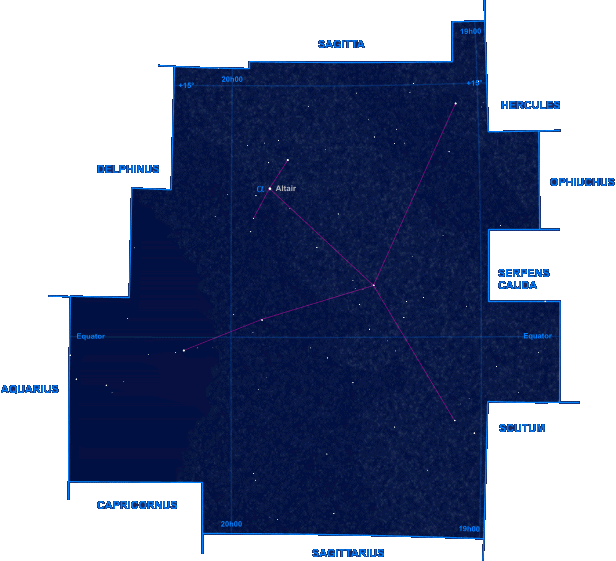
The Aquila, The Eagle, is a constellation at the East Side of Milky Way. You can see the picture that the constellation adjoins the Milky Way, but Aquila has almost no attractive nebulae nor star clusters.
Alpha Aquilae, Altair has a mean of "The Flying Eagle", it's in contrast to Vega, the falling eagle. The star is another main character in the Chinese legend of "Tanabata" with Vega.
The constellation of Aquila surprisingly includes no Messier objects in spite of being soaked in the summer's Milky Way. But you'll be fascinated with various dark lanes being tangled in the Milky Way through small binoculars, and especially, dark nebulae B142 and B143 (registered in the Barnard's catalogue) are the most striking and vastest ones in them. They're positioned at about 3 degrees NW of Altair (alpha Aquilae), and you can see gamma Aquilae which is a NW neighbor of Altair at the lower left-hand side in the picture.
This group of dark nebula looks like a Greek letter of zeta, and is devided into two segments of north (B142) and south (B143) ones.
This composite color Hubble image of NGC 6751 is a beautiful example of a classic planetary nebula with complex features and was selected to commemorate the tenth anniversary of Hubble in orbit. The colors were chosen to represent the relative temperature of the gas - blue, orange, and red indicating the hottest to coolest gas. Winds and radiation from the intensely hot central star (140,000 degrees Celsius) have apparently created the nebula's streamer-like features. The nebula's actual diameter is approximately 0.8 light-years or about 600 times the size of our solar system. NGC 6751 is 6,500 light-years distant in the constellation Aquila.
It is a fan-shaped cloud of gas and dust which is illuminated by R Monocerotis (R Mon), the bright star at the bottom end of the nebula. Dense condensations of dust near the star cast shadows out into the nebula, and as they move the illumination changes, giving rise to the variations first noted by Hubble. The star itself, lying about 2,500 light-years from Earth, cannot be seen directly, but only through light scattered off of dust particles in the surrounding nebula. R Mon is believed to have a mass of about 10 times that of the Sun, and to have an age of only 300,000 years. There is probably a symmetrical counterpart of the fan-shaped nebula on the southern side of the star, but it is heavily obscured from view by dust lying between this lobe and our line of sight.
HH 32 is an excellent example of a "Herbig-Haro object," which is formed when young stars eject jets of material back into interstellar space. This object, about 1,000 light-years from Earth, is somewhat older than Hubble's variable nebula, and the wind from the bright central star has already cleared much of the dust out of the central region, thus exposing the star to direct view. Many young stars, like the central object in HH 32, are surrounded by disks of gas and dust that form as additional material is attracted gravitationally from the surrounding nebula. Material in the disk gradually spirals in toward the star and eventually some of it accretes onto the star, increasing its mass. A fraction of the gas, however, is ejected perpendicularly to the disk at speeds near 200 miles per second, and forms two oppositely directed jets. These jets plow into the surrounding nebula, producing strong shock waves that heat the gas and cause it to glow in the light of hydrogen atoms (green) and sulfur ions (blue), several other atoms and ions, and sometimes radiation from the exciting star that is reflected by the surrounding gas (red). This glow is called a Herbig-Haro object, in honor of astronomers George Herbig and Guillermo Haro, who did much of the early work in this area in the 1950's. The jet on the top side, whose furthest extent is about 0.2 light-year from the star, is pointed more nearly in our direction, while the opposite jet on the bottom lies on the far side of the star and is fainter either because it is partially obscured by dust surrounding the star or because there is much less material in front of the star.
NGC 2346, in contrast to the first two young objects, is a so-called "planetary nebula," which is ejected from Sun-like stars which are near the ends of their lives. NGC 2346 is remarkable because its central star is known to be actually a very close pair of stars, orbiting each other every 16 days. It is believed that the binary star was originally more widely separated. However, when one component of the binary evolved, expanded in size, and became a red-giant star, it literally swallowed its companion star. The companion star then spiralled downwards inside the red giant, and in the process spewed out gas into a ring around the binary system. Later on, when the hot core of the red giant was exposed, it developed a faster stellar wind, which emerged perpendicularly to the ring and inflated two huge "bubbles." This two-stage process is believed to have resulted in the butterfly-like shape of the nebula. NGC 2346 lies about 2,000 light-years away from us, and is about one-third of a light-year in size.
The tangled up galaxies, called IRAS 19297-0406, are crammed together in the center of the picture. IRAS 19297-0406 is part of a class of galaxies known as ultraluminous infrared galaxies (ULIRGs). ULIRGs are considered the progenitors of massive elliptical galaxies.
ULIRGs glow fiercely in infrared light, appearing 100 times brighter than our Milky Way Galaxy. The large amount of dust in these galaxies produces the brilliant infrared glow. The dust is generated by a firestorm of star birth triggered by the collisions. IRAS 19297-0406 is producing about 200 new Sun-like stars every year � about 100 times more stars than our Milky Way creates. The hotbed of this star formation is the central region [the yellow objects]. This area is swamped in the dust created by the flurry of star formation. The bright blue material surrounding the central region corresponds to the ultraviolet glow of new stars. The ultraviolet light is not obscured by dust. Astronomers believe that this area is creating fewer new stars and therefore not as much dust. The colliding system [yellow and blue regions] has a diameter of about 30,000 light-years, or about half the size of the Milky Way. The tail [faint blue material at left] extends out for another 20,000 light-years. Astronomers used both cameras to witness the flocks of new stars that are forming from the galactic wreckage. NICMOS penetrated the dusty veil that masks the intense star birth in the central region. ACS captured the visible starlight of the colliding system's blue outer region. IRAS 19297-0406 may be similar to the so-called Hickson compact groups � clusters of at least four galaxies in a tight configuration that are isolated from other galaxies. The galaxies are so close together that they lose energy from the relentless pull of gravity. Eventually, they fall into each other and form one massive galaxy.
Planetary Destinations In Aquila
MAPPING TECHNIQUE
VISUAL EXERCISE : Two Person Exercise.
DESTINATION : Your Choice
STEP ONE
Traveller : Get comfortable and relax.
STEP TWO
Traveller : Charge your physical body with light energy.
STEP THREE
Traveller : See your visual body standing in front of your physical body and prepare your visual body for interstellar travel with a Interstellar Protection Shield.
STEP FOUR
Traveller : See your visual body filling with light energy.
STEP FIVE
Traveller : Focus your mind on teleporting your visual body to the Your Destination.
STEP SIX
Traveller : Then see your visual body teleporting to the Your Destination.
STEP SEVEN
Traveller : When you arrive in the destination Look around can you see any planets or moons in the System? If not use the Interstellar Planetary Detection Rapid and see if you can detect any planets or moons in that system.
STEP EIGHT
Traveller : If you can see or detect a planet or moon using Telekinesis or Teleportation move towards the planetary body.
STEP NINE
Traveller : When you arrive at the outer atmosphere of the planet or moon stop and ask your spiritual guide to tell you the name of this planet or moon.
Traveller : Tell the mapper the name of the planet or moon. Also tell the mapper all you can about the planet or moon.
STEP TEN
Then us the Core Comparison Crystal Technique to perform a core reading on this planet or moon and give the mapper your reading on this planet or moon
STEP ELEVEN
Traveller : Then levitate or Teleport your visual body to the surface of the planet or moon.
STEP TWELVE
Mapper : When the traveller arrives on the surface ask the following questions.
Is there any plant life or water on the surface of the planet or moon that you can see? Is there an atmosphere around this planet or moon? Is the atmosphere an match with earths atmosphere?
Mapper : Write down the answers to these questions.
PLANETARY DATA FILE 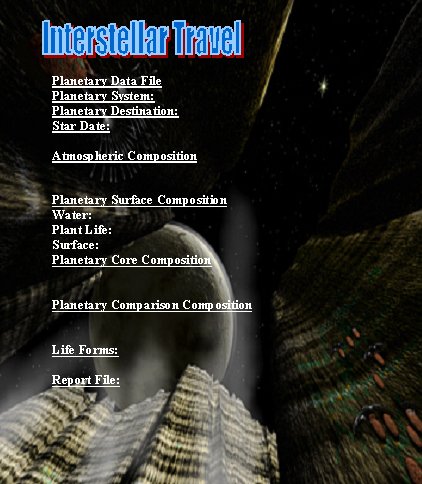
STEP THIRTEEN
Traveller : When you are finished on the surface teleport your visual body to the nearest planetary body that you can see in that Galaxy.
STEP FOURTEEN
Traveller and Mapper : Follow steps nine through to twelve again till you have mapped out the whole Galaxy.
STEP FIFTEEN
Traveller : When you have finished mapping the Galaxy teleport your visual body back to your physical body back on earth.
REMEMBER
When you are travelling if you come across an alien race that you think may be friendly feel free to make contact with that alien race.
IMPORTANT
When you are contacting alien races always be ready to teleport if there is trouble.
MAPPER
Make a note of any planets or moons with an atmospheric match with earths. That way you both know which planets can support human life forms.
MAPPER & TRAVELLER
To check that your mapping of that Galaxy is correct by changing roles and do this exercise again. Also remember to check for life force energy around the planets or moons that you visit on your journeys. Because if you can feel life force energy that means the planet or moons is a real planet or moon.