← The Wingmakers Ways · Astronomy & Exoplanets
Archived page · Checkable
Ara
Ara.html · captured from wingmakers.co.nz
Constellation : Ara 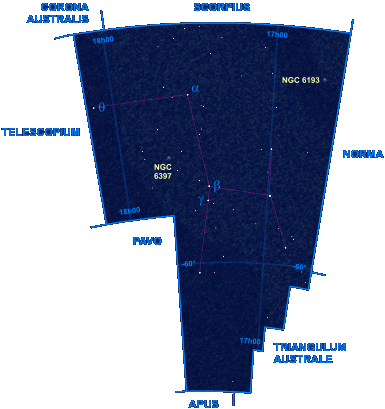
As a far southern constellation, Ara is today almost invisible from Europe at any time of the year. Between 2,000 and 3,000 years ago, though, it was clearly visible from southern Europe and northern Africa during the summer months. The Greeks of that time called it Thytérion or Thysiastérion, the Altar of Sacrifice, perhaps because it rose in the sky at a propitious time of the year. This tradition was inherited by the Romans, who gave the constellation the name we know today: 'Ara' is the Latin word for 'Altar'.
Stars
There are few bright stars in this region of the sky. The two brightest, Alpha and Beta Arae, are coincidentally almost exactly the same magnitude of +2.8. Though the Beta star is almost 400 light years beyond the Alpha, it is much more luminous.
Some of Ara's stars are very distant: both Gamma Arae and Theta Arae lie more than 1,000 light years away, but both of these stars are brilliant supergiants, and so are clearly visible to the naked eye of an observer on Earth.
Star Clusters
The most notable cluster in Ara is a Globular group that lies somewhat 'below' the plane of the galactic disc. NGC 6397 is a fairly loose ball of stars lying approximately 7,000 light years (about 2,000 parsecs) from Earth's Solar System.
A little nearer to Earth, at about 4,500 light years distance, is an open star cluster, NGC 6193. This is quite a young cluster on a cosmic timescale, and still surrounded by much of its original nebulous material.
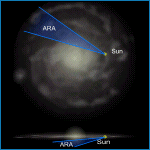
NGC6397 (Bennett 98, Caldwell 86) is a globular cluster located 2.9° north-east of Beta Arae. Described as bright (mag. 5.7), very large (26'), rich (but not especially so for a globular), it contains stars at mag. 10 and fainter.
NGC6362 (Bennett 95) is a nice globular cluster located near the far southern border of Ara, 1.2° north-east of Zeta Apodis, and 2.7.° south-west of Eta Pavonis. Described as quite bright (mag. 8.1), large (10.7'), and very gradually much brighter middle, well resolved, with stars of magnitude 14 to 17. Other sources indicate stars of mag. 12.5 and fainter. From the Digital Sky Survey. The bright star in the upper, right (north-west) corner shines at mag. 6.9, and is cataloged as GSC 9065:3654, or HIP 85668.
NGC6352 (Bennett 94, Caldwell 81) is an open cluster located 1.8° north-west of Alpha Arae. Described as fairly faint (mag. 8.2), and large (2'), it contains stars mag. 12 and fainter.
NGC6253 (Bennett 84) is a mag. 10 open cluster in western Ara described as small (5'), triangular, and containing (about 30) magnitude 13 stars. Epsilon-1 Arae lies 27' to the south.
NGC6193 (Caldwell 82) is a mag. 5.2 open cluster located 8.3° WNW of Alpha Arae, and 2.6° ESE of Epsilon Normae. Described as very large (15'), loose, and uncondensed, it contains about 30 stars mag. 6 and fainter. Dreyer mentions that a faint nebulosity is involved.
MAPPING TECHNIQUE
VISUAL EXERCISE : Two Person Exercise.
DESTINATION : Your Choice
STEP ONE
Traveller : Get comfortable and relax.
STEP TWO
Traveller : Charge your physical body with light energy.
STEP THREE
Traveller : See your visual body standing in front of your physical body and prepare your visual body for interstellar travel with a Interstellar Protection Shield.
STEP FOUR
Traveller : See your visual body filling with light energy.
STEP FIVE
Traveller : Focus your mind on teleporting your visual body to the Your Destination.
STEP SIX
Traveller : Then see your visual body teleporting to the Your Destination.
STEP SEVEN
Traveller : When you arrive in the destination Look around can you see any planets or moons in the System? If not use the Interstellar Planetary Detection Rapid and see if you can detect any planets or moons in that system.
STEP EIGHT
Traveller : If you can see or detect a planet or moon using Telekinesis or Teleportation move towards the planetary body.
STEP NINE
Traveller : When you arrive at the outer atmosphere of the planet or moon stop and ask your spiritual guide to tell you the name of this planet or moon.
Traveller : Tell the mapper the name of the planet or moon. Also tell the mapper all you can about the planet or moon.
STEP TEN
Then us the Core Comparison Crystal Technique to perform a core reading on this planet or moon and give the mapper your reading on this planet or moon
STEP ELEVEN
Traveller : Then levitate or Teleport your visual body to the surface of the planet or moon.
STEP TWELVE
Mapper : When the traveller arrives on the surface ask the following questions.
Is there any plant life or water on the surface of the planet or moon that you can see? Is there an atmosphere around this planet or moon? Is the atmosphere an match with earths atmosphere?
Mapper : Write down the answers to these questions.
PLANETARY DATA FILE 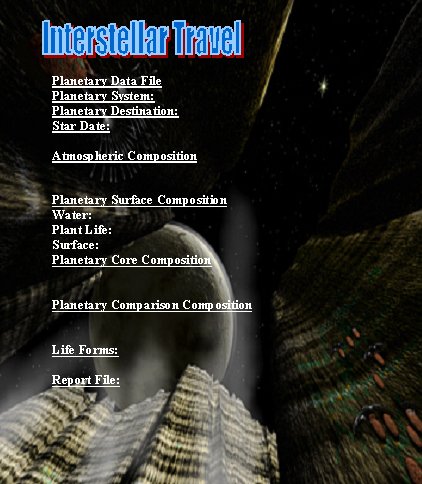
STEP THIRTEEN
Traveller : When you are finished on the surface teleport your visual body to the nearest planetary body that you can see in that Galaxy.
STEP FOURTEEN
Traveller and Mapper : Follow steps nine through to twelve again till you have mapped out the whole Galaxy.
STEP FIFTEEN
Traveller : When you have finished mapping the Galaxy teleport your visual body back to your physical body back on earth.
REMEMBER
When you are travelling if you come across an alien race that you think may be friendly feel free to make contact with that alien race.
IMPORTANT
When you are contacting alien races always be ready to teleport if there is trouble.
MAPPER
Make a note of any planets or moons with an atmospheric match with earths. That way you both know which planets can support human life forms.
MAPPER & TRAVELLER
To check that your mapping of that Galaxy is correct by changing roles and do this exercise again. Also remember to check for life force energy around the planets or moons that you visit on your journeys. Because if you can feel life force energy that means the planet or moons is a real planet or moon.