← The Wingmakers Ways · Astronomy & Exoplanets
Archived page · Checkable
Aries Constellation
Aries.html · captured from wingmakers.co.nz
Aries 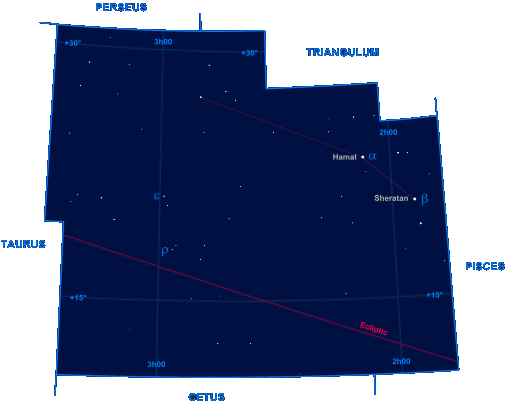
The Ram
Derivation
Phrixus and Helle were the children of Athamas the King of Thebes. When their wicked step-mother threatened to have them killed, they escaped on a magical flying ram with a golden fleece. Helle was understandably alarmed by this experience, and fell from the ram into the sea, but her brother Phrixus survived and landed safely in Colchis. There, he sacrificed the ram to Zeus, who promptly placed it among the stars, while the King of Colchis kept its golden fleece.
Stars
Aries is one of the least conspicuous of the zodiacal constellations, and has only two stars above third magnitude. These are Hamal and Sheratan, the Alpha and Beta stars of the constellation. Unusually, these two stars not only appear to be close together in the sky, but actually are: they lie just six light years from one another.
The First Point of Aries
The First Point of Aries is a place of vital importance in the sky - here, the Ecliptic and the Celestial Equator cross, and when the Sun reaches this point, as it does once a year, the Vernal Equinox occurs. The First Point of Aries also marks the Celestial Meridian, which is the zero-point for calculations of Right Ascension.
Because of the effects of precession on the Earth, though, the First Point of Aries moves through the sky, and in fact it left the constellation from which it takes its name in about the year 70 BC, when it entered the neighbouring constellation of Pisces. Nonetheless, it retains the name 'First Point of Aries'. Roughly 23,000 years from now, the Sun will have completed its circuit of the zodiac, and the First Point will once again lie among the stars from which it takes its name.
Scorpius includes a broad region of the Galaxy, in the general direction of the Core. This explains the density of the Milky Way in the constellation, and the large number of star clusters
Constellation of Aries is a member of zodiac just west of the Pleiades (M45) in Taurus, an asterism of three stars with second or third magnitude lined up a bit strained marks the head of the Ram. Though Aries is tiny and very faint constellation, that had included the vernal equinox about two thousand years ago, and Aries was an important zodiac as the first member of that.
NGC772 is a small spiral galaxy just 2 degrees southeast of beta Aries. The galaxy has a brightness of 11th magnitude and a long axis of 7 arc minutes or so. You can see dimmed elliptic light by using of telescopes about 20cm (8 inches) in aperture. This image shows you two arms stretched and west one is fairly opened, it can be seen that the galaxy looks asymmetry.
MAPPING TECHNIQUE
VISUAL EXERCISE : Two Person Exercise.
DESTINATION : HD20367 Planetary System
STEP ONE
Traveller : Get comfortable and relax.
STEP TWO
Traveller : Charge your physical body with light energy.
STEP THREE
Traveller : See your visual body standing in front of your physical body and prepare your visual body for interstellar travel with a Interstellar Protection Shield.
STEP FOUR
Traveller : See your visual body filling with light energy.
STEP FIVE
Traveller : Focus your mind on teleporting your visual body to the Your Destination.
STEP SIX
Traveller : Then see your visual body teleporting to the Your Destination.
STEP SEVEN
Traveller : When you arrive in the destination Look around can you see any planets or moons in the System? If not use the Interstellar Planetary Detection Rapid and see if you can detect any planets or moons in that system.
STEP EIGHT
Traveller : If you can see or detect a planet or moon using Telekinesis or Teleportation move towards the planetary body.
STEP NINE
Traveller : When you arrive at the outer atmosphere of the planet or moon stop and ask your spiritual guide to tell you the name of this planet or moon.
Traveller : Tell the mapper the name of the planet or moon. Also tell the mapper all you can about the planet or moon.
STEP TEN
Then us the Core Comparison Crystal Technique to perform a core reading on this planet or moon and give the mapper your reading on this planet or moon
STEP ELEVEN
Traveller : Then levitate or Teleport your visual body to the surface of the planet or moon.
STEP TWELVE
Mapper : When the traveller arrives on the surface ask the following questions.
Is there any plant life or water on the surface of the planet or moon that you can see? Is there an atmosphere around this planet or moon? Is the atmosphere an match with earths atmosphere?
Mapper : Write down the answers to these questions.
PLANETARY DATA FILE 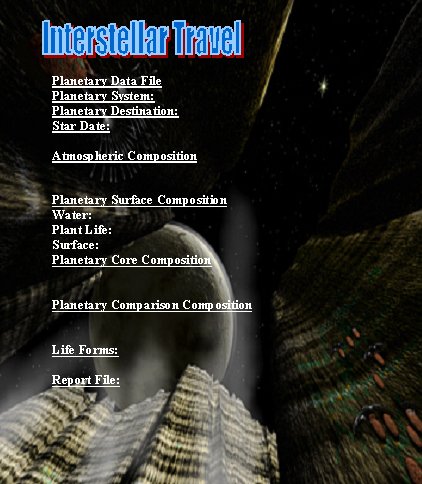
STEP THIRTEEN
Traveller : When you are finished on the surface teleport your visual body to the nearest planetary body that you can see in that Galaxy.
STEP FOURTEEN
Traveller and Mapper : Follow steps nine through to twelve again till you have mapped out the whole Galaxy.
STEP FIFTEEN
Traveller : When you have finished mapping the Galaxy teleport your visual body back to your physical body back on earth.
REMEMBER
When you are travelling if you come across an alien race that you think may be friendly feel free to make contact with that alien race.
IMPORTANT
When you are contacting alien races always be ready to teleport if there is trouble.
MAPPER
Make a note of any planets or moons with an atmospheric match with earths. That way you both know which planets can support human life forms.
MAPPER & TRAVELLER
To check that your mapping of that Galaxy is correct by changing roles and do this exercise again. Also remember to check for life force energy around the planets or moons that you visit on your journeys. Because if you can feel life force energy that means the planet or moons is a real planet or moon.