← The Wingmakers Ways · Astronomy & Exoplanets
Archived page · Checkable
Auriga Constellation
Auriga.html · captured from wingmakers.co.nz
Auriga 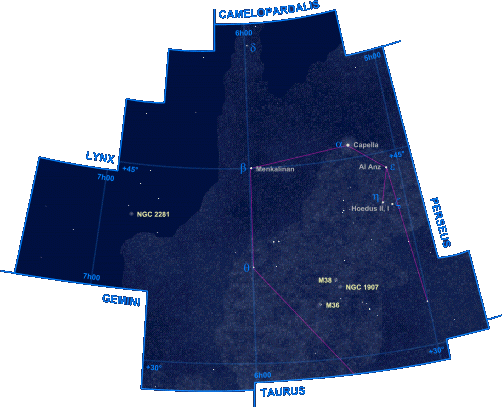
The Charioteer
Myth
Auriga is usually identified with Phaethon, the son of the sun god Helios and Clymene. (From the 5th century BCE, Apollo, originally a deity of light, was more and more interpreted as a sun-god). Responding to the desire to confirm that Helios was his real father, Phaethon confronted him about it. To prove his paternity, Helios promised to give him whatever he wanted. He asked for the permission to drive the sun-chariot through the heavens for a single day. Helios regretted his promise, and sought long and hard to dissuade his son, but a promise is promise; he had to let him make the attempt.
Phaethon soon discovered that the chariot was much harder to handle than he had imagined. The horses soon realized the charioteer was different, and veered over the sky. Eventually he completely lost control. The chariot grazed the earth and the Nile hid its head. It soared into the far north, causing the normally sluggish dragon to writhe. The Earth cried out for aid and Zeus hurled a thunderbolt at Phaethon.
He died and fell into the River Eridanus.
Another story tells that Auriga may represent Erichthonius (the fourth king of ancient Athens), whose lameness inspired him to invent the chariot. We also see Auriga depicted as a warm-hearted herdsman holding a she-goat, with two kids nearby. The she-goat raised Zeus when he was an infant, by giving him her milk. Zeus was hidden in Mt. Ida from his father Cronus. Cronus habitually ate his children, and Zeus was the only survivor.
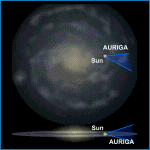
The constellation of Auriga looks 'outwards' along the plane of the Milky Way, towards the edge of our Galaxy.
At about the zenith in winter sky, a trio of open clusters is bathed in the faint Milky Way of Auriga. They are paralleled M37 (NGC2099), M36 (NGC1960), and M38 (NGC1912) from east to west. M38 has a bit sparser star-density than other two, only
M38 is classified in type f, M36 and M37 have a type of e.
Both appearances and real scales of all three are very alike. A telescope is preferred but you can at least locate these objects with binoculars. It'll be very interesting to compare their distributions of stars and/or detailed structures with telescopes. They have sizes of about 20 arc minutes and distances of 3500 to 4700 light years approximately.
M38 is a bright open cluster in Auriga. It is nestled inside the winter Milky Way, so there are a lot of field stars in the image also
There is a bluish variable star "Auriga AE" with 6th magnitude at the center of IC405, known as "The Runaway Star". The variable has born in The Great Orion Nebula (M42) and jumped from the nebula. The star is just passing through IC405 by chance, and brightening the nebula by giving energy and activating the hydrogen molecules. When Auriga AE goes away from IC405 in far future, the nebula will lose its glitter and become a dark nebula.
And very faint gaseous nebulosities are distributed around between IC410 and M38.
IC417 with an apparent diameter of about 15 arc minutes. The dimmed and vast nebula has occupied almost whole of upper part of this photograph, a single filament structure is stretching toward just west (right in picture) of M38.
NGC2281 is a normal open cluster in east of the pentagon of Auriga. Although there are no good guide stars nearby, you will be able to catch the cluster with binoculars by estimating midway of beta Aurigae and Castor. The cluster has a size of about 15 arc minutes and about 30 member stars or so. And the distance is estimated about 5400 light years.
MAPPING TECHNIQUE
VISUAL EXERCISE : Two Person Exercise.
DESTINATION : Your Choice
STEP ONE
Traveller : Get comfortable and relax.
STEP TWO
Traveller : Charge your physical body with light energy.
STEP THREE
Traveller : See your visual body standing in front of your physical body and prepare your visual body for interstellar travel with a Interstellar Protection Shield.
STEP FOUR
Traveller : See your visual body filling with light energy.
STEP FIVE
Traveller : Focus your mind on teleporting your visual body to the Your Destination.
STEP SIX
Traveller : Then see your visual body teleporting to the Your Destination.
STEP SEVEN
Traveller : When you arrive in the destination Look around can you see any planets or moons in the System? If not use the Interstellar Planetary Detection Rapid and see if you can detect any planets or moons in that system.
STEP EIGHT
Traveller : If you can see or detect a planet or moon using Telekinesis or Teleportation move towards the planetary body.
STEP NINE
Traveller : When you arrive at the outer atmosphere of the planet or moon stop and ask your spiritual guide to tell you the name of this planet or moon.
Traveller : Tell the mapper the name of the planet or moon. Also tell the mapper all you can about the planet or moon.
STEP TEN
Then us the Core Comparison Crystal Technique to perform a core reading on this planet or moon and give the mapper your reading on this planet or moon
STEP ELEVEN
Traveller : Then levitate or Teleport your visual body to the surface of the planet or moon.
STEP TWELVE
Mapper : When the traveller arrives on the surface ask the following questions.
Is there any plant life or water on the surface of the planet or moon that you can see? Is there an atmosphere around this planet or moon? Is the atmosphere an match with earths atmosphere?
Mapper : Write down the answers to these questions.
PLANETARY DATA FILE 
STEP THIRTEEN
Traveller : When you are finished on the surface teleport your visual body to the nearest planetary body that you can see in that Galaxy.
STEP FOURTEEN
Traveller and Mapper : Follow steps nine through to twelve again till you have mapped out the whole Galaxy.
STEP FIFTEEN
Traveller : When you have finished mapping the Galaxy teleport your visual body back to your physical body back on earth.
REMEMBER
When you are travelling if you come across an alien race that you think may be friendly feel free to make contact with that alien race.
IMPORTANT
When you are contacting alien races always be ready to teleport if there is trouble.
MAPPER
Make a note of any planets or moons with an atmospheric match with earths. That way you both know which planets can support human life forms.
MAPPER & TRAVELLER
To check that your mapping of that Galaxy is correct by changing roles and do this exercise again. Also remember to check for life force energy around the planets or moons that you visit on your journeys. Because if you can feel life force energy that means the planet or moons is a real planet or moon.