← The Wingmakers Ways · Astronomy & Exoplanets
Archived page · Checkable
Beta Pictoris
Beta_Pictoris.html · captured from wingmakers.co.nz
Beta Pictoris Planetary System
Interstellar Card
System Components
(Mass in Multiples of Jupiter's Mass) 
Beta Pictoris B
Statistics
Star System: Beta Pictoris
Discovery Status: Confirmed
Mass: 2 Jupiters
Average Distance: 8 AUs
Period: 19 Years
Detection Method: Planet Transit Occulation
Inferred from Asymetry in Dust Disc
Discovered By: Transit from Lecavelier des Etangs, 1995
Asymmetry from Burrows, 1996
Year Discovered: 1995
Speculations
Beta Pictoris b is almost certainly a world of wonders, assuming it exists at all. Currently, we don't know much about it. What we do know is that beta Pictoris is surrounded by a disk of dust and gas similar to the disk which our own solar system formed from. In many ways, beta Pictoris may be a solar system in the making.
There are two interesting facts about this system. First, the disk does not start at beta Pictoris itself. The inner edge of the disk is 50 AU from beta Pictoris, more distant than Pluto is from the sun. Second, the disk is warped. Both these facts lend credence to the idea that there is something orbiting beta Pictoris that can both clear a wide area of debris and gravitationally affect the disk. That something is a massive planet, perhaps even a brown dwarf.
As we have not detected the planet orbiting beta Pictoris using Doppler Spectroscopy, which would give us relatively good values for its speed, distance, and mass, we don't have any exact information about its attributes. We can only make approximations.
If we assume a 2.5 to 8 Jupiter mass planet orbiting at about Jupiter-like distances (figures which fit into what we do know of this system) then beta Pictoris b is probably much like its other jovian cousins. It may have a ring system and a retinue of moons. If it is closer to the 8 Jupiter mass end of the spectrum, then its night side will be glowing due to high internal temperatures as we saw with 70 Virginis b. As beta Pictoris is a blue giant, it is intrinsically brighter and hotter than the sun, so beta Pictoris b would receive more energy than Jupiter. Combined with the greater mass involved, the planet and its moons would be at least as dynamic as Jupiter, probably more so.
Imagine, for a moment, that you are in a spacecraft passing through the beta Pictoris system. As you fly by the star's giant companion planet, you would be struck by a host of splendors. A menagerie of moons, some frozen snowballs, some volcanic dynamos, some with think hydrocarbon atmospheres. Graceful arcing rings of dust and ice glinting in the ample sunlight. A vast protoplanetary cloud encircling and dominating the whole sky. A brilliant blue diamond of a parent star. And the massive planet itself, slowly glowing with its own heat and gaseous bulk as lightning strikes play across its turbulent surface. This is one system where the potential for awesome beauty is quite high.
Planetary Orbit Around Beta Pictoris 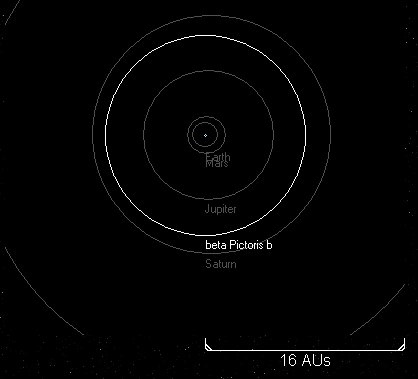
Inner Protoplanet Disk
Statistics
Star System: beta Pictoris
Discovery Status: Imaged
Minimum Distance: 24 AUs
Maximum Distance: 300 AUs
Detection Method: Imaging
Comet 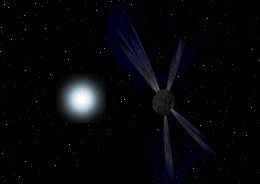
Statistics
Star System: beta Pictoris
Discovery Status: Inferred
Average Distance: 40 AUs
Detection Method: Ultraviolet Spectroscopy
Discovered By: Lecavelier des Etangs et al
Year Discovered: 2001
Planetary Orbit Around Beta Pictoris
Outer Protoplanet Disk
Statistics
Star System: beta Pictoris
Discovery Status: Imaged
Minimum Distance: 380 AUs
Maximum Distance: 900 AUs
Detection Method: Imaging
Beta Pictoris C
Statistics
Star System: beta Pictoris
Discovery Status: Uncertain
Mass: 13 Jupiters
Average Distance: 537 AUs
Detection Method: Inferred from Asymetry in Dust Disc
Inferred from Dust Blob Disconnected from Main Disc
Discovered By: Asymmetry from Burrows, 96
Dust Blob from Holland, 1998
Year Discovered: 1996
Planetary Orbit Around Beta Pictoris 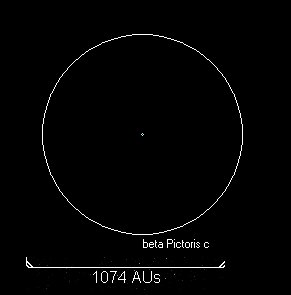
Position in Pictor