← The Wingmakers Ways · not in the site's own index
Archived page · Asserted
Sagitta
Canis_Minor~2004.html · captured from wingmakers.co.nz
Canis Minor
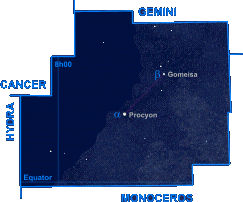
The Lesser Dog, The Little Dog
This small group of stars hugs the edge of the Milky Way. Among them lies Procyon, a near neighbour of the Sun lying just eleven light years away.
A tiny winter constellation of Canis Minor is found at opposite side of its mate of Canis Major separated by the Milky Way. Its only point of interest is in alpha CMi, Procyon. The star is one of members that forms the large asterism of the Winter's Great Triangle with Betelgeuse, alpha Ori, and Sirius, alpha Canis Majoris.
PROCYON (Alpha Canis Minoris). The eastern anchor of the Winter Triangle, Procyon is the Alpha star of Canis Minor, the smaller dog. The Greek name means "before the dog," as in northern latitudes the star rises before Sirius, the "Dog Star," and its constellation, Canis Major, and announces their quick arrival. The eighth brightest star we see in the sky, Procyon is just behind Rigel in Orion. The star is bright in part, however, because it is close to us, a mere 11 1/4 light years away, compared with Rigel's 1600 light years. By comparison, Procyon is a feeble radiator even if it is still 7 times intrinsically more luminous than the Sun. The star is an example of a "subgiant," one that is just beginning its death process, its internal core hydrogen about all burned away to helium. Procyon's chief claim to fame is a tiny companion, Procyon B, a "white dwarf" discovered in 1895, though its existence was already known from the wobbles it exerts on the brighter star, Procyon A, which were discovered in 1844. Recent Hubble Space Telescope observations show that Procyon B has a temperature of 8700 degrees above absolute zero, a bit warmer than Procyon A's 6500 degree temperature, and is only about the size of Earth. Oddly, another member of the Winter Triangle, Sirius, has a similar companion. Both are dead stars that have gone through the entire cycle of stellar evolution and now consist of highly compressed gas that is just cooling off. At one time they were mighty stars brighter than their visible companions are today.
The name of Procyon means "Before the Dog", coming from the fact that this star rises just before (about 11 minutes at Tokyo) Sirius. The distance is estimated about 11.4 light years; Procyon is nearly as close to us as Sirius (8.7 light years away).
Procyon had a former name of "Gomeisa", that means, "eye in tears". The star was regarded as being sad because many asterisms like Orion or bright stars in West Side of Milky Way left Gomeisa behind at the opposite side. Now, Gomeisa is named another principal star, beta CMi with third magnitude. 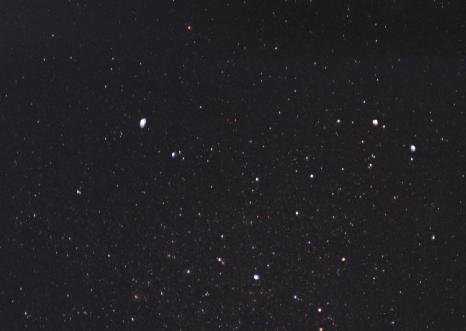
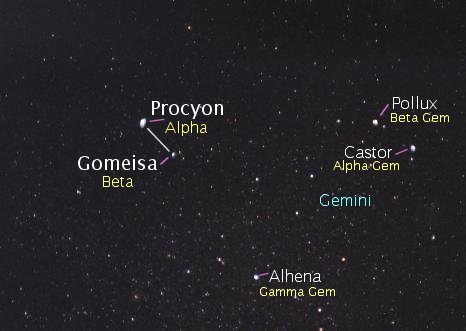
Canis Minor (the Smaller Dog) is a simple two-star figure seen here to the left of Gemini, which is easily recognizable by the twin stars Pollux and Castor at its top. (They are to the right of center near the edge; Pollux is the one on the left). The brightest star in the photograph, seen to the upper left of center, is Procyon of Canis Minor. Gomeisa, the Beta star in the constellation, is just down and to the right from Procyon. Procyon is at the northeast apex of the Winter Triangle.
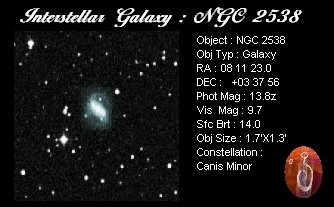
Galaxies In Canis Minor 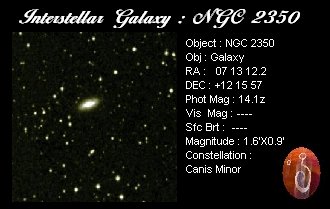
MAPPING TECHNIQUE
VISUAL EXERCISE : Two Person Exercise.
DESTINATION : Your Choice
STEP ONE
Traveller : Get comfortable and relax.
STEP TWO
Traveller : Charge your physical body with light energy.
STEP THREE
Traveller : See your visual body standing in front of your physical body and prepare your visual body for interstellar travel with a Interstellar Protection Shield.
STEP FOUR
Traveller : See your visual body filling with light energy.
STEP FIVE
Traveller : Focus your mind on teleporting your visual body to the Your Destination.
STEP SIX
Traveller : Then see your visual body teleporting to the Your Destination.
STEP SEVEN
Traveller : When you arrive in the destination Look around can you see any planets or moons in the System? If not use the Interstellar Planetary Detection Rapid and see if you can detect any planets or moons in that system.
STEP EIGHT
Traveller : If you can see or detect a planet or moon using Telekinesis or Teleportation move towards the planetary body.
STEP NINE
Traveller : When you arrive at the outer atmosphere of the planet or moon stop and ask your spiritual guide to tell you the name of this planet or moon.
Traveller : Tell the mapper the name of the planet or moon. Also tell the mapper all you can about the planet or moon.
STEP TEN
Then us the Core Comparison Crystal Technique to perform a core reading on this planet or moon and give the mapper your reading on this planet or moon
STEP ELEVEN
Traveller : Then levitate or Teleport your visual body to the surface of the planet or moon.
STEP TWELVE
Mapper : When the traveller arrives on the surface ask the following questions.
Is there any plant life or water on the surface of the planet or moon that you can see? Is there an atmosphere around this planet or moon? Is the atmosphere an match with earths atmosphere?
Mapper : Write down the answers to these questions.
PLANETARY DATA FILE 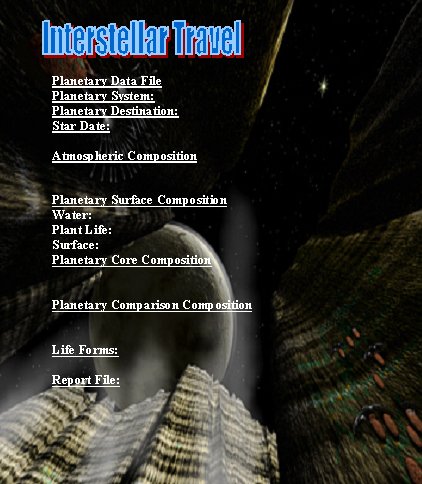
STEP THIRTEEN
Traveller : When you are finished on the surface teleport your visual body to the nearest planetary body that you can see in that Galaxy.
STEP FOURTEEN
Traveller and Mapper : Follow steps nine through to twelve again till you have mapped out the whole Galaxy.
STEP FIFTEEN
Traveller : When you have finished mapping the Galaxy teleport your visual body back to your physical body back on earth.
REMEMBER
When you are travelling if you come across an alien race that you think may be friendly feel free to make contact with that alien race.
IMPORTANT
When you are contacting alien races always be ready to teleport if there is trouble.
MAPPER
Make a note of any planets or moons with an atmospheric match with earths. That way you both know which planets can support human life forms.
MAPPER & TRAVELLER
To check that your mapping of that Galaxy is correct by changing roles and do this exercise again. Also remember to check for life force energy around the planets or moons that you visit on your journeys. Because if you can feel life force energy that means the planet or moons is a real planet or moon.