← The Wingmakers Ways · Astronomy & Exoplanets
Archived page · Checkable
Capricornus
Capricorn.html · captured from wingmakers.co.nz
CAPRICORNUS 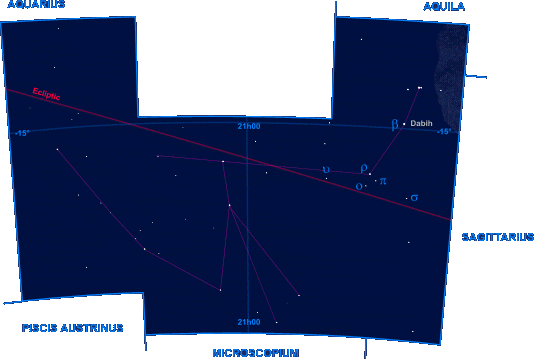
The Goat, The Sea-goat
Constellation of Capricornus is a member of zodiac in autumn, the figure of Capricornus is strange, to say, the lower half of the body shows the tail of fish, so the constellation is often translated as "The Sea Goat" or "The Goat-Fish".
Capricornus is rather faint, but asterism of a large reverse-triangle is fairly obvious.
About two thousand years ago when the origins of zodiac were associated, the constellation of Capricornus had the winter solstice. It was the rainy season at the ancient Near East, and that was one of main reasons why the constellation had a tail of fish to make a relation with the water. And an east neighbored constellation of Aquarius is 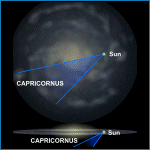
The stars of Capricornus lie in the general direction of our Galaxy's Core, but outside the dense plane of the Milky Way.
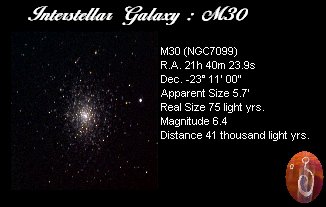
M30 is a tiny globular cluster about 7 degrees south of gamma Cap, positioned at the eastern edge of reverse triangle of Capricornus. And a fifth magnitude star of 41 Cap is paralleling with M30, a good mark to search the cluster with finder scopes.
The globular is very normal one without any mentioned characteristics. You can see it as a dimmed nebulosity with binoculars, and perhaps it would be fairly difficult to resolve the member stars even if you use medium-sized telescopes with a magnifying power of 100 or so. M30 has a real size of about 75 light years and about 40 thousand light years away. a zodiac that was connected with the rain or water.
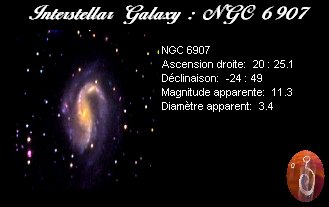
While the constellation of Capricorn covers a large area of sky I was surprised to discover it is relatively empty of NGC/IC type deep sky objects. The NGC objects, mostly galaxies, ranged in brightness from relatively bright to extremely faint as seen through the telescope. On the other hand, I found the IC galaxies to be very difficult to detect with most way too faint. Among the galaxies I targetted, there are also two globular clusters; one being the very impressive M30, the other is Pal 12. I found it was easy enough to navigate through Capricorn with numerous bright to relatively bright field stars marking a trail from one field to the next.
Other Galaxies In Capricornus
NGC 6903 - elliptical galaxy mag 11.9
NGC 6912 - spiral galaxy mag 13.6
NGC 6924 - elliptical galaxy mag 12.6
NGC 6936 - elliptical galaxy mag 12.8
NGC 7016/7/8 - galaxy group of two ellipticals and one spiral, mags 14.4, 13.7, 14.4
NGC 7103/4 - two bright galaxies in a galaxy cluster at mags 10.3 and 13.8
Planetary Destinations In Capricornus
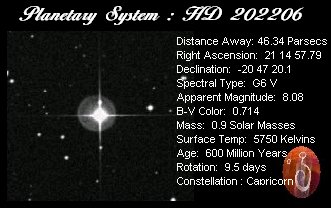
The brown-dwarf candidate HD 202206b has a comparable minimum mass of 14.7 Jupiter masses. It orbits HD 202206 (in constellation Capricornus; visual magnitude 8.1; stellar type G6V) in 259 days and the orbit is fairly eccentric.
MAPPING TECHNIQUE
VISUAL EXERCISE : Two Person Exercise.
DESTINATION : Your Choice
STEP ONE
Traveller : Get comfortable and relax.
STEP TWO
Traveller : Charge your physical body with light energy.
STEP THREE
Traveller : See your visual body standing in front of your physical body and prepare your visual body for interstellar travel with a Interstellar Protection Shield.
STEP FOUR
Traveller : See your visual body filling with light energy.
STEP FIVE
Traveller : Focus your mind on teleporting your visual body to the Your Destination.
STEP SIX
Traveller : Then see your visual body teleporting to the Your Destination.
STEP SEVEN
Traveller : When you arrive in the destination Look around can you see any planets or moons in the System? If not use the Interstellar Planetary Detection Rapid and see if you can detect any planets or moons in that system.
STEP EIGHT
Traveller : If you can see or detect a planet or moon using Telekinesis or Teleportation move towards the planetary body.
STEP NINE
Traveller : When you arrive at the outer atmosphere of the planet or moon stop and ask your spiritual guide to tell you the name of this planet or moon.
Traveller : Tell the mapper the name of the planet or moon. Also tell the mapper all you can about the planet or moon.
STEP TEN
Then us the Core Comparison Crystal Technique to perform a core reading on this planet or moon and give the mapper your reading on this planet or moon
STEP ELEVEN
Traveller : Then levitate or Teleport your visual body to the surface of the planet or moon.
STEP TWELVE
Mapper : When the traveller arrives on the surface ask the following questions.
Is there any plant life or water on the surface of the planet or moon that you can see? Is there an atmosphere around this planet or moon? Is the atmosphere an match with earths atmosphere?
Mapper : Write down the answers to these questions.
PLANETARY DATA FILE 
STEP THIRTEEN
Traveller : When you are finished on the surface teleport your visual body to the nearest planetary body that you can see in that Galaxy.
STEP FOURTEEN
Traveller and Mapper : Follow steps nine through to twelve again till you have mapped out the whole Galaxy.
STEP FIFTEEN
Traveller : When you have finished mapping the Galaxy teleport your visual body back to your physical body back on earth.
REMEMBER
When you are travelling if you come across an alien race that you think may be friendly feel free to make contact with that alien race.
IMPORTANT
When you are contacting alien races always be ready to teleport if there is trouble.
MAPPER
Make a note of any planets or moons with an atmospheric match with earths. That way you both know which planets can support human life forms.
MAPPER & TRAVELLER
To check that your mapping of that Galaxy is correct by changing roles and do this exercise again. Also remember to check for life force energy around the planets or moons that you visit on your journeys. Because if you can feel life force energy that means the planet or moons is a real planet or moon.