← The Wingmakers Ways · Astronomy & Exoplanets
Archived page · Checkable
Cassiopeia Constellation
Cassiopeia.html · captured from wingmakers.co.nz
Cassiopeia
Cassiopeia was the wife of Cepheus, the Ethiopian king, and the mother of Andromeda. The asterism clearly shows the chair upon which Cassiopeia sits. It looks like a shape of "W", and is a guide to find out the Polar Star like the Big Dipper. Japanese had given the asterism names of "The stars of Anchor" or "The stars of shape of mountains", and so on.
The constellation is bathed in the faint autumn's Milky Way, so includes various nebulae and star clusters. 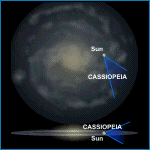
The dense band of the Milky Way passing through Cassiopeia shows that it lies on the plane of our Galaxy. The familiar W-shaped constellation looks out towards the Galaxy's rim.
Cassiopeia's constellation straddles the Milky Way in the far northern sky, neighbouring the constellations dedicated to her husband King Cepheus, her daughter Andromeda, and Andromeda's rescuer Perseus.
Stars
The familiar 'W' of Cassiopeia is made up from five stars, Segin, Ksora, Cih, Schedir and Caph. The central star Cih is the brightest of these (at magnitude +2.2), while Caph is the closest of the five to Earth's Solar System at 55 light years. By a curious coincidence, all five of these stars are variables. In particular, Cih can vary by nearly 5% of a magnitude, and is the prototype of a class of irregular variables, 'Gamma Cassiopeiae' variables, that periodically cast off rings of matter.
Also notable among the stars of Cassiopeia is Achird, a fairly bright star roughly half-way between Cih and Schedir. This yellow binary, though not as bright as some of Cassiopeia's other stars, is much closer to Earth, at roughly nineteen light years' distance.
Star Clusters
Cassiopeia includes a number of open clusters, but none of these is visible to the naked eye. Particularly notable are two Messier objects, M52 and, close to Ksora in the sky, M103. Another cluster, NGC 457, can be found near the distant star Phi Cassiopeiae. All of these clusters are young (no more than 35 million years old), and their distances range between five and ten thousand light years, in the direction of the Galaxy's rim.
Supernovae
Cassiopeia has been the site of two supernovae in historical times. The first occurred in 1572, and reached a maximum magnitude of roughly -4, making it brighter than Venus in the sky. The second took place nearly a century later, leaving a shattered region that is still detectable today, especially by radio telescopes, and is designated Cassiopeia A. These stellar explosions took place about 10,000 light years away.
There are many gaseous regions and star clusters around the Milky Way flowing from Cepheus, Cassiopeia to Perseus. This attractive reddish nebula, IC1805, is unfortunately invisible with our eyes, but very photogenic and one of the largest ones around this field. The nebula has a span of about one-degree, floating 2500 light years away.
IC1805 shows us a bit warped heart-shape. You can see a small and bright region in the upper right-hand side, which has an another number of NGC1795. And the nebula has a neighbor of IC1848 at just east, this couple can be captured with medium-ranged telephoto lenses.
IC1848 is a dimmed diffused nebula neighboring IC1805.
These nebulae are invisible with our eyes. IC1848 has a size of 60 arc minutes in east-west and 30 minutes in north-south direction. And it's often said that IC1848 looks like a shape of "embryo" turning its head eastward. The body of embryo is brighter than the head, and the region of head includes two fine open clusters of Cr33 and Cr44.
This picture has captured a star field around gamma Cassiopeiae. The bright star is accompanied by very faint reflection nebulae. Though this nebula is single lump of inter-stellar gaseous matter, the Index Catalogue has given two numbers of IC59 and IC65 for the north and northwest parts respectively. Both nebulae has apparent size of about 10 arc minutes and we can detect them only on films with long exposure. IC63 is brighter than IC59, being M-shaped filament structure.
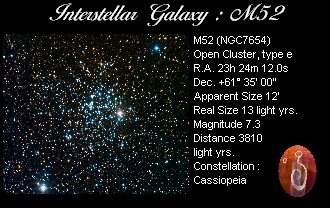
Please try to draw a line from alpha Cas. to beta Cas, then continue this line, doubling its length. You'll be able to find out a beautiful open cluster M52 (NGC7654) in your field of vision. The cluster contains about 120 faint stars gathering like a semicircle, 3800 light years away.
It's considered that a supernova explosion in the nebula has formed the characteristic structure. This reddish nebula isn't so well known, but it can be captured with M52, and have made a lively and interesting field in autumn sky.
Bubble Nebula, NGC7635. As a magnified image below shows us, the nebula has a well-proportioned circle structure around the center. It's considered that a supernova explosion in the nebula has formed the characteristic structure. This reddish nebula isn't so well known, but it can be captured with M52, and have made a lively and interesting field in autumn sky.
NGC281 is a red diffused nebula about 2 degrees east of alpha Cas. Though almost all of diffused nebulae emitting the reddish spectra by the activated hydrogen molecule can hardly be detected with our naked eyes, NGC281 is fairly bright, and you can appreciate its dimmed shape with binoculars in the extremely good conditioned sky.
The constellation of Cassiopeia is located in the autumn's Milky Way, and has various attractive and photographed objects including the nebula.
NGC457 is a open cluster about four degrees SE of gamma Cassiopeiae. It has a size of about 13 arc minutes, and seems to be a dimmed nebula surrounding a star with fifth magnitude, phi Cas, by using of binoculars.
Although this cluster isn't so popular, it's worthy of note that the cluster looks like a human with arms extended when this picture being upside down. I strongly recommend you to see the cluster with telescopes once, you'll be impressed with its unique shape.
Around between delta and epsilon Cassiopeiae, several open clusters are scattered and can be enjoyed only with small binoculars. A large cluster in the center is NGC663, gathering plenty of faint stars in 11 arc minutes. Apparent shape of the cluster looks like a triangle through scopes.
And a tiny open cluster at the lower right-hand side is M103, it's wonder that NGC663 wasn't registered in the Messier's catalogue in spite of that NGC663 is larger and brighter than M103.
NGC7790 is a medium sized open cluster positioned about 2.5 degrees northwest from beta Cas, the western star of W-shaped Cassiopeia. You can see it a bit lower part in this picture. And there is another open cluster of NGC7788 just 16-arc minutes northwest from NGC7790. These two clusters have an impression like very compact double-clusters.
NGC7790 and NGC7788 have apparent diameters of 17 and 9 arc minutes respectively, both have several tens fine stars gathered in sparse. Though you can detect this pair only with compact binoculars, not so striking because they're bathed in the Milky Way.
MAPPING TECHNIQUE
VISUAL EXERCISE : Two Person Exercise.
DESTINATION : Your Choice
STEP ONE
Traveller : Get comfortable and relax.
STEP TWO
Traveller : Charge your physical body with light energy.
STEP THREE
Traveller : See your visual body standing in front of your physical body and prepare your visual body for interstellar travel with a Interstellar Protection Shield.
STEP FOUR
Traveller : See your visual body filling with light energy.
STEP FIVE
Traveller : Focus your mind on teleporting your visual body to the Your Destination.
STEP SIX
Traveller : Then see your visual body teleporting to the Your Destination.
STEP SEVEN
Traveller : When you arrive in the destination Look around can you see any planets or moons in the System? If not use the Interstellar Planetary Detection Rapid and see if you can detect any planets or moons in that system.
STEP EIGHT
Traveller : If you can see or detect a planet or moon using Telekinesis or Teleportation move towards the planetary body.
STEP NINE
Traveller : When you arrive at the outer atmosphere of the planet or moon stop and ask your spiritual guide to tell you the name of this planet or moon.
Traveller : Tell the mapper the name of the planet or moon. Also tell the mapper all you can about the planet or moon.
STEP TEN
Then us the Core Comparison Crystal Technique to perform a core reading on this planet or moon and give the mapper your reading on this planet or moon
STEP ELEVEN
Traveller : Then levitate or Teleport your visual body to the surface of the planet or moon.
STEP TWELVE
Mapper : When the traveller arrives on the surface ask the following questions.
Is there any plant life or water on the surface of the planet or moon that you can see? Is there an atmosphere around this planet or moon? Is the atmosphere an match with earths atmosphere?
Mapper : Write down the answers to these questions.
PLANETARY DATA FILE 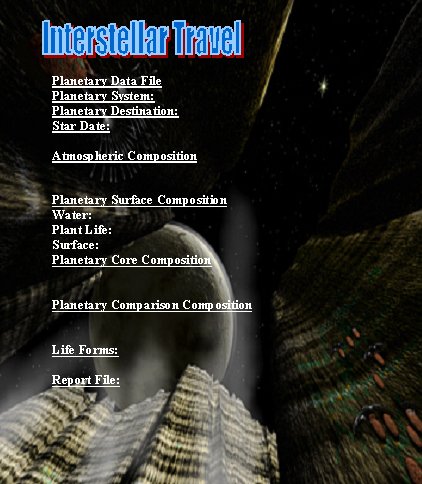
STEP THIRTEEN
Traveller : When you are finished on the surface teleport your visual body to the nearest planetary body that you can see in that Galaxy.
STEP FOURTEEN
Traveller and Mapper : Follow steps nine through to twelve again till you have mapped out the whole Galaxy.
STEP FIFTEEN
Traveller : When you have finished mapping the Galaxy teleport your visual body back to your physical body back on earth.
REMEMBER
When you are travelling if you come across an alien race that you think may be friendly feel free to make contact with that alien race.
IMPORTANT
When you are contacting alien races always be ready to teleport if there is trouble.
MAPPER
Make a note of any planets or moons with an atmospheric match with earths. That way you both know which planets can support human life forms.
MAPPER & TRAVELLER
To check that your mapping of that Galaxy is correct by changing roles and do this exercise again. Also remember to check for life force energy around the planets or moons that you visit on your journeys. Because if you can feel life force energy that means the planet or moons is a real planet or moon.