← The Wingmakers Ways · Astronomy & Exoplanets
Archived page · Checkable
Centaurus Constellation
Centaurus.html · captured from wingmakers.co.nz
Centarus Constellation 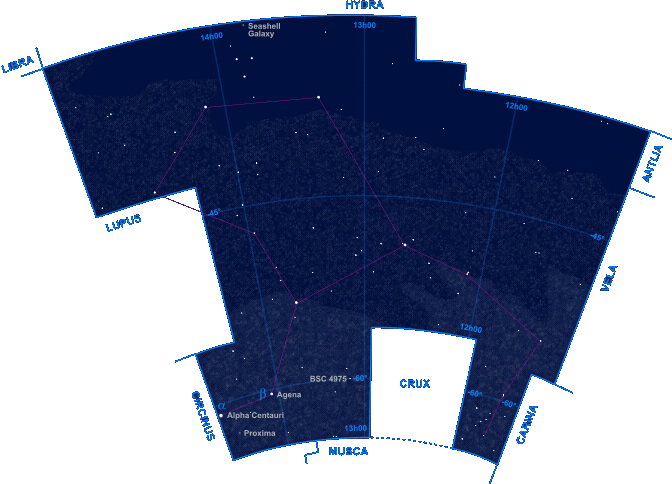
The Centaur A rich and extensive constellation of the southern sky. Centaurus contains much that is of interest, but is perhaps most famous for the stars Proxima and Alpha Centauri, the nearest stars to Earth's Solar System.
Centaurus NGC 4650A Planetary System.
Explanation: This strangely distorted galaxy of stars is cataloged as NGC 4650A. It lies about 165 million light-years away in the southern constellation Centaurus. The complex system seems to have at least two parts, a flattened disk of stars with a dense, bright, central core and a sparse, sharply tilted ring of gas, dust and stars. Observations show that the stars in the disk and the stars and gas in the ring really do move in two different, nearly perpendicular planes, probably as the result of a past galaxy vs. galaxy collision. The observed motions within both disk and ring also indicate the presence of "dark matter" - an unseen source of gravity which influences the movement of this system's visible stars. Over the decades evidence that our Universe is largely composed of such dark matter has grown while the nature of dark matter has remained a profound astrophysical mystery. The picture was constructed from images made using part of the European Southern Observatory's (ESO) new Very Large Telescope system now undergoing its testing phase.
Centaurus A is a giant galaxy with three times the stellar population of our Milky Way (itself a very large galaxy). While possessing the size and shape of a giant elliptical galaxy, it also has dust lanes and blue stars more typical of a spiral galaxy. In addition to being very bright optically, it is also an extremely powerful emitter of radio and X rays. It has been proposed that we are seeing the merger of two galaxies: one elliptical, and one spiral. Very recent research I have read seems to support this.
Around the time when major spring constellations like Virgo and Bootes have the meridian transit, the galaxy of NGC5128 appears in the southern constellation of Centaurus. The constellation makes an appearance only its upper part at Japan, which is why the galaxy can be seen in very low southern sky and it's difficult to observe. The elliptical galaxy has an another code of radio objects "Centaurus A"; it's familiar in pictures taken by big telescopes of official observatories. The galaxy has a very clear characteristic of a thick dark lane crossing over the center of galaxy. The dark lane can be taken in pictures only with small telephoto lenses.
NGC5128 is emitting the powerful radio wave from the bodies divided by dark lane, an amount of radio energy equals to about 50 million times of that of our Galaxy. Astronomers have advanced some theories of the cause of this extremely strong radio wave, for example, existence of a huge black hole at the center of the galaxy, or an influence of the collision of two galaxies.
The Omega Cluster, NGC5139, is the largest globular cluster in heavens. The apparent size is over half of degree. But the cluster culminates at only 7 degrees around Tokyo; it needs extremely clear sky to enjoy the splendid cluster at the Northern Hemisphere. The cluster has the magnitude of 3.7; you can detect it with naked eyes under dark night. The omega cluster forms the constellation of Centaurus as a star of omega Centauri, registered as a normal star before discovered that it was a globular cluster.
You can resolve individual stars in the outer region only with binoculars, and the view through small scopes should be extremely splendid.