← The Wingmakers Ways · Astronomy & Exoplanets
Archived page · Checkable
Cepheus Constellation
Cepheus.html · captured from wingmakers.co.nz
Cepheus 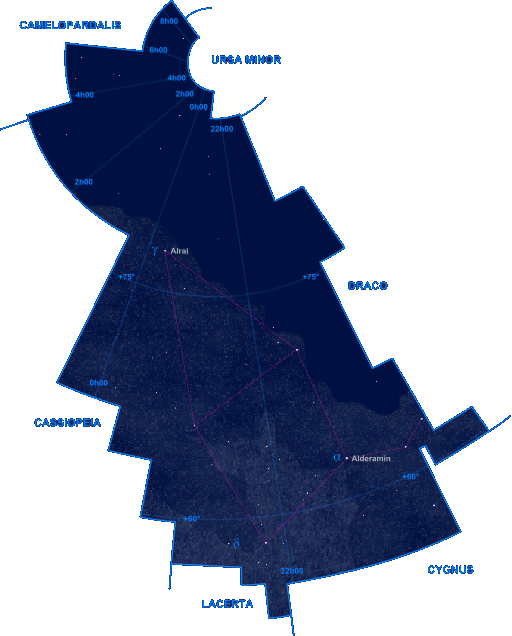
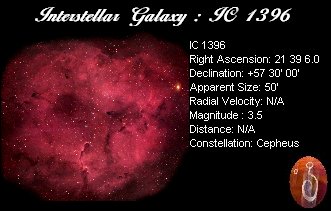
IC1396 is a vast round nebula at the north side of the Milky Way in autumn, has a diameter of about 3 degrees. There is a red star with fourth magnitude at the north edge of the nebula, you'll see the star being a curious red with scopes. The star, mu Cephei is a semiregular supergiant that also varies roughly from 4.5 to 3.5 with a very long period of 730 days, and prompting William Herschel to call it the Garnet Star.
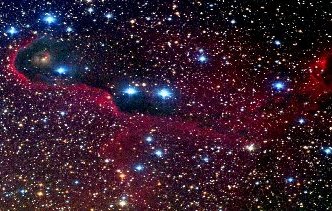
IC1396 is a very large nebulosity in Cepheus. This selected area shows a dark nebula portion and the cometary nebula VdB142.
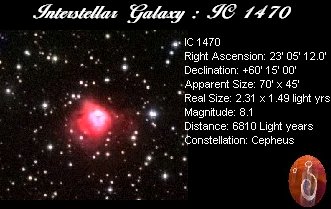
This is a nebula positioned between Cepheus and Cassiopeia; actually this object has been classified in a planetary or diffused nebula according to reference. The nebula is not very well known; perhaps it's one of reasons why the kind of object of IC1470 is confused.
This image shows you a bright nucleus and reddish surrounding region in circle, it's looks like a tiny diffused nebula with a diameter of 1 arc minute. The nebula has a visual brightness of 8th magnitude, you can see it easily through a small telescope.
A tiny planetary nebula in the pentagon of Cepheus is NGC7139. You can find it about 3 degrees 15 arc minutes ENE of alpha Cep. The nebula has an apparent diameter of 1.3 arc minute and shape of reddish and flat disk. You can see only very dimmed light through medium sized telescopes.
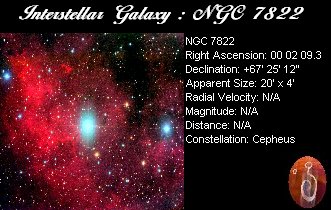
This unique-shaped diffused nebula of H-alpha line spectrum is positioned at the midway between beta Cas (west star in W-shaped Cassiopeia) and gamma Cep (a northern vertex star of Cepheus' pentagon). The nebula is spread out in the field of 2 degrees. It's one of many reddish nebulae distributed around the Milky Way of Cassiopeia and Cepheus. This NGC7822 stays a bit far from the Milky Way, and the nebula is positioned at the most northern position in all nebulae in the all celestial sphere. This nebula is very photogenic, and can be taken easily only with the wide-angled photo lenses.
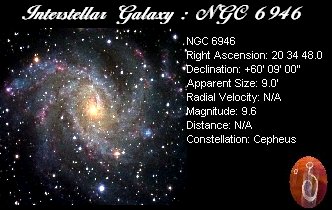
The galaxy NGC6946 is a very fine face-on, has a diameter of over 10 arc minutes but fairly dark. We cannot detect spirals with naked eyes through telescopes. This image barely shows you indistinct spiral structure, and it looks like M33 in photographs taken by big telescopes.
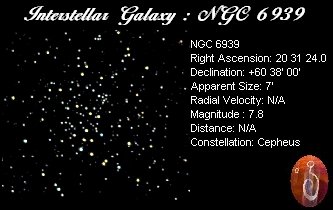
The open cluster NGC6939 has a diameter of 8 arc minutes, nearly same with NGC6946. The cluster is fairly dim, looks like a nebula with binoculars, and you can appreciate fine member stars gathering in half circle with telescopes.
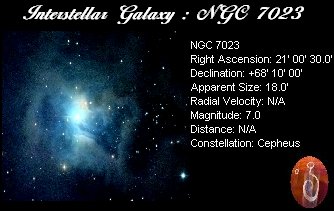
NGC7023 is a minor reflection nebula in Cepheus. The nebula is lying 6 degrees NNW of alpha Cep. This image shows you that there are fewer stars on the outskirts of nebula comparing with outer region. Actually there is a huge dark nebula surrounding the reflection nebula. NGC7023 is emitting white light by reflecting the light of 7th magnitude star passing though in front of the dark nebula by chance.
The celestial sphere includes various flows of dark nebulae in everywhere. Although we cannot detect almost all of those, can be seen like a silhouette if dark clouds are lying in front of the Milky Way, and also can be detected by reflecting the neighboring star's light like the case of NGC7023.
This image shows you a very dimmed diffused H-alpha nebula of Sh2-129 in the constellation of Cepheus. The nebula is positioned about 4 degrees west of IC1396, a vast round nebula in Cepheus. Sh2-129 has a shape of hemisphere surrounding eastern part of two stars in center of picture. Actually very faint nebulosities are spread out the whole of center of image. The Cepheus is bathed in autumnal Milky Way, contains many minor reddish nebulae like this inner-Galactic cloud.
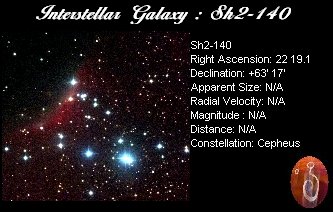
This very faint nebula has some common points with the Cave nebula: it combines an emission portion at the border of a dark portion.
An odd couple lives some 100 million light years away. Here we find a spiral galaxy, NGC 2276 on the left, and its neighbor NGC 2300 on the right. There are quite a few intriguing questions concerning this pair. First of all NGC 2276 displays a perturbed spiral structure yet astronomers seem to agree that NGC 2300 is not the source of the angst. Instead, astronomers have learned that there is an abundance of gas (not shown in this picture) surrounding these galaxies. It could be that NGC 2276's motion through the gas affects its morphology.
The second question that astronomers have deals with how two galaxies of seemingly different types are found together. Many theories of galactic formation state that it is the environment in which a galaxy forms that most strongly determines its structure. So how did these two come about?
Finally, recent studies have revealed that the common envelope of gas that surrounds these two galaxies is very massive and hot (emitting X-ray radiation). Yet there isn't enough luminous mass from these two galaxies alone to gravitationally hold on to the gas. This is one of many observations that lends credence to "dark matter" and its ubiquitous nature in our Universe
At a distance of 7000 light years this nebula contains the largest protostar yet to be discovered. This protostar is 300 times the size of our own solar system. A protostar is a gas cloud that "shrinks" its way to becoming a star.
MAPPING TECHNIQUE
VISUAL EXERCISE : Two Person Exercise.
DESTINATION : Your Choice
STEP ONE
Traveller : Get comfortable and relax.
STEP TWO
Traveller : Charge your physical body with light energy.
STEP THREE
Traveller : See your visual body standing in front of your physical body and prepare your visual body for interstellar travel with a Interstellar Protection Shield.
STEP FOUR
Traveller : See your visual body filling with light energy.
STEP FIVE
Traveller : Focus your mind on teleporting your visual body to the Your Destination.
STEP SIX
Traveller : Then see your visual body teleporting to the Your Destination.
STEP SEVEN
Traveller : When you arrive in the destination Look around can you see any planets or moons in the System? If not use the Interstellar Planetary Detection Rapid and see if you can detect any planets or moons in that system.
STEP EIGHT
Traveller : If you can see or detect a planet or moon using Telekinesis or Teleportation move towards the planetary body.
STEP NINE
Traveller : When you arrive at the outer atmosphere of the planet or moon stop and ask your spiritual guide to tell you the name of this planet or moon.
Traveller : Tell the mapper the name of the planet or moon. Also tell the mapper all you can about the planet or moon.
STEP TEN
Then us the Core Comparison Crystal Technique to perform a core reading on this planet or moon and give the mapper your reading on this planet or moon
STEP ELEVEN
Traveller : Then levitate or Teleport your visual body to the surface of the planet or moon.
STEP TWELVE
Mapper : When the traveller arrives on the surface ask the following questions.
Is there any plant life or water on the surface of the planet or moon that you can see? Is there an atmosphere around this planet or moon? Is the atmosphere an match with earths atmosphere?
Mapper : Write down the answers to these questions.
PLANETARY DATA FILE 
STEP THIRTEEN
Traveller : When you are finished on the surface teleport your visual body to the nearest planetary body that you can see in that Galaxy.
STEP FOURTEEN
Traveller and Mapper : Follow steps nine through to twelve again till you have mapped out the whole Galaxy.
STEP FIFTEEN
Traveller : When you have finished mapping the Galaxy teleport your visual body back to your physical body back on earth.
REMEMBER
When you are travelling if you come across an alien race that you think may be friendly feel free to make contact with that alien race.
IMPORTANT
When you are contacting alien races always be ready to teleport if there is trouble.
MAPPER
Make a note of any planets or moons with an atmospheric match with earths. That way you both know which planets can support human life forms.
MAPPER & TRAVELLER
To check that your mapping of that Galaxy is correct by changing roles and do this exercise again. Also remember to check for life force energy around the planets or moons that you visit on your journeys. Because if you can feel life force energy that means the planet or moons is a real planet or moon.