← The Wingmakers Ways · Astronomy & Exoplanets
Archived page · Checkable
Cetus Constellation
Cetus.html · captured from wingmakers.co.nz
Cetus 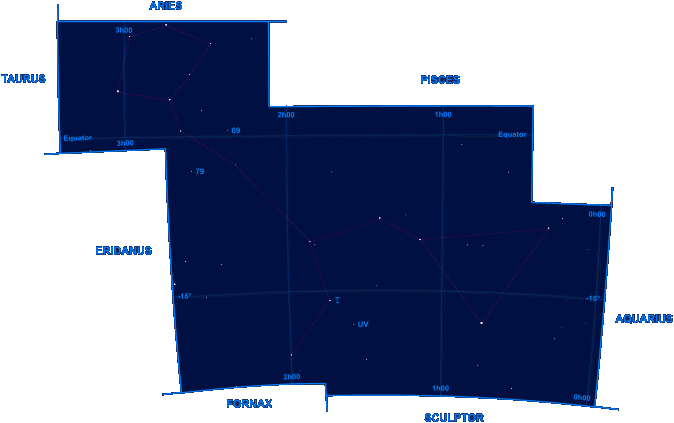
Constellation of Cetus is seen at southern sky in autumn with the third largest size in heavens. It doesn't have so many bright stars; it's fairly hard to recognize that as a monster. The constellation is the monster "Tiamat" that tried to threaten Andromeda before Perseus killed it and rescued the princess. Though the "Cetus" means Whale in any case, the constellation has no relation with a kind of mammal in the ocean.
This constellation is famous for the prototype of long range variables and the earliest variables ever discovered. The variable star of "Mira", omicron Ceti, is positioned at the neck of the monster. The star has a magnitude range from about 10 to as bright as 2.0 with the average period of about 330 days. It's considered that Mira is a red supergiant, and has a diameter of over 400 times of that of the sun.
M77 (NGC1068) is a small spiral galaxy at 50 arc minutes ESE of delta Ceti.
The constellation of Cetus includes a number of galaxies, but most of which are very faint and generally unnoticeable. The galaxy has a size of 7-by-6 arc minutes and 9th magnitude, and is one of the brightest in the constellation, distance is estimated about 47 million light years. You can recognize the figure of an ellipse with only small scopes, but the galaxy has no evoluted spirals, so detailed structures do not come visible with larger telescopes. M77 is one of the so-called Seyfert galaxies, which have strong radio sources.
NGC246 is a very dimmed planetary nebula at about 6 degrees north of beta Ceti marking a tail of Cetus. You need high magnifying power over 100 to appreciate the nebula with telescopes because it has very small diameter like many other planetary nebulae. And the nebula has very low surface brightness, so you need very conditioned dark sky to enjoy the complicated structure of NGC246. The nebula may give us an impression like very dimmed Helix Nebula (NGC7293), has a central dwarf star with 12th magnitude. And you can detect a fine galaxy of NGC255 just north of NGC246.
NGC247 is a large, but extraordinary dimmed galaxy positioned at 3 degrees south of beta Ceti forming the tail of Cetus. The galaxy has a major axis of about 20 arc minutes and 9.7 in magnitude, you might be needed good conditioned night sky to appreciate the galaxy through a medium-sized telescopes over 6-inch in aperture. NGC247 has a visual figure stretched in north south direction, with a very small and dimmed central nucleus but no spiral structures at all. At 4.5 degrees south of the galaxy, you can find a bright and splendid spiral galaxy of NGC253. This bright galaxy is attracted considerable attention rather than NGC247. But please challenge to find out this minor galaxy in autumnal night with high atmospheric transparency.
These are two compact galaxies positioned at forefoot of Cetus, about 7.5degrees SE from Mira. Spiral one positioned in lower center is NGC1042, and an elliptic one in upper left has an ID of NGC1052. They're floating with an interval of 15 arc minutes.
Both have a size of 3 arc minutes in diameter and very dimmed with a visual brightness of 11th magnitude or so, you need a fairly large telescope to detect them with your own eyes. But it might be interested in that two galaxies with different types are snuggling up.
This image shows you two small galaxies lying about 1 degree ESE from M77, the brightest galaxy in Cetus. The lower one is NGC1087 and upper one has a number of NGC1090. Both galaxies are inconspicuous with sizes about 3 or 4 arc minutes at most, and have visual magnitudes of 11th or 12th, or dimmer magnitude.
You can see NGC1087 with dimmed spiral structure in this image. And this galaxy has been classified in a group of bared-galaxy.
MAPPING TECHNIQUE
VISUAL EXERCISE : Two Person Exercise.
DESTINATION : Your Choice
STEP ONE
Traveller : Get comfortable and relax.
STEP TWO
Traveller : Charge your physical body with light energy.
STEP THREE
Traveller : See your visual body standing in front of your physical body and prepare your visual body for interstellar travel with a Interstellar Protection Shield.
STEP FOUR
Traveller : See your visual body filling with light energy.
STEP FIVE
Traveller : Focus your mind on teleporting your visual body to the Your Destination.
STEP SIX
Traveller : Then see your visual body teleporting to the Your Destination.
STEP SEVEN
Traveller : When you arrive in the destination Look around can you see any planets or moons in the System? If not use the Interstellar Planetary Detection Rapid and see if you can detect any planets or moons in that system.
STEP EIGHT
Traveller : If you can see or detect a planet or moon using Telekinesis or Teleportation move towards the planetary body.
STEP NINE
Traveller : When you arrive at the outer atmosphere of the planet or moon stop and ask your spiritual guide to tell you the name of this planet or moon.
Traveller : Tell the mapper the name of the planet or moon. Also tell the mapper all you can about the planet or moon.
STEP TEN
Then us the Core Comparison Crystal Technique to perform a core reading on this planet or moon and give the mapper your reading on this planet or moon
STEP ELEVEN
Traveller : Then levitate or Teleport your visual body to the surface of the planet or moon.
STEP TWELVE
Mapper : When the traveller arrives on the surface ask the following questions.
Is there any plant life or water on the surface of the planet or moon that you can see? Is there an atmosphere around this planet or moon? Is the atmosphere an match with earths atmosphere?
Mapper : Write down the answers to these questions.
PLANETARY DATA FILE 
STEP THIRTEEN
Traveller : When you are finished on the surface teleport your visual body to the nearest planetary body that you can see in that Galaxy.
STEP FOURTEEN
Traveller and Mapper : Follow steps nine through to twelve again till you have mapped out the whole Galaxy.
STEP FIFTEEN
Traveller : When you have finished mapping the Galaxy teleport your visual body back to your physical body back on earth.
REMEMBER
When you are travelling if you come across an alien race that you think may be friendly feel free to make contact with that alien race.
IMPORTANT
When you are contacting alien races always be ready to teleport if there is trouble.
MAPPER
Make a note of any planets or moons with an atmospheric match with earths. That way you both know which planets can support human life forms.
MAPPER & TRAVELLER
To check that your mapping of that Galaxy is correct by changing roles and do this exercise again. Also remember to check for life force energy around the planets or moons that you visit on your journeys. Because if you can feel life force energy that means the planet or moons is a real planet or moon.