← The Wingmakers Ways · Astronomy & Exoplanets
Archived page · Checkable
Circinus
Circinus.html · captured from wingmakers.co.nz
Circinus 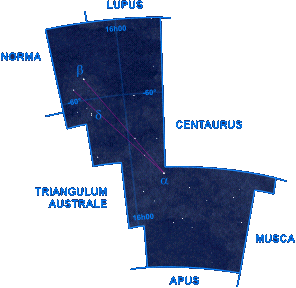
The Pair of Compasses
Though it lies on the main belt of the Milky Way, this is an unremarkable region of the southern sky, most notable for the fact that it lies close to the famous and bright Alpha Centauri.
Myth
Nicolas Louis de Lacaille was born in 1713 in Rumigny, France. By 1739 he taught mathematics at Mazarin College in Paris. In 1750, he traveled to the Cape of Good Hope in southern Africa, and by 1754 had named 14 constellations (including this one), made important measurements of the moon, Venus, and Mars, and cataloged almost 10,000 stars. On his return to Paris he attempted to compile his data by himself, a process that hastened his death in 1762. His Coelum Australe Stelliferum (Southern Sky Star Catalog) appeared the following year.
Powerful forces are at play in the nearby Circinus Galaxy. Hot gas, colored pink, is being ejected out of the spiral galaxy from the central region. Much of Circinus' tumultuous gas, however, is concentrated in two rings. The outer ring, located about 700 light-years from the center, appears mostly red and is home to tremendous bursts of star formation. A previously unseen inner ring, inside the green disk above, is visible only 130 light years from the center on this recently released, representative color image taken by the Hubble Space Telescope. At the very center is an active galactic nucleus, where matter glows brightly before likely spiraling into a massive black hole. Although only 15 million light years distant, the Circinus Galaxy went unnoticed until 25 years ago because it is so obscured by material in the plane of our own Galaxy. The galaxy can be seen with a small telescope, however, in the constellation of Circinus.
NGC 5823 is an open cluster in the Circinus Constellation
NGC 5288 is an open cluster in the Circinus Constellation
NGC 5315 is an Planetary Nebula in the Circinus Constellation
NGC 5715 is an open cluster in the Circinus Constellation
MAPPING TECHNIQUE
VISUAL EXERCISE : Two Person Exercise.
DESTINATION : Your Choice
STEP ONE
Traveller : Get comfortable and relax.
STEP TWO
Traveller : Charge your physical body with light energy.
STEP THREE
Traveller : See your visual body standing in front of your physical body and prepare your visual body for interstellar travel with a Interstellar Protection Shield.
STEP FOUR
Traveller : See your visual body filling with light energy.
STEP FIVE
Traveller : Focus your mind on teleporting your visual body to the Your Destination.
STEP SIX
Traveller : Then see your visual body teleporting to the Your Destination.
STEP SEVEN
Traveller : When you arrive in the destination Look around can you see any planets or moons in the System? If not use the Interstellar Planetary Detection Rapid and see if you can detect any planets or moons in that system.
STEP EIGHT
Traveller : If you can see or detect a planet or moon using Telekinesis or Teleportation move towards the planetary body.
STEP NINE
Traveller : When you arrive at the outer atmosphere of the planet or moon stop and ask your spiritual guide to tell you the name of this planet or moon.
Traveller : Tell the mapper the name of the planet or moon. Also tell the mapper all you can about the planet or moon.
STEP TEN
Then us the Core Comparison Crystal Technique to perform a core reading on this planet or moon and give the mapper your reading on this planet or moon
STEP ELEVEN
Traveller : Then levitate or Teleport your visual body to the surface of the planet or moon.
STEP TWELVE
Mapper : When the traveller arrives on the surface ask the following questions.
Is there any plant life or water on the surface of the planet or moon that you can see? Is there an atmosphere around this planet or moon? Is the atmosphere an match with earths atmosphere?
Mapper : Write down the answers to these questions.
PLANETARY DATA FILE 
STEP THIRTEEN
Traveller : When you are finished on the surface teleport your visual body to the nearest planetary body that you can see in that Galaxy.
STEP FOURTEEN
Traveller and Mapper : Follow steps nine through to twelve again till you have mapped out the whole Galaxy.
STEP FIFTEEN
Traveller : When you have finished mapping the Galaxy teleport your visual body back to your physical body back on earth.
REMEMBER
When you are travelling if you come across an alien race that you think may be friendly feel free to make contact with that alien race.
IMPORTANT
When you are contacting alien races always be ready to teleport if there is trouble.
MAPPER
Make a note of any planets or moons with an atmospheric match with earths. That way you both know which planets can support human life forms.
MAPPER & TRAVELLER
To check that your mapping of that Galaxy is correct by changing roles and do this exercise again. Also remember to check for life force energy around the planets or moons that you visit on your journeys. Because if you can feel life force energy that means the planet or moons is a real planet or moon.