← The Wingmakers Ways · not in the site's own index
Archived page · Asserted
Corona Borealis
Corona_Borealis~2004.html · captured from wingmakers.co.nz
Corona Borealis 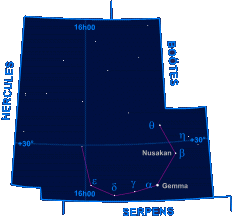
The Northern Crown
Corona Borealis, has another name of the Northern Crown, is made up by seven stars that lines up like a semicircle. The constellation is found nearly midway between Arcturus and Vega. Member stars are not so bright except for Gemma, or Alphecca (alpha Coronae Borealis), but it's pretty obvious because there aren't so many bright ones around. It's the crown that was given Ariadne by Dionysus.
Derivation
This group of stars is small and not particularly bright (the brightest, Gemma, is only magnitude +2.2). Nonetheless, the seven main stars are grouped in a distinctive and recognizable U-shaped formation that calls to mind the shape of a crown or diadem.
This group has been called 'The Crown' since classical times, and there are several conflicting myths to explain its presence in the sky. The most popular legend makes it the headband of Ariadne, the daughter of Minos. When Dionysus came upon her on the island of Naxos, it is said, he threw her jewelled band into the sky to prove his godhood, and then claimed her as his wife.
Stars
Counting clockwise, the seven stars that make up the crown are Theta Coronae Borealis, Nusakan, Gemma, and then Gamma, Delta, Epsilon and Iota Coronae Borealis. Gemma is the brightest, while faint Iota Coronae Borealis has a magnitude of just +5.0.
Following the loop of the crown, the next star is fainter still (magnitude +5.4), but important. This is Rho Coronae Borealis, a binary star but otherwise very similar to our own Sun, and one of the few stars known to have a planet in orbit.
Galaxies
Only double stars and some faint galaxies are here to tempt the deep sky observer. Some of the doubles are fine objects. For those who like pursuing small faint fuzzies,
NGC 5958 is a small galaxy at RA 15h 34.7m, +28 deg 40m. Listed at visual magnitude (mv) 12.6 and about 1' across, this spiral galaxy might be found by offsetting the telescope from Beta CrB.
NGC 6109 (16 17.7, +35 00) is perhaps the brightest of a collection of faint galaxies, between and north of Sigma and Nu CrB. 6109 is mv 12.7, spiral, about 1' across; Uranometria shows eight NGC galaxies here within a 1-degree field, with two others nearby. Most of them are very faint.
MAPPING TECHNIQUE
VISUAL EXERCISE : Two Person Exercise.
DESTINATION : Your Choice
STEP ONE
Traveller : Get comfortable and relax.
STEP TWO
Traveller : Charge your physical body with light energy.
STEP THREE
Traveller : See your visual body standing in front of your physical body and prepare your visual body for interstellar travel with a Interstellar Protection Shield.
STEP FOUR
Traveller : See your visual body filling with light energy.
STEP FIVE
Traveller : Focus your mind on teleporting your visual body to the Your Destination.
STEP SIX
Traveller : Then see your visual body teleporting to the Your Destination.
STEP SEVEN
Traveller : When you arrive in the destination Look around can you see any planets or moons in the System? If not use the Interstellar Planetary Detection Rapid and see if you can detect any planets or moons in that system.
STEP EIGHT
Traveller : If you can see or detect a planet or moon using Telekinesis or Teleportation move towards the planetary body.
STEP NINE
Traveller : When you arrive at the outer atmosphere of the planet or moon stop and ask your spiritual guide to tell you the name of this planet or moon.
Traveller : Tell the mapper the name of the planet or moon. Also tell the mapper all you can about the planet or moon.
STEP TEN
Then us the Core Comparison Crystal Technique to perform a core reading on this planet or moon and give the mapper your reading on this planet or moon
STEP ELEVEN
Traveller : Then levitate or Teleport your visual body to the surface of the planet or moon.
STEP TWELVE
Mapper : When the traveller arrives on the surface ask the following questions.
Is there any plant life or water on the surface of the planet or moon that you can see? Is there an atmosphere around this planet or moon? Is the atmosphere an match with earths atmosphere?
Mapper : Write down the answers to these questions.
PLANETARY DATA FILE 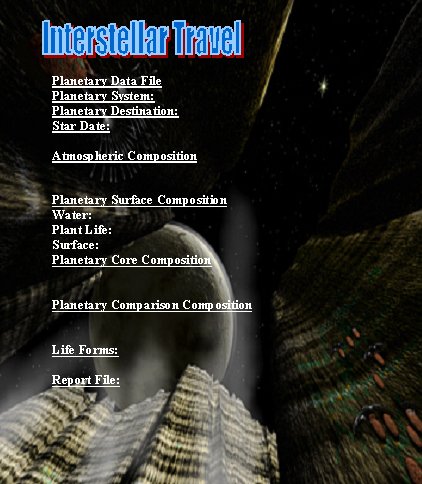
STEP THIRTEEN
Traveller : When you are finished on the surface teleport your visual body to the nearest planetary body that you can see in that Galaxy.
STEP FOURTEEN
Traveller and Mapper : Follow steps nine through to twelve again till you have mapped out the whole Galaxy.
STEP FIFTEEN
Traveller : When you have finished mapping the Galaxy teleport your visual body back to your physical body back on earth.
REMEMBER
When you are travelling if you come across an alien race that you think may be friendly feel free to make contact with that alien race.
IMPORTANT
When you are contacting alien races always be ready to teleport if there is trouble.
MAPPER
Make a note of any planets or moons with an atmospheric match with earths. That way you both know which planets can support human life forms.
MAPPER & TRAVELLER
To check that your mapping of that Galaxy is correct by changing roles and do this exercise again. Also remember to check for life force energy around the planets or moons that you visit on your journeys. Because if you can feel life force energy that means the planet or moons is a real planet or moon.