← The Wingmakers Ways · Astronomy & Exoplanets
Archived page · Checkable
Crater
Crater.html · captured from wingmakers.co.nz
Crater 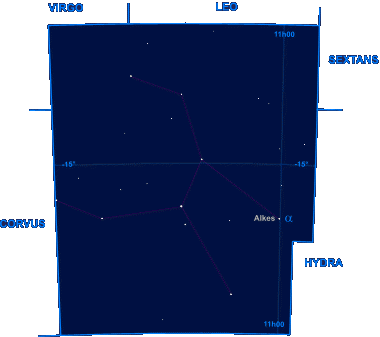
The Goblet
The constellation of Crater, the goblet, is lying just above the Hydra like the Corvus in previous page. The constellation has stars fainter than 4th magnitude; it may be fairy difficult to appreciate it under light-polluted night sky. But the Crater has been established in ancient time, so the constellation has clear shape. You can easily trace a magnificent goblet with a grip and a pedestal from several stars. This Crater is the goblet of Appolo according to the Greek myth.
Derivation
Crater is a very ancient constellation: this region of the sky was known as 'The Cup' at least as long ago as the second century, and the name is almost certainly older.
According to myth, the god Apollo sent a crow (represented by Corvus, the neighbouring constellation) to fetch the Water of Life in a Cup. Tempted by figs, the crow forgot its errand and dropped the cup, returning with a water-snake (Hydra) in its claws. The infuriated deity banished all three, crow, cup and water-snake, to the sky.
Stars
The stars of Crater are unremarkable except in one respect; their unusual uniformity. Most lie between 100 and 200 light years from the Sun, are between fourth and fifth magnitude, and belong to the K-type orange spectral classification. There is, almost certainly, no astronomical reason why this should be - the stars are separated from one another by dozens of parsecs, and their similarity to one another appears to be a remarkable coincidence.
The Alpha star is known as Alkes, but at a faint magnitude of just over four, this is not easily distinguished as the brightest of the group. In fact, though, it is an orange giant, and would be considerably more noticeable if it were closer than its actual distance of 174 light years.
NGC 3511: ! Of average brightness, 4'x1' p.a. 75 deg., mottled with the brightest portion to the N of center measuring 1'x0.5'. Great pairing with NGC 3513, 12' p.a. 150 deg. - it is round, 2' across, with spiral hints in the form of a tiny bar oriented E-W. There is a 13th mag. star on the E end of N3511 and a 14th mag. star on its W end
MAPPING TECHNIQUE
VISUAL EXERCISE : Two Person Exercise.
DESTINATION : Your Choice
STEP ONE
Traveller : Get comfortable and relax.
STEP TWO
Traveller : Charge your physical body with light energy.
STEP THREE
Traveller : See your visual body standing in front of your physical body and prepare your visual body for interstellar travel with a Interstellar Protection Shield.
STEP FOUR
Traveller : See your visual body filling with light energy.
STEP FIVE
Traveller : Focus your mind on teleporting your visual body to the Your Destination.
STEP SIX
Traveller : Then see your visual body teleporting to the Your Destination.
STEP SEVEN
Traveller : When you arrive in the destination Look around can you see any planets or moons in the System? If not use the Interstellar Planetary Detection Rapid and see if you can detect any planets or moons in that system.
STEP EIGHT
Traveller : If you can see or detect a planet or moon using Telekinesis or Teleportation move towards the planetary body.
STEP NINE
Traveller : When you arrive at the outer atmosphere of the planet or moon stop and ask your spiritual guide to tell you the name of this planet or moon.
Traveller : Tell the mapper the name of the planet or moon. Also tell the mapper all you can about the planet or moon.
STEP TEN
Then us the Core Comparison Crystal Technique to perform a core reading on this planet or moon and give the mapper your reading on this planet or moon
STEP ELEVEN
Traveller : Then levitate or Teleport your visual body to the surface of the planet or moon.
STEP TWELVE
Mapper : When the traveller arrives on the surface ask the following questions.
Is there any plant life or water on the surface of the planet or moon that you can see? Is there an atmosphere around this planet or moon? Is the atmosphere an match with earths atmosphere?
Mapper : Write down the answers to these questions.
PLANETARY DATA FILE 
STEP THIRTEEN
Traveller : When you are finished on the surface teleport your visual body to the nearest planetary body that you can see in that Galaxy.
STEP FOURTEEN
Traveller and Mapper : Follow steps nine through to twelve again till you have mapped out the whole Galaxy.
STEP FIFTEEN
Traveller : When you have finished mapping the Galaxy teleport your visual body back to your physical body back on earth.
REMEMBER
When you are travelling if you come across an alien race that you think may be friendly feel free to make contact with that alien race.
IMPORTANT
When you are contacting alien races always be ready to teleport if there is trouble.
MAPPER
Make a note of any planets or moons with an atmospheric match with earths. That way you both know which planets can support human life forms.
MAPPER & TRAVELLER
To check that your mapping of that Galaxy is correct by changing roles and do this exercise again. Also remember to check for life force energy around the planets or moons that you visit on your journeys. Because if you can feel life force energy that means the planet or moons is a real planet or moon.