← The Wingmakers Ways · Astronomy & Exoplanets
Archived page · Checkable
Crux
Crux.html · captured from wingmakers.co.nz
Crux 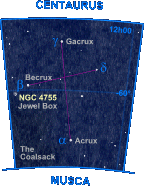
Crux Australis, The Cross, The Southern Cross
Derivation:
All constellations are in some sense artificial, but while many, especially in the northern sky, date back thousands of years and have rich histories, the elegant Southern Cross has a disappointingly prosaic derivation. In the late seventeenth century, Royer (or, according to some sources, Abbé de la Caille) simply carved a rectangular region of sky out of Centaurus and renamed it Crux (Latin for 'Cross').
Crux is often called the Southern Cross (Crux Australis) to distinguish it from the 'Northern Cross', a traditional, but entirely unofficial, name for the bright stars that make up Cygnus in the northern sky.
With an area of less than seventy square degrees, Crux has the distinction of being the smallest constellation in the sky. It occupies only about one twentieth of the area of Hydra, the largest of the constellations.
Stars:
Crux lies within a densely populated area of the Milky Way, and so in a densely starred region. As one might imagine from its name, the body of the Cross is made up of four bright stars, Alpha, Beta, Gamma and Delta Crucis. Though Delta Crucis does not appear to have a proper name, its three brighter companions do: they are known as Acrux, Becrux and Gacrux, respectively. These are, without doubt, the three least inspired star names in the entire sky.
These four main stars lie between 200 and 600 light years (about 60 and 180 parsecs) from Earth. Much further away, at around 7,600 light years (2,300 parsecs) lies an open cluster known as the Jewel Box that is just visible to the naked eye. 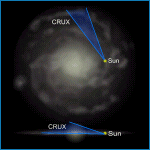
Tiny Crux carves out a thin sliver of space within the plane of the Milky Way.
This cluster was one of the finest open clusters discovered by Abbe Lacaille when he was in South Africa during 1751-1752.
This cluster is one of the youngest known, with an estimated age of only 7.1 million years (Sky Catalog 2000). Its hottest star is of spectral type B0. According to Burnham, the 3 brightest stars are blue giants of mag 5.75 and spectral type B9, mag 5.94 and type B3, and mag 6.80/B2, while the fourth brightest star is a mag 7.58 M2 red supergiant. Another mag 5.7/spectral type A1 star is probably also a member, another white supergiant: This star would be the brioghtest of the cluster at about absolute magnitude -7.7 (83,000 solar luminosities).
Situated close to the cluster is a huge dark area of the sky, right within the band of the Milky Way: the Coal Sack. This is a huge dark nebula, probably the nearest at 500 to 600 light years distance, and 60 to 70 light years diameter.
The Coal Sack is a large dark nebula only 550 light years away, just to the south of the Jewel Box, visible to the naked eye.
Dark nebulae are massive clouds of interstellar gases and dust, dense enough to block out most of the light from stars behind it. The Coal Sack and Horsehead Nebulae (in Orion) are the two best known dark nebulae; of all dark nebulae, the Coal Sack is the largest one visible to the unaided eye.
Planetary Destinations In Crux
MAPPING TECHNIQUE
VISUAL EXERCISE : Two Person Exercise.
DESTINATION : Your Choice
STEP ONE
Traveller : Get comfortable and relax.
STEP TWO
Traveller : Charge your physical body with light energy.
STEP THREE
Traveller : See your visual body standing in front of your physical body and prepare your visual body for interstellar travel with a Interstellar Protection Shield.
STEP FOUR
Traveller : See your visual body filling with light energy.
STEP FIVE
Traveller : Focus your mind on teleporting your visual body to the Your Destination.
STEP SIX
Traveller : Then see your visual body teleporting to the Your Destination.
STEP SEVEN
Traveller : When you arrive in the destination Look around can you see any planets or moons in the System? If not use the Interstellar Planetary Detection Rapid and see if you can detect any planets or moons in that system.
STEP EIGHT
Traveller : If you can see or detect a planet or moon using Telekinesis or Teleportation move towards the planetary body.
STEP NINE
Traveller : When you arrive at the outer atmosphere of the planet or moon stop and ask your spiritual guide to tell you the name of this planet or moon.
Traveller : Tell the mapper the name of the planet or moon. Also tell the mapper all you can about the planet or moon.
STEP TEN
Then us the Core Comparison Crystal Technique to perform a core reading on this planet or moon and give the mapper your reading on this planet or moon
STEP ELEVEN
Traveller : Then levitate or Teleport your visual body to the surface of the planet or moon.
STEP TWELVE
Mapper : When the traveller arrives on the surface ask the following questions.
Is there any plant life or water on the surface of the planet or moon that you can see? Is there an atmosphere around this planet or moon? Is the atmosphere an match with earths atmosphere?
Mapper : Write down the answers to these questions.
PLANETARY DATA FILE 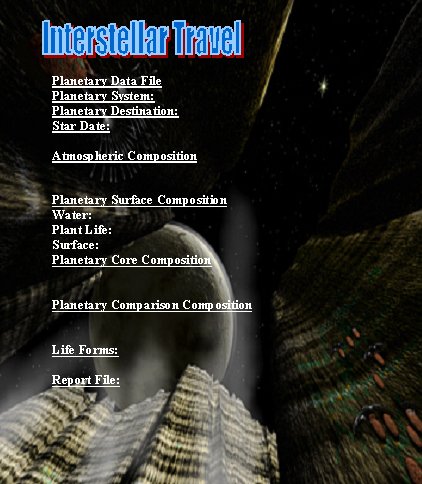
STEP THIRTEEN
Traveller : When you are finished on the surface teleport your visual body to the nearest planetary body that you can see in that Galaxy.
STEP FOURTEEN
Traveller and Mapper : Follow steps nine through to twelve again till you have mapped out the whole Galaxy.
STEP FIFTEEN
Traveller : When you have finished mapping the Galaxy teleport your visual body back to your physical body back on earth.
REMEMBER
When you are travelling if you come across an alien race that you think may be friendly feel free to make contact with that alien race.
IMPORTANT
When you are contacting alien races always be ready to teleport if there is trouble.
MAPPER
Make a note of any planets or moons with an atmospheric match with earths. That way you both know which planets can support human life forms.
MAPPER & TRAVELLER
To check that your mapping of that Galaxy is correct by changing roles and do this exercise again. Also remember to check for life force energy around the planets or moons that you visit on your journeys. Because if you can feel life force energy that means the planet or moons is a real planet or moon.