← The Wingmakers Ways · Astronomy & Exoplanets
Archived page · Checkable
Cygnus
Cygnus.html · captured from wingmakers.co.nz
Cygnus 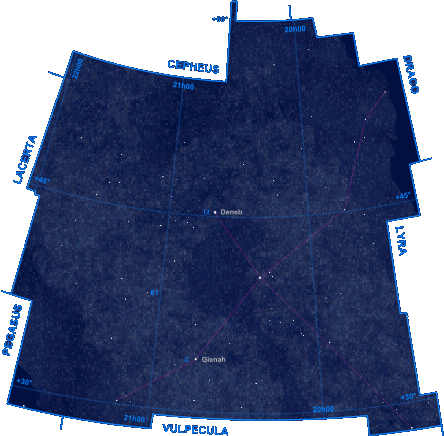
The Swan
The constellation of Cygnus, The Swan, is seen in about zenith at northern hemisphere, and is one of most obvious asterisms in summer skies, which because of its shape is known as the Northern Cross. Alpha Cygni that marks the tail of swan is called Deneb, from "Al Dhanab al Dajajah" meaning of the Hen's tail. The star forms "The Great Summer's Triangle" with Altair (alpha Aquilae) and Vega (alpha Lyrae), and Deneb has the lowest magnitude in the trio, because of the star has the farthest distance of 1500 light years in bright stars with the first magnitude in heavens. Deneb is considered as a white supergiant. And beta Cygni positioned at the head of swan is also known as "Albireo", a magnificent binary system of gold and blue. The component is quite wide, marking it a popular object for binoculars. 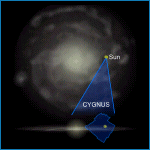
As this diagram shows, the constellation of Cygnus lies exactly on the band of the Milky Way, and so is also exactly on the plane of our galaxy.
NGC7000 is called "The North American Nebula" because of its shape. It's a bright emission nebula at about 3 degrees east of Deneb, alpha Cygni. The nebula is very photographed and attractive on long-exposure. Unfortunately you'll find it is extremely faint with a slightly greenish color. It's best seen in binoculars.
The North American Nebula has very interesting shape by chance, and you can find one more unique shaped nebula of IC5067-70 just west of NGC7000. It has a nickname of " The Pelican Nebula".
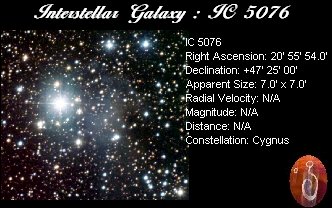
IC5146 is a small round reflection nebula near a border to Cepheus, with a size of 12 arc minutes. A nickname of "The Cocoon Nebula" has came from its round shape and dimmed impression. A dark filament of B168 is stretched westward from the cocoon nebula itself, and it seemingly looks like that the nebula is drifting in the Milky Way, very humorous view. The nebula is estimated about 5500 light years away.
I've captured the field of the part of swan's tail soaked in the summer's Milky Way around the zenith by using of a medium ranged telephoto lens. You can identify three popular emission nebulae in this picture, the North American Nebula around the center, IC1318 surrounding gamma Cygni at the right-hand side, and the Veil Nebula at the edge of lower side, respectively.
These attractive red clouds in the Milky Way are emitting by neighbored stars.
A central star in this picture is gamma Cygni (Sadr), and the star has been surrounded by the faint red nebula spread out like snatches of clouds. The nebula can hardly be detected in naked eye, but very photographed.
It's the deepest region just east (left-hand side) of Sadr, clearly recognized that is tangled with dark nebulae.
Veil Nebula is a faint and vast loop spread at the south wing of swan, consists of east (NGC6992-5) and west (NGC6960) segments. They are fine filaments seemingly suspended in the space. East Side is brighter, and can be seen with binoculars in perfect conditions. The star 52 Cygni is in the same field as the western part, and a dimmed and vast cloud is spread between these two without being registered in any catalogues.
It's considered that the nebula is a remnant of supernova exploded over ten thousand years ago, and is expanding outward with a velocity of about 100km (62 miles) per second. This elusive nebula has a real size of about 50 light years and a distance of 1300 light years.
NGC6826 is a small planetary nebula about 1.3 degrees east of theta Cygni, a tip star of Swan's western wing. The nebula has a diameter of 30 arc seconds and a visual brightness of 9th magnitude. The nebula looks almost oval figure and dimmed light is surrounding the central star. NGC6826 has a nickname of "The Blinking Plantary" maybe from its figure looks like an eye. You can distinguish the nebula from normal stars only with small telescopes, but it might be needed fairly larger scopes and high magnifying power to detect the central dwarf star. It's estimated the nebula is about 1700 light years away.
You can see a compact semicircular diffused nebula in this picture. The nebula of NGC6888 has a nickname of "The Crescent Nebula", positioned about 6 degrees southwest of gamma Cygni (Sadr).
At around this field, very fine diffused nebula of IC1318 is floating and surrounding gamma Cyg.
Actually, NGC6888 is part of IC1318, but the nebula is sufficiently bright by comparing with the nebulae in circumference, NGC6888 is noticeable in long-exposed films.
M29 is a small open cluster found at about 2 degrees south of Sadr, gamma Cygni. The cluster is fairly modest for registered in the Messier's catalogue; not suitable for binoculars. You can detect four bright stars forming a tiny rectangle and some other members are surrounding with a magnifying power of about 30 or so.
Actually, this field has a fine gaseous region of IC1318, and a fluffy nebula surrounds M29 itself.
M39 is an open cluster about 7 degrees north-east of North American Nebula (NGC7000). You can find the cluster just in the Milky Way between the tail of Cygnus and Cassiopeia, there are plenty of faint stars that form the autumnal Milky Way around this field. M39 is large and scattered, telescope is unsuitable for appreciating that, and you should need a small binocular. About 20 faint stars with about 7th magnitude are forming a rough triangle. The cluster is about 810 light years away.
Explanation:
Subaru Telescope has successfully taken a sharp and deep infrared image of the star-forming region, S106. In addition, many objects with masses less than that of an ordinary star have been discovered in this region.
S106 is at a distance of approximately 2000 light-years from the Earth. There is a large massive star called IRS4 (Infrared Source 4) at the center of S106. The star is approximately one hundred thousand years old, and its mass is approximately 20 times that of the Sun. The hourglass appearance of S106 is thought to be the result of the way material is flowing outwards from the central star. A huge disk of gas and dust surrounding IRS4 produces the constriction at the center.
Ultraviolet rays emitted from IRS4 ionize the surrounding hydrogen gas, creating what astronomers call an HII region. As the excited hydrogen gas relaxes, it emits the blue glow we see in the inner part of the nebula. We call this an emission nebula. The red region towards the edge of the nebula is a reflection nebula, made as surrounding dust particles directly reflect the light emitted from IRS4. Since this infrared image is extremely sharp, we can see subtle details like ripples inside the emission nebula. Furthermore, the differences in color and structure between the emission and reflection nebulae are beautifully displayed. In comparison, a visible-light image of the same region taken with the Hubble Space Telescope barely shows any detail in the upper part of the nebula because visible light is strongly absorbed by the region's dust.
A study of this deep S106 image has revealed hundreds of faint young objects around IRS4 and throughout the surrounding nebula. The mass of these objects is less than 0.08 times that of our Sun, too small to sustain the nuclear burning of hydrogen gas that causes a normal star to shine. They are considered to be young brown dwarfs.
The lightest and faintest objects discovered have an estimated mass of only a few times that of Jupiter. A joint group of astronomers from the National Astronomical Observatory of Japan and the University of Tokyo have observed similar light objects elsewhere in the sky, in the nearby star-forming regions towards the constellation of Taurus and Chameleon. Other researchers have seen such objects in the constellation of Orion. While such objects would be called "planets" if they orbited a star, this is not appropriate for these independent objects. For this reason, we would refer to them as "floating small objects."
From the observation with Subaru Telescope, it's clear that many light objects are born out in space along with the ordinary stars we see, and that the relative number of such objects differs from place to place. But the birth mechanism for these objects is still unclear.
IC1396 is a very large nebulosity in Cygnus. This selected area shows a dark nebula portion and the cometary nebula
VdB142.
MAPPING TECHNIQUE
VISUAL EXERCISE : Two Person Exercise.
DESTINATION : Your Choice
STEP ONE
Traveller : Get comfortable and relax.
STEP TWO
Traveller : Charge your physical body with light energy.
STEP THREE
Traveller : See your visual body standing in front of your physical body and prepare your visual body for interstellar travel with a Interstellar Protection Shield.
STEP FOUR
Traveller : See your visual body filling with light energy.
STEP FIVE
Traveller : Focus your mind on teleporting your visual body to the Your Destination.
STEP SIX
Traveller : Then see your visual body teleporting to the Your Destination.
STEP SEVEN
Traveller : When you arrive in the destination Look around can you see any planets or moons in the System? If not use the Interstellar Planetary Detection Rapid and see if you can detect any planets or moons in that system.
STEP EIGHT
Traveller : If you can see or detect a planet or moon using Telekinesis or Teleportation move towards the planetary body.
STEP NINE
Traveller : When you arrive at the outer atmosphere of the planet or moon stop and ask your spiritual guide to tell you the name of this planet or moon.
Traveller : Tell the mapper the name of the planet or moon. Also tell the mapper all you can about the planet or moon.
STEP TEN
Then us the Core Comparison Crystal Technique to perform a core reading on this planet or moon and give the mapper your reading on this planet or moon
STEP ELEVEN
Traveller : Then levitate or Teleport your visual body to the surface of the planet or moon.
STEP TWELVE
Mapper : When the traveller arrives on the surface ask the following questions.
Is there any plant life or water on the surface of the planet or moon that you can see? Is there an atmosphere around this planet or moon? Is the atmosphere an match with earths atmosphere?
Mapper : Write down the answers to these questions.
PLANETARY DATA FILE 
STEP THIRTEEN
Traveller : When you are finished on the surface teleport your visual body to the nearest planetary body that you can see in that Galaxy.
STEP FOURTEEN
Traveller and Mapper : Follow steps nine through to twelve again till you have mapped out the whole Galaxy.
STEP FIFTEEN
Traveller : When you have finished mapping the Galaxy teleport your visual body back to your physical body back on earth.
REMEMBER
When you are travelling if you come across an alien race that you think may be friendly feel free to make contact with that alien race.
IMPORTANT
When you are contacting alien races always be ready to teleport if there is trouble.
MAPPER
Make a note of any planets or moons with an atmospheric match with earths. That way you both know which planets can support human life forms.
MAPPER & TRAVELLER
To check that your mapping of that Galaxy is correct by changing roles and do this exercise again. Also remember to check for life force energy around the planets or moons that you visit on your journeys. Because if you can feel life force energy that means the planet or moons is a real planet or moon.