← The Wingmakers Ways · Astronomy & Exoplanets
Archived page · Checkable
Dorado
Dorado.html · captured from wingmakers.co.nz
Dorado 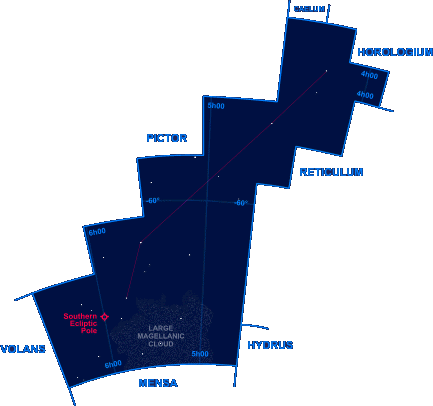
The Goldfish, The Swordfish
The most conspicuous features of Dorado lie outside the bounds of the Milky Way Galaxy: it contains the majority of the Large Magellanic Cloud, a smaller 'companion' galaxy to our own.
The wonderful Tarantula Nebula / NGC 2070 in Dorado. The star cluster in the centre of the
nebula is R136.
Halloween and the Ghost Head Nebula
Halloween's origin is ancient and astronomical. Since the fifth century BC, Halloween has been celebrated as a cross-quarter day, a day halfway between an equinox (equal day / equal night) and a solstice (minimum day / maximum night in the northern hemisphere). With our modern calendar, however, the real cross-quarter day will occur next week. Another cross-quarter day is Groundhog's Day. Halloween's modern celebration retains historic roots in dressing to scare away the spirits of the dead. A perhaps-fitting modern tribute to this ancient holiday is the above-pictured Ghost Head Nebula taken with the Hubble Space Telescope. Appearing similar to the icon of a fictional ghost, NGC 2080 is actually a star forming region in the Large Magellanic Cloud, a satellite galaxy of our own Milky Way Galaxy. The Ghost Head Nebula spans about 50 light-years and is shown in representative colors
NGC 1748 cannot contain all the new stars it has formed. The young stars, the most massive of which are bright blue, emit so much energy they are pushing out and dispersing the gas and dust that comprise this star forming nebula. Within only the past hundred thousand years, these stars have altered the bubble-like shape of the nebula and will likely destroy the nebula over the next few million years. Of particular interest is a bright region surrounded by a pink ring of dust and gas visible on the left of the above recently released picture by the Hubble Space Telescope. The center of this region is being evacuated by the wind of the brightest star in the nebula. A lane of cooler dust connects NGC 1748 to a larger more diffuse nebula seen on the right. NGC 1748 spans about 25 light-years in diameter and can be found in our galactic neighbor: the Large Magellanic Cloud.
NGC 1818: A Young Globular Cluster
Globular clusters once ruled the Milky Way. Back in the old days, back when our Galaxy first formed, perhaps thousands of globular clusters roamed our Galaxy. Today, there are perhaps 200 left. Many globular clusters were destroyed over the eons by repeated fateful encounters with each other or the Galactic center. Surviving relics are older than any earth fossil, older than any other structures in our Galaxy, and limit the universe itself in raw age. There are few, if any, young globular clusters in our Milky Way Galaxy because conditions are not ripe for more to form. But things are different next door - in the neighboring LMC galaxy. Pictured above is a "young" globular cluster residing there: NGC 1818. Recent observations show it formed only about 40 million years ago - just yesterday compared to the 12 billion year ages of globular clusters in our own Milky Way
Nebulas like 30 Doradus are the "signposts" of recent star birth. High-energy ultraviolet radiation from the young, hot, massive stars in R136 causes the surrounding gaseous material to glow. Previous Hubble telescope observations showed that R136 contains several dozen of the most massive stars known, each about 100 times the mass of the Sun and about 10 times as hot. These stellar behemoths all formed at the same time about 2 million years ago.
The stars in R136 are producing intense "stellar winds" (streams of material traveling at several million miles an hour), which are wreaking havoc on the gas and dust in the surrounding neighborhood. The winds are pushing the gas away from the cluster and compressing the inner regions of the surrounding gas and dust clouds [the pinkish material]. The intense pressure is triggering the collapse of parts of the clouds, producing a new generation of star formation around the central cluster. The new stellar nursery is about 30 to 50 light-years from R136. Most of the stars in the nursery are not visible because they are still encased in their cocoons of gas and dust.
Some of the nascent stars are forming in long columns of gas and dust. Previous Hubble observations revealed that the process of "triggered" star formation often involves massive pillars of material that point toward the central cluster. Such pillars form when particularly dense clouds of gas and dust shield columns of material behind them from the blistering radiation and strong winds released by massive stars, like the stars in R136. This protected material becomes the pillars where stars can form and grow. The Hubble telescope first spied these pillars of stellar creation when it captured close-up views of the Eagle Nebula.
The new image of 30 Doradus shows numerous pillars � each several light-years long � oriented toward the central cluster. These pillars, which resemble tiny fingers, are similar in size to those in the Eagle Nebula. Without Hubble's resolution, they would not be visible. One pillar is visible within the oval-shaped structure to the left of the cluster. Two [one dark and one bright] are next to each other below and to the right of the cluster. One pillar is at upper right, and still another is just above the cluster.
Newborn stars within most of these pillars already have been discovered in pictures taken by Hubble's infrared camera, the Near Infrared Camera and Multi-Object Spectrometer, which can penetrate the dust to detect embryonic stars. Eventually, intense radiation and stellar winds from the developing stars will blow off the tops of the pillars. The Hubble image shows that one such eruption already has occurred in 30 Doradus. A trio of young stars has just been "born" by breaking out of its natal pillar. These new stars are just a few hundred thousand years old.
In another 2 million years, the new generation of stars will be in full bloom. But the massive stars in R136 will have burned themselves out. And the nebula's central region will be a giant shell, devoid of gas and dust. Still later, all of the most massive stars and gas will have disappeared from the entire region. Only older, less massive stars will remain in a region cleared of gas and dust.
The mosaic image of 30 Doradus consists of five overlapping pictures taken between January 1994 and September 2000 by Hubble's Wide Field and Planetary Camera 2. Several color filters were used to enhance important details in the stars and the nebula. Blue corresponds to the hot stars. The greenish color denotes hot gas energized by the central cluster of stars. Pink depicts the glowing edges of the gas and dust clouds facing the cluster, which are being bombarded by winds and radiation. Reddish-brown represents the cooler surfaces of the clouds, which are not receiving direct radiation from the central cluster.
Planetary Destination In Dorado
MAPPING TECHNIQUE
VISUAL EXERCISE : Two Person Exercise.
DESTINATION : Your Choice
STEP ONE
Traveller : Get comfortable and relax.
STEP TWO
Traveller : Charge your physical body with light energy.
STEP THREE
Traveller : See your visual body standing in front of your physical body and prepare your visual body for interstellar travel with a Interstellar Protection Shield.
STEP FOUR
Traveller : See your visual body filling with light energy.
STEP FIVE
Traveller : Focus your mind on teleporting your visual body to the Your Destination.
STEP SIX
Traveller : Then see your visual body teleporting to the Your Destination.
STEP SEVEN
Traveller : When you arrive in the destination Look around can you see any planets or moons in the System? If not use the Interstellar Planetary Detection Rapid and see if you can detect any planets or moons in that system.
STEP EIGHT
Traveller : If you can see or detect a planet or moon using Telekinesis or Teleportation move towards the planetary body.
STEP NINE
Traveller : When you arrive at the outer atmosphere of the planet or moon stop and ask your spiritual guide to tell you the name of this planet or moon.
Traveller : Tell the mapper the name of the planet or moon. Also tell the mapper all you can about the planet or moon.
STEP TEN
Then us the Core Comparison Crystal Technique to perform a core reading on this planet or moon and give the mapper your reading on this planet or moon
STEP ELEVEN
Traveller : Then levitate or Teleport your visual body to the surface of the planet or moon.
STEP TWELVE
Mapper : When the traveller arrives on the surface ask the following questions.
Is there any plant life or water on the surface of the planet or moon that you can see? Is there an atmosphere around this planet or moon? Is the atmosphere an match with earths atmosphere?
Mapper : Write down the answers to these questions.
PLANETARY DATA FILE 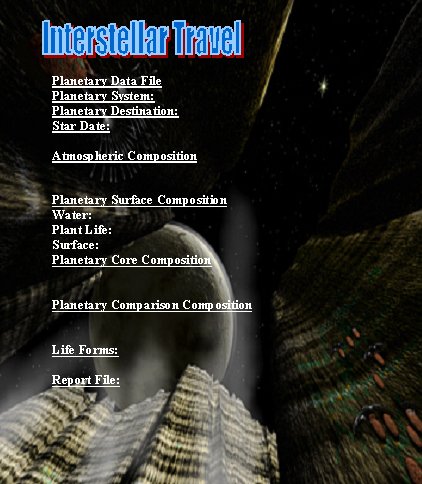
STEP THIRTEEN
Traveller : When you are finished on the surface teleport your visual body to the nearest planetary body that you can see in that Galaxy.
STEP FOURTEEN
Traveller and Mapper : Follow steps nine through to twelve again till you have mapped out the whole Galaxy.
STEP FIFTEEN
Traveller : When you have finished mapping the Galaxy teleport your visual body back to your physical body back on earth.
REMEMBER
When you are travelling if you come across an alien race that you think may be friendly feel free to make contact with that alien race.
IMPORTANT
When you are contacting alien races always be ready to teleport if there is trouble.
MAPPER
Make a note of any planets or moons with an atmospheric match with earths. That way you both know which planets can support human life forms.
MAPPER & TRAVELLER
To check that your mapping of that Galaxy is correct by changing roles and do this exercise again. Also remember to check for life force energy around the planets or moons that you visit on your journeys. Because if you can feel life force energy that means the planet or moons is a real planet or moon.