← The Wingmakers Ways · Astronomy & Exoplanets
Archived page · Checkable
Epsilon Indi
Epsilon_Indi.html · captured from wingmakers.co.nz
Epsilon Indi
System Summary
This star system is located about 11.8 light-years (ly) away from our Sun, Sol, at the northwestern edge (22:03:21.66-56:47:09.51, ICRS 2000.0) of Constellation Indus, the Indian -- southeast of Delta Indi and northwest of Alpha Tucanae. The fifth brightest star in Indus, the star is the title member of the Epsilon Indi stellar moving group. Although smaller and dimmer than Sol, it is clearly visible with the naked eye. Epsilon Indi has such a high proper motion that, within a few thousand years, it will have moved out of Constellation Indus constellation and into neighbouring Constellation Tucana, the Toucan.
A methane brown dwarf companion "b", encircled at left, has been detected at a wide separation of around 1,500 AUs from Epsilon Indi, at right
The Star
Epsilon Indi is a orange-red main sequence dwarf star of spectral and luminosity type K5 Ve. The star has about 77 percent of Sol's mass (RECONS), 76 percent of its diameter (Johnson and Wright, 1983, page 701), and about 14.7 percent of its luminosity. It appears to be about 59 to 110 percent as enriched as Sol with elements heavier than hydrogen ("metallicity"), based on its abundance of iron (Cayrel de Strobel et al, 1991, page 310).
The star was once suspected of being older than Sol, because it does not rotate rapidly and exhibits moderately high U,V,W velocities in its galactic orbital motion (Ken Croswell, 1995, pp. 253-254). New analysis, however, suggests that it may be between 0.8 and two billion years old -- possibly 1.3 billion years based on its rotational speed (press release; Scholz et al, 2003; and Lachaume et al, 1999). Epsilon Indi has a stellar wind similiar to the Sun's "Solar wind" (Wood et al, 1995). Useful star catalogue numbers for Epsilon Indi include: Eps Ind, HR 8387, Gl 845, Hip 108870, HD 209100, CP(D)-57 10015, SAO 247287, FK5 825, LHS 67, LTT 8813, and LFT 1677.
Brown Dwarf "b"
On January 13, 2003, a team of astronomers (including Ralf-Dieter Scholz, Mark McCaughrean, Nicolas Lodieu, and Bjoern Kuhlbrodt) announced the discovery of a brown dwarf companion "b" to this nearby star with a total (bolometric) luminosity of just 0.002 percent that of the Sun (ESO and AIP joint press release and API press release in German -- more below). The extremely dim companion object was observed to share the same high proper motion as Epsilon Indi -- around 4.7 arcseconds per year -- from the perspective of an observer in the Solar System . According to two model estimates based on its presumed age and measurements of its temperature, brightness, and distance, the substellar companion probably has between 40 and 60 times Jupiter's mass, with a most likely estimate around 43 Jupiter-masses. Its diameter is estimated to be around that of Jupiter's (Scholz et al, 2003).
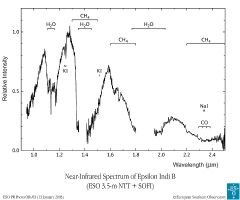
Methane, carbon monoxide, and water
molecules were detected in the relatively
cool atmosphere of the brown dwarf
companion (more).
The brown dwarf has a surface temperature of only around 987 +/- 60 °C (1,810 °F or 1,260 °K). B. (By comparison, its host star (Epsilon Indi) has a surface temperature of around 4,000 °C (7,200 °F), which is somewhat cooler than the Sun.) Epsilon Indi b's is so cool that methane has been detected in its atmosphere and so it has been classified as a early T-type (T 2.5 +/- 0.5 V), methane brown dwarf -- a "T-dwarf"), like the brown dwarf companion to Gliese 229. It is separated from its host star by an estimated 1,459 AUs (around seven arcminutes) -- into the reaches of the Oort Cloud in the Solar System (Scholz et al, 2003).
Hunt for Planetary Companions
Since Epsilon Indi is sort of like a distant cousin to Sol, some speculate whether it might just be bright enough to support Earth-type life on a planet lucky enough to orbit in its water zone. The distance from Epsilon Indi where an Earth-type planet could possibly have liquid water on its surface is centered around only 0.38 AU -- around Mercury's orbital distance in the Solar System. At that distance from the star, such a planet would have an orbital period of around 99 days -- just over a quarter of an Earth year. Astronomers would find it very difficult to detect using present methods.
Previously, a search for faint companions using the Hubble Space Telescope in 1996 found no supporting evidence for a large Jupiter or brown dwarf sized object close to the star, possibly due to guide star acquisition problems (Scholz et al, 2003; and Schroeder et al, 2000). The failure to find large substellar objects like brown dwarfs or a Jupiter- or Saturn-class planet in a "torch" orbit (closer than the Mercury to Sun distance) around Epsilon Indi -- with even the highly effective radial-velocity methods of Geoff Marcy and Paul Butler -- bodes well for the possibility of Earth-type terrestrial planets around this star (Scholz et al, 2003; and Endl et al, 2002). On the other hand, the discovery of a brown dwarf companion in a wide orbit that could perturb dormant comets in an Oort Cloud around Epsilon Indi inwards towards the star's inner planetary regions may periodically shower an Earth-type, inner planet with catastrophic impacts.
Brown Dwarfs or Planets?
When brown dwarfs were just a theoretical concern, astronomers differentiated those hypothetical objects from planets by how they were formed. If a substellar object was formed the way a star does, from a collapsing cloud of interstellar gas and dust, then it would be called a brown dwarf. If it was formed by gradually accumulating gas and dust inside a star's circumstellar disk, however, it was called a planet. Once the first brown dwarf candidates were actually found, however, astronomers realized that it was actually quite difficult to definitely rule on the validity of competing hypotheses about how a substellar object was actually formed without having been there. This problem is particularly difficult to resolve in the case of stellar companions, objects that orbit a star -- or two.
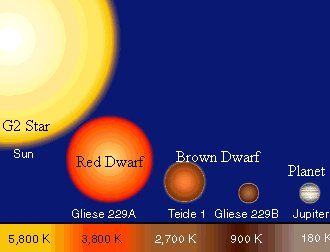
Although brown dwarfs lack sufficient mass (at least 75-80 Jupiters) to
ignite core hydrogen fusion, the smallest true stars (red dwarfs) can
have such cool atmospheric temperatures (below 4,000° K) that it is
difficult to distinguish them from brown dwarfs. While Jupiter-class planets
may be much less massive than brown dwarfs, they are about the same
diameter and may contain many of the same atmospheric molecules.
University of California at Berkeley astronomer Ben R. Oppenheimer, who helped to discover Gliese 229 b, is part of a growing group that would like to define a brown dwarf as an substellar object with the mass of 13 to 80 (or so) Jupiters. While these objects cannot fuse "ordinary" hydrogen (a single proton nucleus) like stars, they have enough mass to briefly fuse deuterium (hydrogen with a proton-neutron nucleus). Therefore, stellar companions with less than 13 Jupiter masses would be defined as planets.
Other prominent astronomers, such as San Francisco State University astronomer Geoffrey W. Marcy who also has helped to discover many extrasolar planets, note that there may in fact be many different physical processes that lead to the formation of planets. Similarly, there may also be many different processes that lead to the creation of brown dwarfs, and some of these may also lead to planets. Hence, more observational data may be needed before astronomers can determine how to make justifiable distinctions in the classification of such substellar objects.
Cool Methane Brown Dwarfs
While brown dwarfs have too little mass to fuse "regular" hydrogen (which has a single proton nucleus), virtually all of the ones discovered until 1999 were too hot -- that is "young" -- to show evidence of methane which is destroyed by stellar temperatures. In fact, while methane is a atmospheric characteristic of giant gas planets like Jupiter, the only brown dwarf found to even have a trace of methane was Gliese 229 b.
In Spring 1999, however, two very dim and reddish brown dwarfs were found as solitary objects (one 30 light-years away in Ophiuchus and another also relatively nearby in Virgo). Analysis of their spectra indicated that both have atmospheres that are rich in methane. In addition, four similar objects that are too cool to be observed in visible light were found using near-infrared telescopes also to have the methane fingerprint of extremely cool (that is "old") brown dwarfs. These discoveries represent strong evidence that, although hard for astronomers to detect, faint brown dwarfs which have had billions of years to cool may represent a significant population of the universe. Some astronomers speculate that these objects may well be as numerous as the stars, reviving theories of stellar formation that suggest the existence of uncountably numerous brown dwarfs, rather than the relatively few easy-to-detect, bright ones found thus far.