← The Wingmakers Ways · Astronomy & Exoplanets
Archived page · Checkable
Gemini
Gemini.html · captured from wingmakers.co.nz
GEMINI
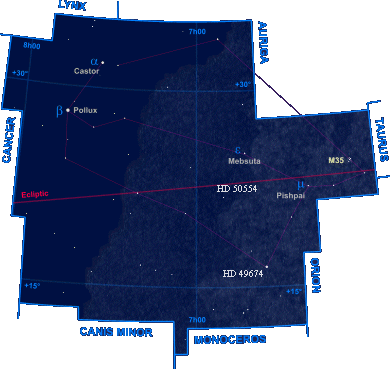
The Twins
Gemini, the Twins, is an only half-brothers. They share the same mother (Leda) and different fathers. Castor's father was Tyndareus, a king of Sparta, and the father of Pollux was Zeus.
Alpha Geminorum Castor marks the head of older, and beta Gem Pollux indicates that of shorter. But Pollux is the brighter of the two stars with a visual magnitude of 1.2, and Castor has a magnitude of 1.6.
Castor is a well-known binary system with visual magnitudes are 2.0 and 2.9, and known that they are spectroscopic binary each other. In fact, the entire system is comprised of six stars, including another spectroscopic binary system of red dwarfs with a magnitude of 9, that revolving around visual binary system.
The constellation is also famous for a major meteoric swarm, alpha Geminids, has the peak of appearance around Dec 13 every year. It shows as many meteors as Gamma Persei.
You can see two orange stars with 3rd magnitudes paralleled in east west direction at the leg of Pollux, the shorter brother of twins. An invisible H-alpha diffused nebula of IC443 is positioned between those stars. The eastern edge of IC443 takes a loop structure, and it's considered that a supernova explosion made the shape, gaseous matter is spreading out.
The whole shape gave a nickname of "Jerry fish Nebula", enjoyed only in long-exposure films. And there is very fine reddish gas at the east of IC443.
This picture shows around Castor's feet, an older brother of Gemini. You can see M35 (NGC2168) with medium-sized diameter. This is an open cluster easily enjoyed in small scopes, extremely attractive, with curving series of glittering stars. Several hundred of stars are contained in the cluster, which is about 2600 light-years away.
Another small cluster can be detected at just SW of M35, it's NGC2158. The cluster is characteristic because many reddish stars are included in that, about 15 thousand light years away.
NGC2371 is a very tiny planetary nebula squeezed between Castor and Pollux in the constellation of Gemini. The nebula has a brightness of 13th magnitude and a diameter of only 0.9-arc minute. You might need a fairly large-sized telescope with a magnifying power over 100 to see it. A long exposed image shows you a bit bright central nucleus and an asymmetric rounded structure that surrounds the nucleus. Same as many other planetary nebulae, this NGC2371 is an appearance of a dead star with its matter gushed out in space.
The planetary nebula began forming about 10,000 years ago, when the dying star began flinging material into space. The nebula is composed of two elliptically shaped lobes of matter streaming above and below the dying star. In this photo, one bubble lies in front of the other, obscuring part of the second lobe.
Scientists believe that a ring of dense material around the star's equator, ejected during its red giant phase, created the nebula's shape. This dense waist of material is plodding along at 72,000 miles per hour (115,000 kilometers per hour), preventing high-velocity stellar winds from pushing matter along the equator. Instead, the 900,000-mile-per-hour (1.5-million-kilometer-per-hour) winds are sweeping the material above and below the star, creating the elongated bubbles. The bubbles are not smooth like balloons but have filaments of denser matter. Each bubble is about 1 light-year long and about half a light-year wide. Scientists are still puzzled about the origin of the comet-shaped features in the "parka." One possible explanation is that these objects formed from a collision of slow- and fast-moving gases.
The Eskimo Nebula is about 5,000 light-years from Earth in the constellation Gemini.
This is a large planetary nebula lying around south of Gemini nearby Canis Minor. You can estimate about 5 arc minutes in diameter from the image, it's one of the largest planetary nebulae in heavens. But strange to say, the object is not very well known so doesn't be registered in NGC catalogue. The code of this nebula "PLN" is a minor catalogue of "Strasbourg Catalogue of Planetary Nebulae" that contains 1445 planetary nebulae.
The nebula has an apparent shape of circle, but fairly bright in southeast part so this image shows like the crescent moon. And the nebula is often called "Medusa Nebula". Medusa is a name of monster exterminated by Perseus, but a reason why the nebula has such a nickname is not clear.
NGC2420 is a compact open cluster lying at 4 degrees east of delta Geminorum that forms the body of younger brother of the twins, Pollux. The cluster has 10-arc minutes diameter and 8th magnitude, contains about 100 fine member stars. The stellar density of NGC2420 is fairly high, it looks like a dimmed nebula with binoculars. And you can enjoy several bright stars scattered in front of the nebulous faint light of other stars through telescopes with an aperture of about 3 to 4 inches or so. It is certain that the cluster compares unfavorably with a major open cluster of M35 in Gemini, but it may give you great interest to compare these clusters in winter skies.
Planetary Destinations In Gemini
MAPPING TECHNIQUE
VISUAL EXERCISE : Two Person Exercise.
DESTINATION : Your Choice
STEP ONE
Traveller : Get comfortable and relax.
STEP TWO
Traveller : Charge your physical body with light energy.
STEP THREE
Traveller : See your visual body standing in front of your physical body and prepare your visual body for interstellar travel with a Interstellar Protection Shield.
STEP FOUR
Traveller : See your visual body filling with light energy.
STEP FIVE
Traveller : Focus your mind on teleporting your visual body to the Your Destination.
STEP SIX
Traveller : Then see your visual body teleporting to the Your Destination.
STEP SEVEN
Traveller : When you arrive in the destination Look around can you see any planets or moons in the System? If not use the Interstellar Planetary Detection Rapid and see if you can detect any planets or moons in that system.
STEP EIGHT
Traveller : If you can see or detect a planet or moon using Telekinesis or Teleportation move towards the planetary body.
STEP NINE
Traveller : When you arrive at the outer atmosphere of the planet or moon stop and ask your spiritual guide to tell you the name of this planet or moon.
Traveller : Tell the mapper the name of the planet or moon. Also tell the mapper all you can about the planet or moon.
STEP TEN
Then us the Core Comparison Crystal Technique to perform a core reading on this planet or moon and give the mapper your reading on this planet or moon
STEP ELEVEN
Traveller : Then levitate or Teleport your visual body to the surface of the planet or moon.
STEP TWELVE
Mapper : When the traveller arrives on the surface ask the following questions.
Is there any plant life or water on the surface of the planet or moon that you can see? Is there an atmosphere around this planet or moon? Is the atmosphere an match with earths atmosphere?
Mapper : Write down the answers to these questions.
PLANETARY DATA FILE 
STEP THIRTEEN
Traveller : When you are finished on the surface teleport your visual body to the nearest planetary body that you can see in that Galaxy.
STEP FOURTEEN
Traveller and Mapper : Follow steps nine through to twelve again till you have mapped out the whole Galaxy.
STEP FIFTEEN
Traveller : When you have finished mapping the Galaxy teleport your visual body back to your physical body back on earth.
REMEMBER
When you are travelling if you come across an alien race that you think may be friendly feel free to make contact with that alien race.
IMPORTANT
When you are contacting alien races always be ready to teleport if there is trouble.
MAPPER
Make a note of any planets or moons with an atmospheric match with earths. That way you both know which planets can support human life forms.
MAPPER & TRAVELLER
To check that your mapping of that Galaxy is correct by changing roles and do this exercise again. Also remember to check for life force energy around the planets or moons that you visit on your journeys. Because if you can feel life force energy that means the planet or moons is a real planet or moon.