← The Wingmakers Ways · Astronomy & Exoplanets
Archived page · Checkable
HD 209458
HD_209458_Planetary_System.html · captured from wingmakers.co.nz
HD 209458 Planetary System 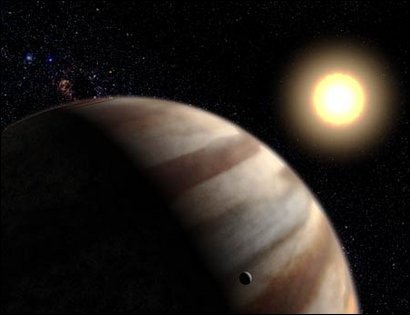 First Direct Measurements of Atmosphere on World Around Another Star
Astronomers using NASA's Hubble Space Telescope have made the first direct detection of the atmosphere of a planet orbiting a star outside our solar system and have obtained the first information about its chemical composition. Their unique observations demonstrate that it is possible with Hubble and other telescopes to measure the chemical makeup of extrasolar planet atmospheres and to potentially search for chemical markers of life beyond Earth.
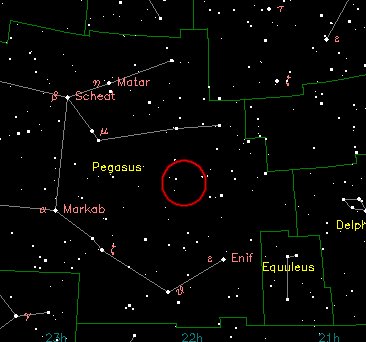
The planet orbits a yellow, Sun-like star called HD 209458, a seventh magnitude star (visible in an amateur telescope), which lies 150 light-years away in the autumn constellation Pegasus. Its atmospheric composition was probed when the planet passed in front of its parent star, allowing astronomers for the first time ever to see light from the star filtered through the planet's atmosphere.
Lead investigator David Charbonneau of the California Institute of Technology (Pasadena, California) and the Harvard-Smithsonian Center for Astrophysics (Cambridge, Massachusetts), Timothy Brown of the National Center for Atmospheric Research (Boulder, Colorado), and colleagues used Hubble's spectrometer (the Space Telescope Imaging Spectrograph) to detect the presence of sodium in the planet's atmosphere.
"This opens up an exciting new phase of extrasolar planet exploration, where we can begin to compare and contrast the atmospheres of planets around other stars," says Charbonneau.
The astronomers actually saw less sodium than predicted for the Jupiter-class planet, leading to one interpretation that high-altitude clouds in the alien atmosphere may have blocked some of the light. (Findings are to be published in the Astrophysical Journal).
The Hubble observation was not tuned to look for gases expected in a life-sustaining atmosphere (which is improbable for a planet as hot as the one observed). Nevertheless, this unique observing technique opens a new phase in the exploration of extrasolar planets, say astronomers. Such observations could potentially provide the first direct evidence for life beyond Earth by measuring unusual abundances of atmospheric gases caused by the presence of living organisms.
The planet orbiting HD 209458 was discovered in 1999 through its slight gravitational tug on the star. Based on that observation the planet is estimated to be 70 percent the mass of the giant planet Jupiter (or 220 times more massive than Earth).
Interstellar Galaxy Card 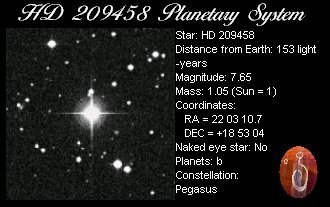
Location
Constellation: Pegasus
Right Ascension: 22 03 10.77
Declination: +18 53 03.5
Distance from Sol: 153.55 Light Years
Alternate Designations: V376 Peg
Basic Data
Spectral Type: F8 V
Apparent Magnitude: 7.65
B-V Color: 0.594
Mass: 1.1 Solar Masses
Radius: 1.3 Solar Radii
Effective Temperature: 6000 Kelvin
Metallicity: 0.04 [Fe/H]
1.09 times Solar
Age: 4000 - 6000 Million Years
Rotation: 15.7 days
Habitability
Inner Edge of Habitability Zone: 0.7 AU
Outer Edge of Habitability Zone: 2.18 AU
Estimated Stellar Lifespan 7513 million years
Comments Soon after the detection of HD 209458 b via doppler spectroscopy, a 1.7 percent dimming of the star was detected, caused as the planet passed in front of the star from the vantage point of Earth. As the transit requires the inclination of the planet's orbit to be 90 degrees, its mass can be calculated to high accuracy. The timing and intensity of the dimming of the star allows the radius and density of an extrasolar planet to be measured for the first time. Because HD209458 b passes in front of its star from the vantage point of the Earth, in 2001 astronomers using the Hubble Space Telescope were able to detect traces of sodium in the planet's atmosphere. This was the first detection of the chemical composition of an extrasolar planetary atmosphere.
System Components
(Mass in Multiples of Jupiter's Mass) 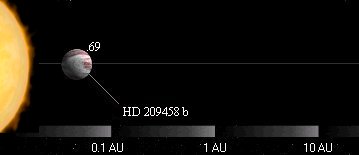
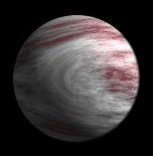
HD209458b is a so-called "hot Jupiter," or epistellar jovian, orbiting its host star once every 3.5 days at a distance of only 7 million km. The fact that it passes in front of the star, from our vantage point, for three hours every orbit, offers scientists the opportunity to study the planet and its environs in a unique way. Specifically, they can look for dark lines in the spectrum of the star's ultraviolet light caused by passage of the starlight through the planet's atmosphere. In March 2003, astronomers announced that measurements carried out with a spectrograph attached to the Hubble Telescope had shown that the planet is surrounded by a vast cloud of hydrogen, over 200,000 km across, that is billowing into space. Evidently, the intense heat of the nearby star is causing HD209458b to vaporize at the rate of least 10,000 tonnes per second. Not only is the planet's upper atmosphere being subjected to intense heating, the star's strong pull of gravity is likely creating tidal forces that also distort its outer gas layers. The atmosphere is thus stretched, then hydrogen is pushed away by the starlight and strewn out in a large tail similar to those of comets. This evaporation of planets that are close in to their parent stars could explain the very few detections of planets orbiting at less than seven million km out. These planets either quickly evaporate, or become hydrogen-poor Neptune-like worlds.1
Basic Data
Parent Star: HD 209458 (F8 V)
Discovery Status: Confirmed
Planet Type: Hot Jupiter
Physical Data
Mass ( M sin i ): 0.69 Jupiters
Radius: 1.54 Jupiters
Mean Distance: 0.047 AU
Orbital Period: 3.52433 Days
Eccentricity: 0
Argument of Perihelion (omega): 84°
Radial Velocity of Star: 14.7652 m/s
Inferred Properties
Average Angular Size of Star: 14.713°
Planet Appearance:
Silicate clouds, dim red glow
Mean Temp: 1365 Kelvin
Discovery Facts
Year Discovered: 1999
Detection Method: Doppler Spectroscopy/Transit
Discovered By: Marcy et al,
Confirmed by Elodie and Coralie Teams
Transit first detected by Charbonneau et al, Transit identified by G. Henry et
Planetary Orbit Of HD 209458b 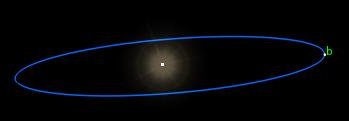
Orbital period : 3.52 days
Position In Pegasus