← The Wingmakers Ways · Astronomy & Exoplanets
Archived page · Checkable
HD 68988
HD_68988_NGC_3184.html · captured from wingmakers.co.nz
HD 68988 / NGC 3184
NGC3184 is a dimmed spiral galaxy positioned at only 45 arc minutes west of mu Ursae Majoris that forms the tip of Big Bear's one of hind legs. It's almost on a boundary on Leo Minor. The galaxy has a visual brightness of 10.5, but it looks fainter than this magnitude so it's fairly difficult to distinguish its detailed structure through telescopes. Though this picture is a bit noisy, you can see NGC3184 as a typical face-on galaxy and two arms coiled up loosely. And the galaxy is about 7 arc minutes in diameter.
The central star of HD 68988 can be found on the outer rim of spirial galaxy NGC 3184 In the constellation of ursa major. There is one comfirmed one by NASA in this solar system and the planet is known as HD 68988b. The planet has a rotational orbit of 0.6 AUs around the central star of HD 68988 and orbits the the star once every 6.276 Days.
Star Statistics
Distance from Sun: 58 Parsecs
Right Ascension: 08 18 22.1731
Declination: +61 27 38.599
Spectral Type: G0
Apparent Magnitude: 8.21
Mass: 1.2 Solar Masses
Metalicity: 0.24
System Components
(Mass in Multiples of Jupiter's Mass)
HD 68988 b
Epistellar Giant 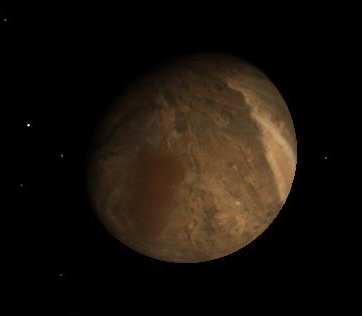
Planetary Statistics
Discovery Status: Confirmed
Planet Type: Hot Jupiter
Basic Data
Parent Star: HD 68988 (G0 V)
Discovery Status: Confirmed
Planet Type: Hot Jupiter
Physical Data
Mass ( M sin i ): 1.9 Jupiters
Periastron Distance: 0.06 AU
Mean Distance: 0.071 AU
Apastron Distance: 0.08 AU
Orbital Period: 6.276 Days
Eccentricity: 0.14
Argument of Perihelion (omega): 35°
Radial Velocity of Star: 187 m/s
Inferred Properties
Average Angular Size of Star: 8.765°
Planet Appearance:
Blue and cloudless, faint red glow
Periastron Temp: 1141 Kelvin
Mean Temp: 1058 Kelvin
Apastron Temp: 991 Kelvin
Discovery Facts
Year Discovered: 2001
Detection Method: Doppler Spectroscopy
Discovered By: Vogt S., Butler P., Marcy G., Fischer D., Pourbaix D., Apps K., & Laughlin G.
Habitability Zone 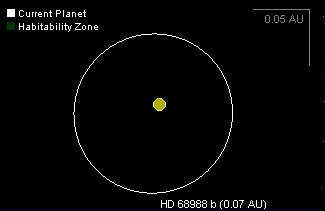
Planetary Orbit Around HD 68988
Rotational orbit : 0.6 AUs
Position In Ursa Major 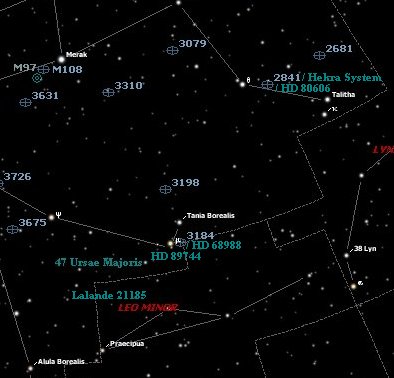
INTERSTELLAR TRAVEL TECHNIQUE
VISUAL EXERCISE : One person Exercise.
CONSTELLATION : Ursa Major
PLANETARY DESTINATION : HD 68988b
STEP ONE
Traveller: Get comfortable and relax.
STEP TWO
Traveller: Charge your physical body with light energy.
STEP THREE
Traveller: See your visual body standing in front of your physical body and prepare your visual body for interstellar travel with a Interstellar Protection Shield and scanner.
STEP FOUR
Traveller: See your visual body filling with light energy.
STEP FIVE
Traveller: Focus your mind on teleporting your visual body to your destination above.
STEP SIX
Traveller: Then see your visual body teleporting to your destination.
STEP SEVEN
Traveller: When you arrive in the Hekar system perform an interstellar planetary detection rapid to check for were the planets are then teleport to the nearest destination in that planetary system.
STEP EIGHT
then scan is the surface of the planet and the atmosphere is the planet a match with earths atmosphere? Can you see any life forms on the surface of planet? Is there any water on the surface of the planet? Place this information on your planetary data file.
STEP NINE
Then use the Core Comparison Crystal Technique to perform a core reading on the core structure of the planet.
STEP TEN
Traveller: When you have finished mapping the Planet or moon teleport your visual body back to your physical body back on earth.
REMEMBER
When you are travelling if you come across an alien race that you think may be friendly feel free to make contact with that alien race.
IMPORTANT
When you are contacting alien races always be ready to teleport if there is trouble.