← The Wingmakers Ways · not in the site's own index
Archived page · Asserted
HD75289 Planetary System
HD75289_Planetary_System.html · captured from wingmakers.co.nz
HD75289 Planetary System
Interstellar Card 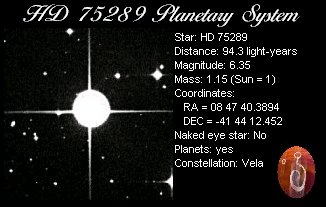
The Star
HD 75289 is a yellow-orange main sequence dwarf star of spectral and luminosity type G0 V Gratton et al, 1989), but it had been previously classified as bright as a supergiant (Ia) or a hypergiant (O) possibly because it was thought to be much further away. The star has about 1.05 times the mass of Sol (HD 75289 at the Observatoire de Genève), probably a greater diameter, and twice (2.01) its visual luminosity. Relatively bright for its spectral type and mass, it appears to be running low on core hydrogen despite being around Sol'age -- around 4.6 billion years (press release; and Henry et al, 1996). HD 75289 is about twice (1.90-1.95) as enriched than Sol with elements heavier than hydrogen ("metallicity"), based on its abundance of iron (HD 75289 at the Observatoire de Genève; Gonzalez and Laws, 2000; and Gratton et al, 1989). According to the Astronomiches Rechen-Institut at Heidelberg's ARICNS, it may be an RV variable. Useful catalogue numbers and designations for the star include: HR 3497, Hip 43177, HD 75289, CD-41 4507, CP(D)-41 2972, SAO 220481, and LTT 3243.
System Summary
HD 75289 is located about 94.4 light-years from Sol (HIPPARCOS Plx= 34.55, e_Plx = 0.56 mas). It lies at the northwest edge (8:47:40.4-41:44:12.5, ICRS 2000.0) of Constellation Vela, the Sails -- northwest of Suhail (Lamda Velorum), west of Psi Velorum, southeast of Naos (Zeta Puppis), northeast of Regor (Gamma2 Velorum), and southwest of Beta and Alpha Pyxidis. In May 1999, astronomers announced the discovery of a Jupiter-class planet around this Sun-like star (Udry et al, 2000, in ps; press release; summary data at the Observatoire de Genève; and HD 75289 at exoplanets.org -- details below). (See an animation of the planetary and potentially habitable zone orbits of this system, with a table of basic orbital and physical characteristics.)
Today, some astronomers prefer to refer to this star as HD 75289, as it is listed in the Henry Draper (1837-82) Catalogue with extension (HDE), a massive photographic stellar spectrum survey carried out by Annie Jump Cannon (1863-1941) and Edward Charles Pickering (1846-1919) from 1911 to 1915 under the sponsorship of a memorial fund created by Henry's wife, Anna Mary Palmer. As a relatively bright star in Earth's night sky, the star is also catalogued as Harvard Revised (HR) 3497, a numbering system derived from the 1908 Revised Harvard Photometry catalogue of stars visible to many Humans with the naked eye. The HR system has been preserved through its successor, the Yale Bright Star Catalogue -- revised and expanded through the hard work of E. Dorrit Hoffleit and others.
On the other hand, the star has an older designation as CD-41 4507, from a visual survey of southern stars begun in 1892 at the Astronomical Observatory of Cordoba in Argentina under the direction of its second director John M. Thome (1843-1908). Thome died before the completion of this southern sky atlas in 1914, when 578,802 stars from declination -22° to -90° were published as the Cordoba Durchmusterung ("Survey"). The "CD" is an extension of an older catalogue by Friedrich Wilhelm August Argelander (1799-1875) in 1863 on the position and brightness of 324,198 stars between +90° and -2° declination that were measured over 11 years from Bonn, Germany, made with his assistants Eduard Schönfeld (1828-1891) and Aldalbert Krüger (1832-1896), which became famous as the Bonner Durchmusterung ("Bonn Survey") abbreviated as BD. The BD and CD were greatly expanded and extended into the modern age of photographic surveys with the subsequent creation of the Cape Photographic Durchmusterung from South Africa.
System Components
(Mass in Multiples of Jupiter's Mass) 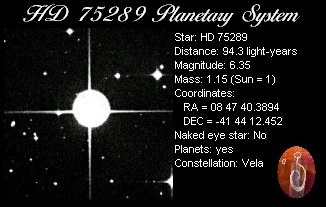
HD 75289 b
Epistellar Giant 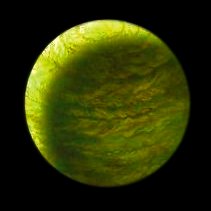
Statistics
Star System: HD 75289
Discovery Status: Confirmed
Mass: 0.42 Jupiters
Average Distance: 0.046 AUs
Period: 3.5096 Days
Orbital Eccentricity: 0.054
Argument of Perihelion (omega): 216°
Tug on Star: 9.258 m/s
Average Temperature: 1260 Kelvin
Detection Method: Doppler Spectroscopy
Discovered By: Mayor et al
Year Discovered: 1999
Planetary Orbit
0.6 AUs
Position in Sky