← The Wingmakers Ways · Astronomy & Exoplanets
Archived page · Checkable
Hercules
Hercules.html · captured from wingmakers.co.nz
Hercules 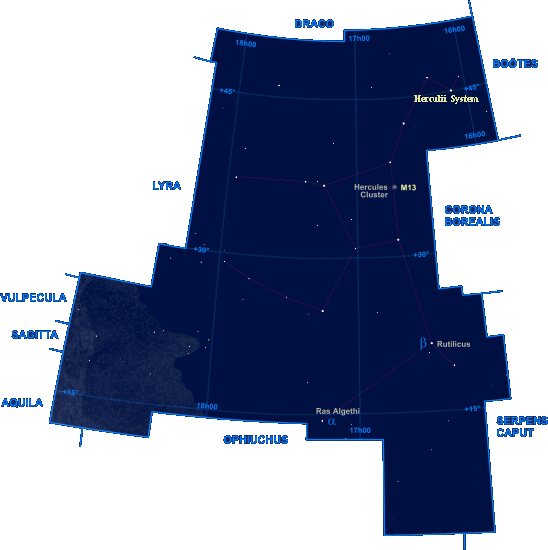 The Hercules is a fairly large constellation in summer, but isn't very obvious. "Hercules" is a name of Greek hero, and the constellation is represented as a kneeling man with his head turning south.
Though the constellation is faint, a fairly strained shape of "H" that forms Hercules' body is a good mark to find that. Alpha Herculis, Ras Algethi, is positioned at the kneeler's head has a magnitude of 3, ancient Chinese had regarded the star as the Emperor's seat, and they had observed this field very carefully whether there was any novae or comets.
M13 (NGC6205) is a spectacular globular cluster known as "The Hercules Cluster". It's universally acclaimed as the best globular in the Northern Hemisphere, lies on a line between eta Herculis and zeta Herculis. The cluster has a size of about 10 arc minutes and about over 100 thousand fine stars, 22 thousand light years away.
Usual nebulae and star clusters in our Galaxy are distributed in the disk being spiral structure. However, almost all of globular clusters, including M13, don't obey this rule, they equally distribute in the gigantic sphere region called "Halo" that encloses whole the Galaxy. Stars included in the globular clusters are very old normally over 10 billion years, about equal with the Galaxy itself. So the globular cluster should be one of the most important objects to research for origin of formation of the Galaxy.
M92 (NGC6341) is a medium-sized globular cluster lies on a line between eta and iota Herculis. The cluster is much smaller than M13, The Hercules Cluster, but has a brighter nucleus than the representative globular cluster in summer skies, can easily be detected by binoculars. You'll be able to appreciate M92 like a dimmed nebula with ellipse shape, should need a telescope larger than 20cm(7.8") to resolve individual stars. The cluster has a diameter of 8.3 arc minute and a distance of about 36 thousand light years.
MAPPING TECHNIQUE
VISUAL EXERCISE : Two Person Exercise.
DESTINATION : Your Choice
STEP ONE
Traveller : Get comfortable and relax.
STEP TWO
Traveller : Charge your physical body with light energy.
STEP THREE
Traveller : See your visual body standing in front of your physical body and prepare your visual body for interstellar travel with a Interstellar Protection Shield.
STEP FOUR
Traveller : See your visual body filling with light energy.
STEP FIVE
Traveller : Focus your mind on teleporting your visual body to the Your Destination.
STEP SIX
Traveller : Then see your visual body teleporting to the Your Destination.
STEP SEVEN
Traveller : When you arrive in the destination Look around can you see any planets or moons in the System? If not use the Interstellar Planetary Detection Rapid and see if you can detect any planets or moons in that system.
STEP EIGHT
Traveller : If you can see or detect a planet or moon using Telekinesis or Teleportation move towards the planetary body.
STEP NINE
Traveller : When you arrive at the outer atmosphere of the planet or moon stop and ask your spiritual guide to tell you the name of this planet or moon.
Traveller : Tell the mapper the name of the planet or moon. Also tell the mapper all you can about the planet or moon.
STEP TEN
Then us the Core Comparison Crystal Technique to perform a core reading on this planet or moon and give the mapper your reading on this planet or moon
STEP ELEVEN
Traveller : Then levitate or Teleport your visual body to the surface of the planet or moon.
STEP TWELVE
Mapper : When the traveller arrives on the surface ask the following questions.
Is there any plant life or water on the surface of the planet or moon that you can see? Is there an atmosphere around this planet or moon? Is the atmosphere an match with earths atmosphere?
Mapper : Write down the answers to these questions.
PLANETARY DATA FILE 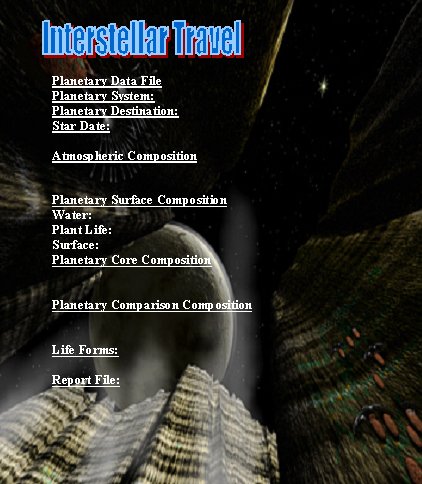
STEP THIRTEEN
Traveller : When you are finished on the surface teleport your visual body to the nearest planetary body that you can see in that Galaxy.
STEP FOURTEEN
Traveller and Mapper : Follow steps nine through to twelve again till you have mapped out the whole Galaxy.
STEP FIFTEEN
Traveller : When you have finished mapping the Galaxy teleport your visual body back to your physical body back on earth.
REMEMBER
When you are travelling if you come across an alien race that you think may be friendly feel free to make contact with that alien race.
IMPORTANT
When you are contacting alien races always be ready to teleport if there is trouble.
MAPPER
Make a note of any planets or moons with an atmospheric match with earths. That way you both know which planets can support human life forms.
MAPPER & TRAVELLER
To check that your mapping of that Galaxy is correct by changing roles and do this exercise again. Also remember to check for life force energy around the planets or moons that you visit on your journeys. Because if you can feel life force energy that means the planet or moons is a real planet or moon.