← The Wingmakers Ways · Astronomy & Exoplanets
Archived page · Checkable
Hydra
Hydra.html · captured from wingmakers.co.nz
Hydra 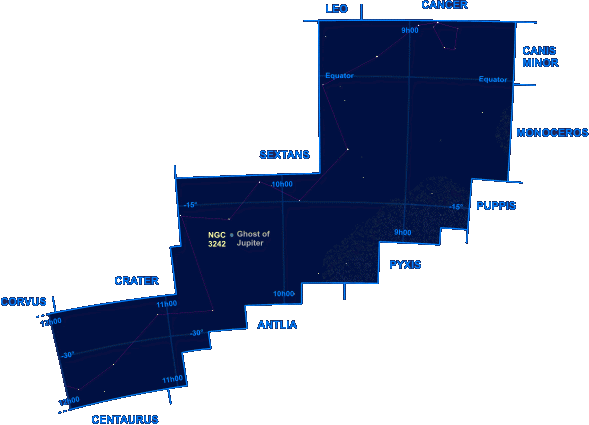
The Sea Monster, The Water Snake The Hydra is the largest constellation in the heavens. It occupies the southern sky in spring bordering Cancer, to as far as Libra and Centaurus, stretching out to around one hundred degrees in the process. This hydra marks a gigantic beast with many heads. And Heracles killed the hydra by cutting off the all of head. Alpha Hydrae, Alphard is very noticeable at the heart of hydra. The star is a bright red-giant, meaning of "Solitary". It came that there are no bright stars around Alphard. Besides, The star has an another name of "Col Hydrae" (The Hydra's Heart), a fitting name. 
The giant constellation Hydra occupies a significant portion of the sky, lying to the north of the galactic plane.
The Hubble telescope has captured an image of an unusual edge-on galaxy, revealing remarkable details of its warped dusty disk and showing how colliding galaxies spawn the formation of new generations of stars. The dust and spiral arms of normal spiral galaxies, like our own Milky Way, appear flat when viewed edge-on. This Hubble Heritage image of ESO 510-G13 shows a galaxy that, by contrast, has an unusual twisted disk structure, first seen in ground-based photographs.
NGC 3314 consists of two large spiral galaxies which just happen to almost exactly line-up. The foreground spiral is viewed nearly face-on, its pinwheel shape defined by young bright star clusters. But against the glow of the background galaxy, dark swirling lanes of interstellar dust are also seen to echo the face-on spiral's structure. The dust lanes are surprisingly pervasive, and this remarkable pair of overlapping galaxies is one of a small number of systems in which absorption of visible light can be used to directly explore the distribution of dust in distant spirals. NGC 3314 is about 140 million light-years away in the southern constellation of Hydra.
M83 is a bright galaxy around the tail of Hydra. The galaxy has almost same right ascension with Spica, alpha Vir, and positioned just 19 degrees south of Spica. M83 has a shape of typical "Bared Galaxy", a clear bar can be seen stretched to NE and SW, and two spirals are coiled up from each tip of the bar. Those unique structures can be captured in films very easily, and you can see those indistinctly with the medium-sized scopes and cleared night sky. It can be said that M83 is a very rare galaxy because we can hardly recognize the spiral structure in almost all other galaxies with naked eyes via telescopes. And it's considered that M83 is only one galaxy the clear spirals had been recorded in sketches before the astro-photographic technology was invented and developed.
This planetary nebula is often called the "Ghost of Jupiter" since it is fairly large and round- though MUCH dimmer than its namesake. Even a small telescope under bright skies can be used to view this nebula. Its color is an unmistakable blue/green. Views through a larger telescope reveal the inner torus and central star (white dwarf). Located in the constellation of Hydra, NGC 3242 is easily found just beneath (south of) Mu Hydrae. It is estimated to be 1,400 light years away.
NGC3621 is a large-sized spiral galaxy lying around central region of Hydra. You can find out the galaxy about 3.2 degrees west of xi Hydrae. Apparent size is 12 x 7 arc minutes and brightness is 9th magnitude. Although the galaxy is classified in spiral, its structure is indistinct. Only dimmed light can be detected.
Globular Cluster in Hydra
M48 (NGC2548) is a medium-sized open cluster at the western-edge of Hydra closing to Monoceros. The cluster contains about 80 fine stars, has a diameter of about 30 arc minutes, almost same as that of full-moon. You can perfectly resolve individual stars only with the portable binoculars, and enjoy various stellar series through small scopes. The distance from the solar system is estimated around 3000 light years.
M68 is a small-scaled globular cluster hided in the body of Hydra. Though the cluster belongs to a constellation of Hydra, it's easy to search it from stars of Corvus. M68 can be found by stretching the eastern edge of square of Corvus southward. The cluster is very sparse; you can detect individual stars only with small telescopes.
Planetary Destination In Hydra
MAPPING TECHNIQUE
VISUAL EXERCISE : Two Person Exercise.
DESTINATION : Your Choice
STEP ONE
Traveller : Get comfortable and relax.
STEP TWO
Traveller : Charge your physical body with light energy.
STEP THREE
Traveller : See your visual body standing in front of your physical body and prepare your visual body for interstellar travel with a Interstellar Protection Shield.
STEP FOUR
Traveller : See your visual body filling with light energy.
STEP FIVE
Traveller : Focus your mind on teleportingyour visual body to the Your Destination.
STEP SIX
Traveller : Then see your visual body teleporting to the Your Destination.
STEP SEVEN
Traveller : When you arrive in the destination Look around can you see any planets or moons in the System? If not use the Interstellar Planetary Detection Rapid and see if you can detect any planets or moons in that system.
STEP EIGHT
Traveller : If you can see or detect a planet or moon using Telekinesis or Teleportation move towards the planetary body.
STEP NINE
Traveller : When you arrive at the outer atmosphere of the planet or moon stop and ask your spiritual guide to tell you the name of this planet or moon.
Traveller : Tell the mapper the name of the planet or moon. Also tell the mapper all you can about the planet or moon.
STEP TEN
Then us the Core Comparison Crystal Technique to perform a core reading on this planet or moon and give the mapper your reading on this planet or moon
STEP ELEVEN
Traveller : Then levitate or Teleport your visual body to the surface of the planet or moon.
STEP TWELVE
Mapper : When the traveller arrives on the surface ask the following questions.
Is there any plant life or water on the surface of the planet or moon that you can see? Is there an atmosphere around this planet or moon? Is the atmosphere an match with earths atmosphere?
Mapper : Write down the answers to these questions.
PLANETARY DATA FILE 
STEP THIRTEEN
Traveller : When you are finished on the surface teleport your visual body to the nearest planetary body that you can see in that Galaxy.
STEP FOURTEEN
Traveller and Mapper : Follow steps nine through to twelve again till you have mapped out the whole Galaxy.
STEP FIFTEEN
Traveller : When you have finished mapping the Galaxy teleport your visual body back to your physical body back on earth.
REMEMBER
When you are travelling if you come across an alien race that you think may be friendly feel free to make contact with that alien race.
IMPORTANT
When you are contacting alien races always be ready to teleport if there is trouble.
MAPPER
Make a note of any planets or moons with an atmospheric match with earths. That way you both know which planets can support human life forms.
MAPPER & TRAVELLER
To check that your mapping of that Galaxy is correct by changing roles and do this exercise again. Also remember to check for life force energy around the planets or moons that you visit on your journeys. Because if you can feel life force energy that means the planet or moons is a real planet or moon.