← The Wingmakers Ways · Astronomy & Exoplanets
Archived page · Checkable
Lalande 21185
Lalande_21185_Planetary_System.html · captured from wingmakers.co.nz
Lalande 21185 Planetary System
System Summary
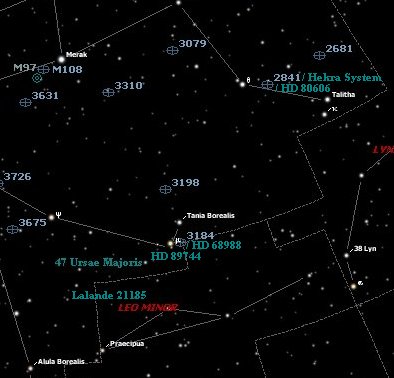
Lalande 21185 is the fourth system closest to Sol after Alpha Centauri 3, Barnard's Star, and Wolf 359. The star is located only about 8.3 light-years away in the southeastern corner (11:03:20.19+35:58:11.55, ICRS 2000.0) of Constellation Ursa Major, the Great Bear which also encompasses the Big Dipper -- northwest of Alula Borealis (Nu Ursae Majoris). It is about three times too faint to be seen with the naked eye.
The star was first listed by Joseph-Jérôme Lefrançais de Lalande (1732-1807), who became director of the Paris Observatory in 1795, produced the most comprehensive catalog for his time of 47,390 star positions (the Histoire Céleste Française) in 1801, and was actually the first person to add Flamsteed numbers to designate the brighter stars within each constellation in a French edition of John Flamsteed's (1645-1719) star catalog. In 1996, astronomers reported the detection of possible planetary companions for Lalande 21185 using astrometric measurements -- details below. (See an animation of the system's possible planetary and potentially habitable zone orbits, with a table of basic orbital and physical characteristics.)
The Star
This cool and dim, main sequence red dwarf (M2.1 Vne) has about 46 percent of Sol's mass (RECONS estimate), 46 percent of its diameter (Johnson and Wright, 1983, page 671), but less than 6/1,000th of its brightness. The star is less enriched in elements heavier than hydrogen ("metals") compared to our Sun, with around 63 percent of Sol's abundance of iron (Cayrel de Strobel et al, 1991, page 292). It is suspected to have at least one, but perhaps as many as three, Jupiter-class planets.
Moving perpendicular to the galactic plane at a fast velocity of 47 km/sec, Lalande 21185 appears to belong to the our Milky Way galaxy's "thick disk," which has a mean thickness of 3,500 ly. Most thick disk stars are old and move rapidly within 5,000 ly of the galactic plane in considerably eccentric orbits. Their abundance of elements heavier than hydrogen ("metals") typically ranges from 0.2 to 0.5 of Sol's (with a mean of 0.3). Thick disk stars may comprise as much as four percent of nearby stars (Ken Croswell, 1995, page 62). While probably much older than our own 4.6-billion-year-old Sun, Lalande 21185 is probably less than 10 billion years old.
Some alternative names and useful star catalogue numbers are: Gl 411, Hip 54035, HD 95735, BD+36 2147, SAO 62377, LHS 37, LTT 12960, LFT 756, Vys/McC 594, G 119-52, G 147-17, and GC 15183.
Interstellar card 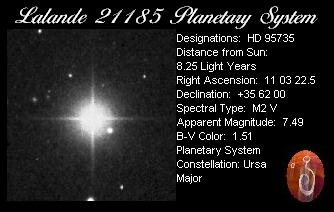
Lalande 21185 b
Jovian Planet 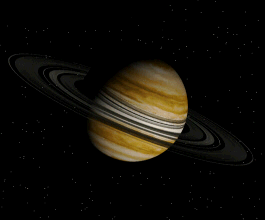
Planetary Statistics
Star System: Lalande 21185
Discovery Status: Unpublished
Mass: 0.9 Jupiters
Average Distance: 2 AUs
Period: 5.8 Years
Detection Method: Optical Astrometry
Discovered By: George Gatewood
Year Discovered: 1996
Planetary Speculations
If Lalande 21185 was a yellow dwarf, like our sun, then Lalande 21185 b and 47 Ursae Majoris b could be considered sister worlds. Both worlds have masses similar to Jupiter. Both are in similar orbits. If Lalande 21185 was a yellow dwarf, then Lalande 21185 b might be orbited by moons with liquid water. But Lalande 21185 is a red dwarf star, cool and dim. Lalande 21185 b is more akin to Saturn or Uranus than it's warmer extrasolar cousins.
Like Jupiter, Lalande 21185 b's atmosphere is probably mostly hydrogen and helium. It's moons are frozen and barren, composed mostly of water, methane, and ammonia ice, with little if any rocky core, like the moons of Saturn and Uranus. Moons that orbit close to the planet may be heated enough to form gysers of liquid methane, such as the ones on Neptune's moon Triton, but not enough for underground oceans or vulcanism. These desolate moons offer little hope for life.
Lalande 21185 c
Jovian Planet
Planetary Statistics
Star System: Lalande 21185
Discovery Status: Unpublished
Mass: 1.6 Jupiters
Average Distance: 10 AUs
Period: 30 Years
Detection Method: Optical Astrometry
Discovered By: George Gatewood
Year Discovered: 1996
Planetary Speculations
Far away from the dim glow of its parent red dwarf, Lalande 21185 c is a world we know very little about, even for extrasolar planets. It may be a medium or small jovian world, akin to Saturn, Uranus, and Neptune, in a close orbit. Or it may be a more massive world much farther out. We do know that it has a 30 year orbital period, suggesting a Saturn like orbit.
Such a planet would be unimaginably cold, orbiting so far away from an already dim star. The moons of Lalande 21185 would be dark, frozen and inert, akin to Pluto and its moon, Charon. The planet itself, with an atmosphere made blue by an abundance of methane, would exist in a perpetual twilight.
And there is the possibility of a third planet, still unconfirmed, about which we know nothing. Dark and cold, much is still to be discovered about the worlds of Lalande 21185.
Planetary Orbits Lalande 21185 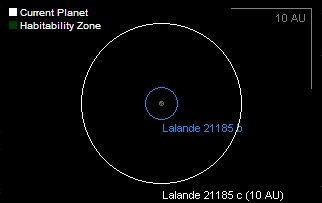
Position In Ursa Major