← The Wingmakers Ways · Astronomy & Exoplanets
Archived page · Checkable
Leo
Leo.html · captured from wingmakers.co.nz
Leo 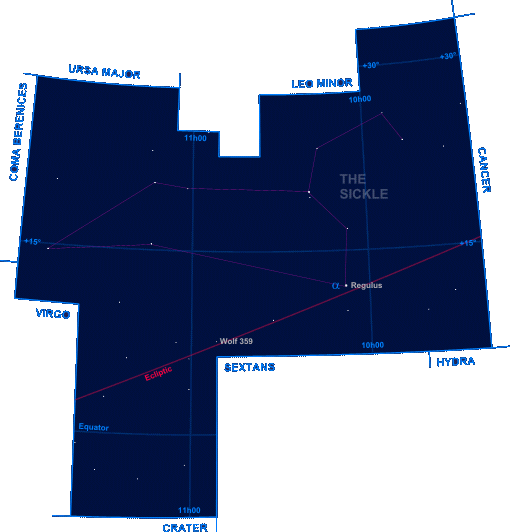
The Lion
The Leo is one of the most recognizable constellations in spring skies, although almost all of them are formed out of faint stars and have complicated shapes. A curve of stars arranged like a mark of "?" being turned over, "The Lion's sickle" that represents Leo's head. One of famous meteor streams, Gamma Leonids, has a radiant point in the sickle, and it's expected that the meteor shower will be observed in November 1999.
Alpha Leonis is named "Regulus" meaning of the little king, the star was well known in antiquity as Cor Leonis, the Lion's Heart.
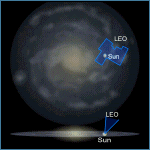
Leo is a neighbour of Coma Berenices, home of the Northern Galactic Pole, and so lies almost directly 'upward' through the plane of the Milky Way.
First Cosmic Ray : Linking Through The Sun
"These subjects are motivated by their will and have lots of energy and drive. But this very active force needs creative outlets otherwise it may degenerate into lust or violence. Basically egocentric and often showy, such subjects are very original, but their natural instinct to rush things sometimes leads to a lack of care. They are stern and sometimes severe, but also fair-minded, paternal, gentle, loving, kind and capable of compassion. Such subjects need to be the dominant partner and, although independent, occasionally need someone to react upon. They tend to have sudden and stunning effects on others, and their will-power is strong enough to force those around them to do what they demand without question.
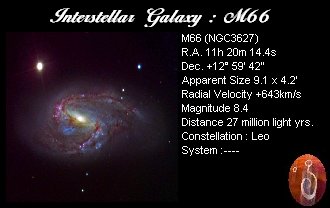
M65 (NGC3623) and M66 (NGC3627) make a splendid pair of spiral galaxies in the same field at Leo's hind legs, between theta and iota Leonis, right and left-hand side ones are M65 and M66 respectively. And about a degree north, you can see one more edge-on galaxy NGC3628 with a dark lane being crossed; the galaxy is dimmer than M65 and M66. You can appreciate this trio as similar scenery to this picture with telescopes. The galaxies have interaction via gravity, and lie on the empty space approximately 27 million light years away.
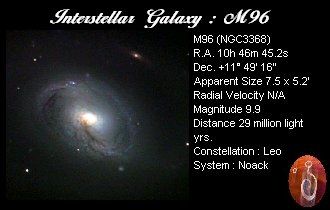
This picture contains two galaxies of M95 (right) and M96 (left) positioned between forelegs and hind legs of Leo. M95 is a spiral galaxy with a visual diameter of 5 arc minutes, arms are coiled up around the nucleus. M96 is also a spiral with almost same size as M95, you can detect two undeveloped arms stretching in east-west direction. Both galaxies are lying about 29 millions light years away, forming a small-scaled galactic cluster with neighbored dimmed galaxies.
M105 is an elliptical galaxy around the center of Leo. The galaxy is lying about a degree north of M95 and M96, those three Messier's galaxies can be appreciated in low powered field of view. The galaxy is one of principal members of a small galactic cluster formed by some dimmed galaxies around this field. M105 lies at right of three triangled galaxies, and other two galaxies are named NGC3384 (upper) and NGC3389 (left), respectively.
M105 has a diameter of about 5 arc minutes and visual magnitude of 10. It's a round shaped elliptical so you cannot resolve clear structures.
NGC2903 is a typical spiral galaxy only 1.5-degree south of lambda Leonis, a tip star of the Lion's sickle, so it's easy to find that by using the star as a pilot. This galaxy has visual magnitude 9.7, which is brighter than any other Messier's objects in the constellation.
You can appreciate an elongated multiple-armed spiral with small telescopes.
NGC2903 is about 20 million light years away.
This image shows you a spiral galaxy of NGC3521 positioned around the southern edge of Leo. This star field contains no bright guide stars, but you can find it out about 7 degrees southwest from sigma Leo, a tip star of Leo's hind leg.
The galaxy has an elliptical shape with a long axis of about 11 arc minutes and 10th magnitude; you can detect the galaxy as a dimmed light only with small telescopes. It's one of easy-to-appreciate galaxies distributed around this field. Although this picture shows no clear spiral structure, bright nucleus and surrounding dimmed light has been captured. The distance from us is estimated about 23 millions light years, and the galaxy belongs to a Leo galactic cluster same as M65, M66, etc.
I'd like to introduce you a bit rare celestial object in Leo. This picture shows you a celestial field just north of alpha Leonis, Regulus. There is an extremely faint elongated galaxy Leo I (Leo-one) just 20 arc minutes north of Regulus. Though Leo I has a size of about 10 arc minutes, is very faint magnitude around 11. It's absolutely impossible to detect it with naked eyes in spite of using fairly large scopes. Please pay your attention around an intersection area of white lines. It's just the figure of the galaxy that the round and bright area.
Leo I is a member of the local group of galaxies includes our Galaxy and the Andromeda Galaxy and so on. The galaxy was discovered in 1950's in an astronomical photograph.
Amid a backdrop of far-off galaxies, the majestic dusty spiral NGC 3370 looms in the foreground in this NASA Hubble Space Telescope image. Recent observations taken with the Advanced Camera for Surveys show intricate spiral arm structure spotted with hot areas of new star formation. But this galaxy is more than just a pretty face. Nearly 10 years earlier, NGC 3370, located in the constellation Leo, hosted a bright exploding star.
First Cosmic Ray
"These subjects are motivated by their will and have lots of energy and drive. But this very active force needs creative outlets otherwise it may degenerate into lust or violence. Basically egocentric and often showy, such subjects are very original, but their natural instinct to rush things sometimes leads to a lack of care. They are stern and sometimes severe, but also fair-minded, paternal, gentle, loving, kind and capable of compassion. Such subjects need to be the dominant partner and, although independent, occasionally need someone to react upon. They tend to have sudden and stunning effects on others, and their will-power is strong enough to force those around them to do what they demand without question.
NGC3628 with a dark lane being crossed; the galaxy is dimmer than M65 and M66. You can appreciate this trio as similar scenery to this picture with telescopes.
A very cool, main sequence red dwarf (M5.8Ve), Wolf 359 is our Sun's dimmest stellar neighbor within 10 ly, with less than 2/100,000th of Sol's luminosity. If our Sun, Sol, were replaced by Wolf 359, then an observer on Earth would need a telescope to see its round shape clearly, and daylight would be very dim with only ten times the brightness of full moonlight with Sol. On the other hand, Wolf 359 is a Flare Star (that has been designated with the variable star name CN Leonis) and so can brighten dramatically from time to time.
The large galaxy near the top of the picture is NGC 3239. This galaxy is part of the Arp catalogue of disturbed galaxies (Arp 263). There are a handful of 15th magnitude galaxies in the image as well as countless others in the background.
MAPPING TECHNIQUE
VISUAL EXERCISE : Two Person Exercise.
DESTINATION : Your Choice
STEP ONE
Traveller : Get comfortable and relax.
STEP TWO
Traveller : Charge your physical body with light energy.
STEP THREE
Traveller : See your visual body standing in front of your physical body and prepare your visual body for interstellar travel with a Interstellar Protection Shield.
STEP FOUR
Traveller : See your visual body filling with light energy.
STEP FIVE
Traveller : Focus your mind on teleporting your visual body to the Your Destination.
STEP SIX
Traveller : Then see your visual body teleporting to the Your Destination.
STEP SEVEN
Traveller : When you arrive in the destination Look around can you see any planets or moons in the System? If not use the Interstellar Planetary Detection Rapid and see if you can detect any planets or moons in that system.
STEP EIGHT
Traveller : If you can see or detect a planet or moon using Telekinesis or Teleportation move towards the planetary body.
STEP NINE
Traveller : When you arrive at the outer atmosphere of the planet or moon stop and ask your spiritual guide to tell you the name of this planet or moon.
Traveller : Tell the mapper the name of the planet or moon. Also tell the mapper all you can about the planet or moon.
STEP TEN
Then us the Core Comparison Crystal Technique to perform a core reading on this planet or moon and give the mapper your reading on this planet or moon
STEP ELEVEN
Traveller : Then levitate or Teleport your visual body to the surface of the planet or moon.
STEP TWELVE
Mapper : When the traveller arrives on the surface ask the following questions.
Is there any plant life or water on the surface of the planet or moon that you can see? Is there an atmosphere around this planet or moon? Is the atmosphere an match with earths atmosphere?
Mapper : Write down the answers to these questions.
PLANETARY DATA FILE 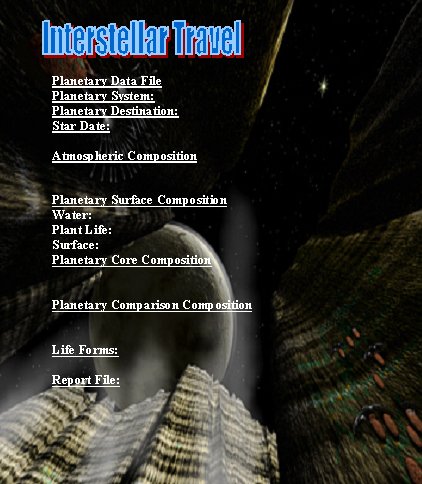
STEP THIRTEEN
Traveller : When you are finished on the surface teleport your visual body to the nearest planetary body that you can see in that Galaxy.
STEP FOURTEEN
Traveller and Mapper : Follow steps nine through to twelve again till you have mapped out the whole Galaxy.
STEP FIFTEEN
Traveller : When you have finished mapping the Galaxy teleport your visual body back to your physical body back on earth.
REMEMBER
When you are travelling if you come across an alien race that you think may be friendly feel free to make contact with that alien race.
IMPORTANT
When you are contacting alien races always be ready to teleport if there is trouble.
MAPPER
Make a note of any planets or moons with an atmospheric match with earths. That way you both know which planets can support human life forms.
MAPPER & TRAVELLER
To check that your mapping of that Galaxy is correct by changing roles and do this exercise again. Also remember to check for life force energy around the planets or moons that you visit on your journeys. Because if you can feel life force energy that means the planet or moons is a real planet or moon.