← The Wingmakers Ways · Astronomy & Exoplanets
Archived page · Checkable
Lepus
Lepus.html · captured from wingmakers.co.nz
Lepus 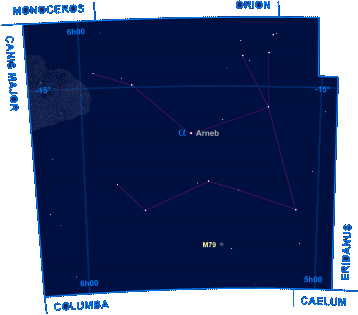
The Hare
Lepus, The Hare, is a minor constellation found under the feet of Orion, you can see Rigel (beta Ori) in the upper side of this picture. Stars forming the constellation are about 3rd or 4th magnitude, so it should be hard to imagine the figure of a hare in the southern skies in winter. Lepus is often ignored, as Orion is such a dominating constellation. The constellation has no major myths, yet it's considered the origin of the Lepus: in ancient Sicily island, farmers were troubled by hares that had ravaged the field. They established the figure of a hare just under the Orion as a charm to drive away the annoying hares.
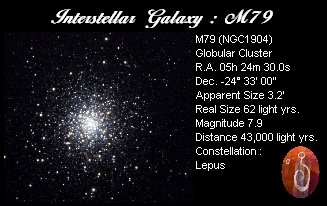
M79 (NGC1904) is a small globular cluster and is found by doubling the line from alpha to beta Lep. The globular cluster hardly can be seen in winter skies, so M79 is almost only one in winter.
M79 has the apparent diameter of about 3 arc minutes, but fairly bright and sufficient to observe with small scopes. You'll be able to recognize the dimmed stellar-like light point, it should be hard to resolve the individual stars. The cluster is estimated about 43 thousand light years away from the solar system.
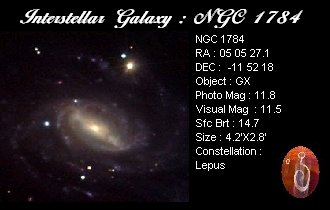
NGC 1784 is a fairly unremarkable barred-spiral galaxy at first glance. However, studying even the seemingly common may reveal unique aspects that help forward our understanding of the universe. Recently astronomer Doug Ratay studied this particular galaxy and found some interesting things. By observing this galaxy in radio wavelengths of light he was able to map the distribution of hydrogen gas both in and surrounding NGC 1784. He found that the envelope of gas that surrounds this galaxy extends well beyond (about twice the diameter) the optical image. Furthermore, he found a clump of gas that could be a very small galaxy orbiting NGC 1784 as well as stream of gas encircling another part of the galaxy. All of these features are very similar to our own Milky Way as we have absorbed small galaxies in the past and currently doing the same to the Magellanic clouds right now. Studying how NGC 1784 does this in its environment might help us understand our own. For more information about Doug Ratay's conclusions, visit his research synopsis Here. NGC 1784 is around 100 million light years away.
The planetary nebula IC 418 lies about 2,000 light-years from Earth in the direction of the constellation Lepus. This photograph is one of the latest from NASA's Hubble Space Telescope, obtained with the Wide Field Planetary Camera 2.
A planetary nebula represents the final stage in the evolution of a star similar to our Sun. The star at the center of IC 418 was a red giant a few thousand years ago, but then ejected its outer layers into space to form the nebula, which has now expanded to a diameter of about 0.1 light-year. The stellar remnant at the center is the hot core of the red giant, from which ultraviolet radiation floods out into the surrounding gas, causing it to fluoresce. Over the next several thousand years, the nebula will gradually disperse into space, and then the star will cool and fade away for billions of years as a white dwarf. Our own Sun is expected to undergo a similar fate, but fortunately this will not occur until some 5 billion years from now.
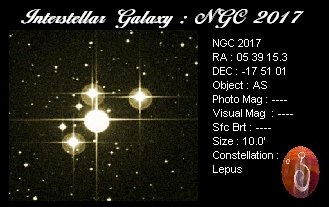
NGC 2017 is a group of a half dozen stars, all gravitationally bound (h3780, see above). The "cluster" is found seven arc minutes due east of alpha Leporis.
Other Destinations In Lepus :
MAPPING TECHNIQUE
VISUAL EXERCISE : Two Person Exercise.
DESTINATION : Your Choice
STEP ONE
Traveller : Get comfortable and relax.
STEP TWO
Traveller : Charge your physical body with light energy.
STEP THREE
Traveller : See your visual body standing in front of your physical body and prepare your visual body for interstellar travel with a Interstellar Protection Shield.
STEP FOUR
Traveller : See your visual body filling with light energy.
STEP FIVE
Traveller : Focus your mind on teleporting your visual body to the Your Destination.
STEP SIX
Traveller : Then see your visual body teleporting to the Your Destination.
STEP SEVEN
Traveller : When you arrive in the destination Look around can you see any planets or moons in the System? If not use the Interstellar Planetary Detection Rapid and see if you can detect any planets or moons in that system.
STEP EIGHT
Traveller : If you can see or detect a planet or moon using Telekinesis or Teleportation move towards the planetary body.
STEP NINE
Traveller : When you arrive at the outer atmosphere of the planet or moon stop and ask your spiritual guide to tell you the name of this planet or moon.
Traveller : Tell the mapper the name of the planet or moon. Also tell the mapper all you can about the planet or moon.
STEP TEN
Then us the Core Comparison Crystal Technique to perform a core reading on this planet or moon and give the mapper your reading on this planet or moon
STEP ELEVEN
Traveller : Then levitate or Teleport your visual body to the surface of the planet or moon.
STEP TWELVE
Mapper : When the traveller arrives on the surface ask the following questions.
Is there any plant life or water on the surface of the planet or moon that you can see? Is there an atmosphere around this planet or moon? Is the atmosphere an match with earths atmosphere?
Mapper : Write down the answers to these questions.
PLANETARY DATA FILE 
STEP THIRTEEN
Traveller : When you are finished on the surface teleport your visual body to the nearest planetary body that you can see in that Galaxy.
STEP FOURTEEN
Traveller and Mapper : Follow steps nine through to twelve again till you have mapped out the whole Galaxy.
STEP FIFTEEN
Traveller : When you have finished mapping the Galaxy teleport your visual body back to your physical body back on earth.
REMEMBER
When you are travelling if you come across an alien race that you think may be friendly feel free to make contact with that alien race.
IMPORTANT
When you are contacting alien races always be ready to teleport if there is trouble.
MAPPER
Make a note of any planets or moons with an atmospheric match with earths. That way you both know which planets can support human life forms.
MAPPER & TRAVELLER
To check that your mapping of that Galaxy is correct by changing roles and do this exercise again. Also remember to check for life force energy around the planets or moons that you visit on your journeys. Because if you can feel life force energy that means the planet or moons is a real planet or moon.