← The Wingmakers Ways · Astronomy & Exoplanets
Archived page · Checkable
Lynx
Lynx.html · captured from wingmakers.co.nz
Lynx 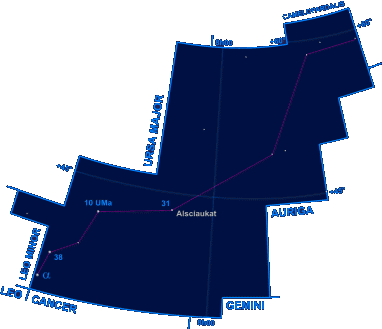
The Wild cat Lynx looks outward and 'upward' from the galactic disc of the Milky Way, out into intergalactic space.
At around the zenith in late winter to spring, you'll notice that you can hardly find out bright stars in where squeezed between Auriga and Ursa Major. For the purpose of filling up the void in sky, Hevelius, an astronomer in Germany invented the constellation of Lynx. He invented many other minor constellations to fill in the blanks like Vulpecula, Leo Minor, etc. Lynx is one of new constellations, it has neither myths nor legend. This picture is carried by turning the north direction rightward. You can see two bright stars at the lower; they're Castor and Pollux in Gemini. And a bright star conspicuously at the lower right is Capella, alpha Aur.
The constellation of Lynx is nothing more than a bumpy line running in north-south direction. The principal star is positioned at the southest one in the line with third magnitude. It should be almost impossible to imagine the figure of a wild cat, and it doesn't have major celestial objects, Lynx is a constellation that has no interest topics.
A compact globular cluster positioned in southwest edge of Lynx is NGC2419. This field is equivalent squeezed by three constellations of Lynx, Gemini and Auriga, it can hardly be found out good guide star around here. You can catch the cluster by tracing your scope about 7 degrees north from Castor in Gemini. This image shows you that two stars with 7th and 8th magnitude are paralleling with the cluster about 3 arc minutes in interval. This globular cluster has no striking features, having an apparent size of 4 arc minutes or so and 10th magnitude, but the cluster has a nickname of "Intergalactic Wanderer", Actually it's estimated that NGC2419 is surprisingly about 300 thousand light years away, this distance is farther than the Magellanic Clouds. It's considered that the cluster is positioned near limit of gravitational sphere of the Galaxy, and it can be regarded that the cluster is floating in the empty space solitarily without belonging to any galaxies. Of course NGC2419 is the most distant one in all globular clusters discovered till now.
NGC2683 is a spiral galaxy lying between constellations of Lynx and Cancer. You can find it about 6 degrees west of alpha Lyn, the southernmost star of Lynx, or 5 degrees north of iota Cnc, the northernmost one in Cancer.
The galaxy has a visual brightness of 10.4 and a long axis of about 9 arc minutes. You're appreciating the galaxy being nearly edge-on, detectable as a dimmed line of light through medium-sized telescopes. But the galaxy is a bit slanted differs from the case of NGC4565, large telescopes can catch arms coiled up and central bulge. And this image shows you the galaxy being somewhat bended. The galaxy of NGC2683 can be said that it's almost only one deep sky object included in a minor spring constellation of Lynx.
MAPPING TECHNIQUE
VISUAL EXERCISE : Two Person Exercise.
DESTINATION : Your Choice
STEP ONE
Traveller : Get comfortable and relax.
STEP TWO
Traveller : Charge your physical body with light energy.
STEP THREE
Traveller : See your visual body standing in front of your physical body and prepare your visual body for interstellar travel with a Interstellar Protection Shield.
STEP FOUR
Traveller : See your visual body filling with light energy.
STEP FIVE
Traveller : Focus your mind on teleporting your visual body to the Your Destination.
STEP SIX
Traveller : Then see your visual body teleporting to the Your Destination.
STEP SEVEN
Traveller : When you arrive in the destination Look around can you see any planets or moons in the System? If not use the Interstellar Planetary Detection Rapid and see if you can detect any planets or moons in that system.
STEP EIGHT
Traveller : If you can see or detect a planet or moon using Telekinesis or Teleportation move towards the planetary body.
STEP NINE
Traveller : When you arrive at the outer atmosphere of the planet or moon stop and ask your spiritual guide to tell you the name of this planet or moon.
Traveller : Tell the mapper the name of the planet or moon. Also tell the mapper all you can about the planet or moon.
STEP TEN
Then us the Core Comparison Crystal Technique to perform a core reading on this planet or moon and give the mapper your reading on this planet or moon
STEP ELEVEN
Traveller : Then levitate or Teleport your visual body to the surface of the planet or moon.
STEP TWELVE
Mapper : When the traveller arrives on the surface ask the following questions.
Is there any plant life or water on the surface of the planet or moon that you can see? Is there an atmosphere around this planet or moon? Is the atmosphere an match with earths atmosphere?
Mapper : Write down the answers to these questions.
PLANETARY DATA FILE 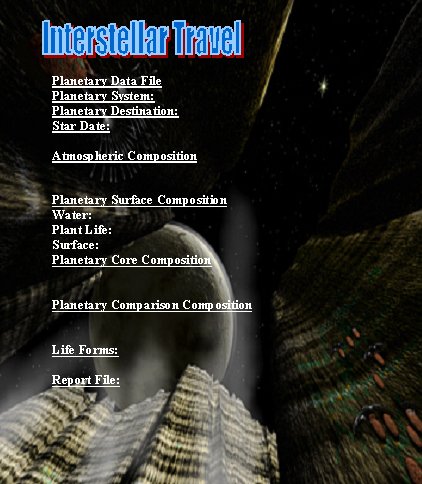
STEP THIRTEEN
Traveller : When you are finished on the surface teleport your visual body to the nearest planetary body that you can see in that Galaxy.
STEP FOURTEEN
Traveller and Mapper : Follow steps nine through to twelve again till you have mapped out the whole Galaxy.
STEP FIFTEEN
Traveller : When you have finished mapping the Galaxy teleport your visual body back to your physical body back on earth.
REMEMBER
When you are travelling if you come across an alien race that you think may be friendly feel free to make contact with that alien race.
IMPORTANT
When you are contacting alien races always be ready to teleport if there is trouble.
MAPPER
Make a note of any planets or moons with an atmospheric match with earths. That way you both know which planets can support human life forms.
MAPPER & TRAVELLER
To check that your mapping of that Galaxy is correct by changing roles and do this exercise again. Also remember to check for life force energy around the planets or moons that you visit on your journeys. Because if you can feel life force energy that means the planet or moons is a real planet or moon.