← The Wingmakers Ways · Astronomy & Exoplanets
Archived page · Checkable
Lyra
Lyra.html · captured from wingmakers.co.nz
LYRA 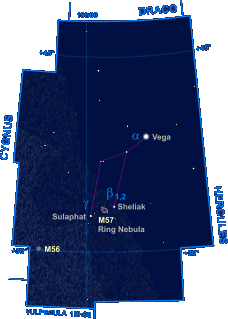
Lyra is one of the ancient musical instruments. The constellation is positioned at the West Side of summer's Milky Way around the zenith, and formed with tiny triangle and parallelogram. This constellation is in the shape of lyre of Orpheus given by his father, Apollo.
The constellation is small and faint, but it's home to the fifth brightest star of Vega with a magnitude of 0, emitting a pure white light. Vega has a mean of "The Falling Eagle", and represents a jewel of Lyra.
The star is also popular in Japan as a heroine of an ancient Chinese legend of "Tanabata".
Myth
One story associates this constellation with Arion's lyre, but most speak of the lyre of Orpheus, a son of the god Apollo and Calliope, one of the muses. He married Eurydice, a nymph who died early in the marriage when bitten by a snake. Orpheus refused all consolation and journeyed to the underworld, armed only with his lyre. Above ground he was capable of charming animals and trees, below ground he charmed Cerberus, the multi-headed dog; Charon, the ferryman over the river Styx; the snake haired Furies; and finally the rulers of the underworld, great Hades and Persephone. They agreed to return Eurydice to the surface provided she would walk behind her husband, and he not look back.
We have yet to hear a story where such instructions get followed. Torn by doubts, Orpheus looked back. We might forgive him, but the powers of the deep never do. Orpheus saw his wife. They reached for each other, but she melted from his grasp. The gates of the deep crashed, closing on Eurydice, and hurling Orpheus on the surface of the earth.
Orpheus wandered alone seven months, singing and playing the lyre. Trees and flowers followed him. Beasts and birds came to listen. A band of women in a drunken frenzy, followers of Dionysus, encountered him. When he would not have sex with them, they tore him limb from limb, scattering his remains and taking his head to the island of Lesbos. The rest of his body received burial in Thrace, where the nightingales now sing more sweetly than anywhere else on earth. Apollo bent down from heaven, gathered the lyre, and placed it in the sky.
In a sequel: At the time of Christ there existed a mystery cult dedicated to Orpheus. Stressing ecstatic experience without the use of alcohol, the members also celebrated the ritualized death of Dionysus.
M56 (NGC6729) is a tiny globular cluster lies near a border between Lyra and Cygnus. You'll be able to see a nebula-like view with telescopes, and you can recognize the individual stars around the edge in good atmospheric condition.
The constellation of Lyra has relatively small area, and two Messier objects in that, M56 and Ring Nebula (M57), are small, too. So it's hard to photograph those with being powerful.
M56 is approximately 34 thousand light years away.
M57 (NGC6720) known as the Ring Nebula, is one of the finest planetary nebula in the skies. It's very popular as "The Doughnut Nebula" in Japan. The ring itself should be clearly visible in medium scopes, and better to have high magnification because of its extremely small size of only 80 arc seconds. The central star with the fifteenth magnitude, which had discharged the gas into space, may take a little longer scope. It is located between beta and gamma Lyrae, and is about 2100 light years away.
This photograph has been taken with a film that has low sensitivity for reddish color. So the image shows you fairly greenish ring that has been emitted by oxygen molecules. Actually the nebula shows us various colors according to brands of photo films, I think the color of this image has comparatively close impression to real view with your own naked eyes.
What appears as a bird's head, leaning over to snatch up a tasty meal, is a striking example of a galaxy collision in NGC 6745. A large spiral galaxy, with its nucleus still intact, peers at the smaller passing galaxy (nearly out of the field of view at lower right), while a bright blue beak and bright whitish-blue top feathers show the distinct path taken during the smaller galaxy's journey. These galaxies did not merely interact gravitationally as they passed one another, they actually collided.
When galaxies collide, the stars that normally comprise the major portion of the luminous mass of each of the two galaxies will almost never collide with each other, but will pass rather freely between each other with little damage. This occurs because the physical size of individual stars is tiny compared to their typical separations, making the chance of physical encounter relatively small. In our own Milky Way galaxy, the space between our Sun and our nearest stellar neighbor, Proxima Centauri (part of the Alpha Centauri triple system), is a vast 4.3 light-years.
However, the situation is quite different for the interstellar media in the above two galaxies - material consisting largely of clouds of atomic and molecular gases and of tiny particles of matter and dust, strongly coupled to the gas. Wherever the interstellar clouds of the two galaxies collide, they do not freely move past each other without interruption but, rather, suffer a damaging collision. High relative velocities cause ram pressures at the surface of contact between the interacting interstellar clouds. This pressure, in turn, produces material densities sufficiently extreme as to trigger star formation through gravitational collapse. The hot blue stars in this image are evidence of this star formation.
MAPPING TECHNIQUE
VISUAL EXERCISE : Two Person Exercise.
DESTINATION : Your Choice
STEP ONE
Traveller : Get comfortable and relax.
STEP TWO
Traveller : Charge your physical body with light energy.
STEP THREE
Traveller : See your visual body standing in front of your physical body and prepare your visual body for interstellar travel with a Interstellar Protection Shield.
STEP FOUR
Traveller : See your visual body filling with light energy.
STEP FIVE
Traveller : Focus your mind on teleporting your visual body to the Your Destination.
STEP SIX
Traveller : Then see your visual body teleporting to the Your Destination.
STEP SEVEN
Traveller : When you arrive in the destination Look around can you see any planets or moons in the System? If not use the Interstellar Planetary Detection Rapid and see if you can detect any planets or moons in that system.
STEP EIGHT
Traveller : If you can see or detect a planet or moon using Telekinesis or Teleportation move towards the planetary body.
STEP NINE
Traveller : When you arrive at the outer atmosphere of the planet or moon stop and ask your spiritual guide to tell you the name of this planet or moon.
Traveller : Tell the mapper the name of the planet or moon. Also tell the mapper all you can about the planet or moon.
STEP TEN
Then us the Core Comparison Crystal Technique to perform a core reading on this planet or moon and give the mapper your reading on this planet or moon
STEP ELEVEN
Traveller : Then levitate or Teleport your visual body to the surface of the planet or moon.
STEP TWELVE
Mapper : When the traveller arrives on the surface ask the following questions.
Is there any plant life or water on the surface of the planet or moon that you can see? Is there an atmosphere around this planet or moon? Is the atmosphere an match with earths atmosphere?
Mapper : Write down the answers to these questions.
PLANETARY DATA FILE 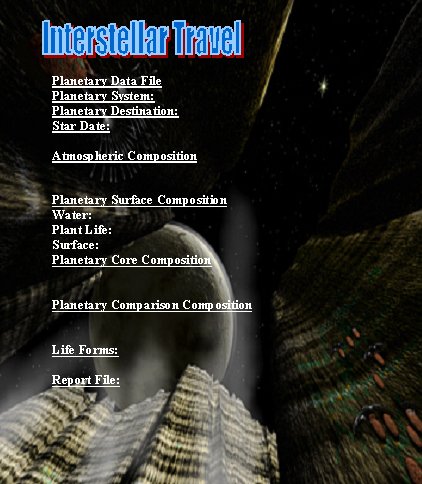
STEP THIRTEEN
Traveller : When you are finished on the surface teleport your visual body to the nearest planetary body that you can see in that Galaxy.
STEP FOURTEEN
Traveller and Mapper : Follow steps nine through to twelve again till you have mapped out the whole Galaxy.
STEP FIFTEEN
Traveller : When you have finished mapping the Galaxy teleport your visual body back to your physical body back on earth.
REMEMBER
When you are travelling if you come across an alien race that you think may be friendly feel free to make contact with that alien race.
IMPORTANT
When you are contacting alien races always be ready to teleport if there is trouble.
MAPPER
Make a note of any planets or moons with an atmospheric match with earths. That way you both know which planets can support human life forms.
MAPPER & TRAVELLER
To check that your mapping of that Galaxy is correct by changing roles and do this exercise again. Also remember to check for life force energy around the planets or moons that you visit on your journeys. Because if you can feel life force energy that means the planet or moons is a real planet or moon.