← The Wingmakers Ways · Astronomy & Exoplanets
Archived page · Checkable
Monoceros
Monoceros.html · captured from wingmakers.co.nz
Monoceros 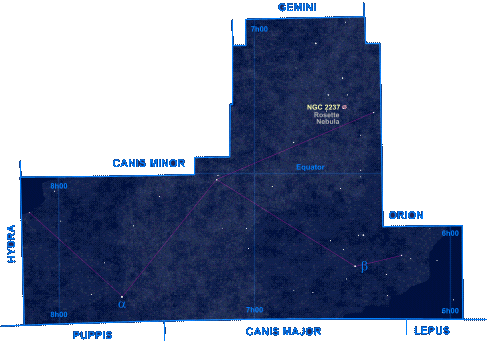
The Unicorn
The constellation of Monoceros, the Unicorn, is often overlooked in the Winter's Great Triangle that is formed by Betelgeuse, Sirius, and Procyon. "Unicorn" is an imaginary animal looks like a horse with a long corn at its head. The constellation was newly established by Bartsch in 17th century.
It might be hard to trace the figure of the beast in the fine Milky Way. But Monoceros includes a few splendid deep sky objects, and it's the Rosette Nebula at the head of the list found around the head of the Unicorn. The nebula is very photogenic; you can see that in this picture. Corn Nebula
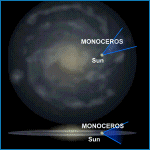
Monoceros lies next to Orion on the band of the Milky Way, and so the area of space it describes is on the plane of our Galaxy. Much of the Milky Way visible in this constellation belongs to the Orion Arm of the Galaxy.
This picture shows you a very distributed open cluster and surrounding nebulosities about 6 degrees north of the Rosette Nebula in Monoceros. A bright bluish star in upper central in image is a variable of S Mon, changing from 4.2 to 4.6 in magnitude. The cluster of NGC2264 is formed from fine stars lying south of S Mon. You can see a bluish reflection nebula just southwest of the variable, and a very very dimmed reddish diffused nebula in the southward. The diffused nebula has a dark cut in southern region; this characteristic structure has given the nebula a nickname of "The Corn Nebula" or "The Christmas Tree", etc. Furthermore, a very gigantic star field including this picture is occupied by pale and reddish nebulosities. The hydrogen gaseous region has a number of NGC2264, same as the open cluster in this image.
A tiny reflection nebula of NGC2261 is positioned at 1 degree SW of nebulosity NGC2264 around the northern region of the Monoceros. NGC2261 is reflecting the light of "R Mon" at the southern edge of the nebula. R Mon changes in magnitude from 11 to 13, and the nebula itself changes the brightness with the variable star. The nebula has a famous nickname of "Hubble's variable nebula".
The nebula has an apparent figure like a flame being spread toward north. You can appreciate the bluish white light like this picture through scopes.
IC2177 is a huge diffused nebula spread around 7 degrees north-east of Sirius, The shape has given a nickname of "The Seagull Nebula". Unfortunately, this nebula hardly be seen with naked eyes same as many other diffused nebulae. The nebula has a length of 2 degrees in north-south direction, only normal photo lenses can detect the shape of seagull clearly.
The catalogue number of IC2177 occupies only area of seagull's wings, and a head is named NGC2327. These gigantic hydrogen clouds are floating about 1800 light-years away. And you can see an open cluster of M50 in upper side of this picture.
M50 (NGC2323) is the only Messier object in this constellation, an open cluster with a size of about 16 arc minutes. You'll find out the cluster near the boundary to Canis Major. Sirius (alpha CMa) is a good mark to search that, about 9 degrees NE of the brightest star in the sky. The cluster contains approximately 100 fine stars, and a nebula-like view will be appreciated through binoculars. Distance is estimated about 2600 light years.
This picture shows you a corner of south west of the constellation of Monoceros. In here you can detect several faint reflection nebulae in a span of about 1 degree. It's considered that those nebulosities is emitting by reflecting light of stars. This picture contains six nebulae; all of those have about 1 to 3 arc minutes in apparent diameter. The gaseous matter of this group of nebulae constitutes the outer region of the Orion Association that is spread out in the constellation of Orion just west of this field.
This image shows you a medium sized open cluster of NGC2301. You can find out about 6.5 degrees southeast of Rosette Nebula in Monoceros. The cluster is floating within the fine Milky Way in winter, you can count about 60 fine stars in 12 arc minutes. The cluster can be enjoyed only with binoculars, has an impression of member stars of even sizes. NGC2301 is in Monoceros in which several dazzling objects like the Rosette Nebula, so the cluster is not taken an attention well.
At around the southern edge of the constellation of Monoceros, NGC2353 is an small open cluster positioned nearby the boundary on Canis Major. The cluster has a visual brightness of 7th magnitude and an apparent diameter of about 20 arc minutes. A famous reddish diffused nebula of "Seagull Nebula (IC2177)" is lying in only 2 degrees west of the tiny cluster. Actually the open cluster is bathed in the extraordinary dimmed gaseous matter that surrounds the Seagull Nebula, but you cannot detect its nebula because of bad condition when this picture was taken. It might be needed small telescopes to appreciate the cluster, rather than binoculars.
The star, named V838 Monocerotis for its location in the constellation of the same name, suddenly grew 600,000 times brighter than the sun in January 2002. The flash temporarily made the star -- in the constellation also known as The Unicorn -- the brightest light in the Milky Way.
Though not the result of a supernova -- a titanic explosion that blasts a giant star into oblivion -- V838 Mon's eruption nevertheless was powerful enough to light up a considerable chunk of its neighborhood.
The nova, a more gradual ejection of stellar material, also provided astronomers with a view to a phenomenon known as "light echo."
"As light from the outburst continues to reflect off the dust surrounding the star, we (can) view continuously changing cross-sections of the dust envelope," said Howard Bond, the lead astronomer, with the Space Telescope Science Institute. "Hubble's sharp view is allowing us to do 'astronomical tomography' of the dust with unprecedented resolution."
MAPPING TECHNIQUE
VISUAL EXERCISE : Two Person Exercise.
DESTINATION : Your Choice
STEP ONE
Traveller : Get comfortable and relax.
STEP TWO
Traveller : Charge your physical body with light energy.
STEP THREE
Traveller : See your visual body standing in front of your physical body and prepare your visual body for interstellar travel with a Interstellar Protection Shield.
STEP FOUR
Traveller : See your visual body filling with light energy.
STEP FIVE
Traveller : Focus your mind on teleporting your visual body to the Your Destination.
STEP SIX
Traveller : Then see your visual body teleporting to the Your Destination.
STEP SEVEN
Traveller : When you arrive in the destination Look around can you see any planets or moons in the System? If not use the Interstellar Planetary Detection Rapid and see if you can detect any planets or moons in that system.
STEP EIGHT
Traveller : If you can see or detect a planet or moon using Telekinesis or Teleportation move towards the planetary body.
STEP NINE
Traveller : When you arrive at the outer atmosphere of the planet or moon stop and ask your spiritual guide to tell you the name of this planet or moon.
Traveller : Tell the mapper the name of the planet or moon. Also tell the mapper all you can about the planet or moon.
STEP TEN
Then us the Core Comparison Crystal Technique to perform a core reading on this planet or moon and give the mapper your reading on this planet or moon
STEP ELEVEN
Traveller : Then levitate or Teleport your visual body to the surface of the planet or moon.
STEP TWELVE
Mapper : When the traveller arrives on the surface ask the following questions.
Is there any plant life or water on the surface of the planet or moon that you can see? Is there an atmosphere around this planet or moon? Is the atmosphere an match with earths atmosphere?
Mapper : Write down the answers to these questions.
PLANETARY DATA FILE 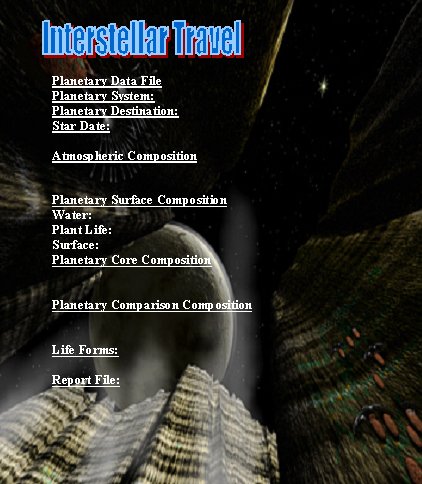
STEP THIRTEEN
Traveller : When you are finished on the surface teleport your visual body to the nearest planetary body that you can see in that Galaxy.
STEP FOURTEEN
Traveller and Mapper : Follow steps nine through to twelve again till you have mapped out the whole Galaxy.
STEP FIFTEEN
Traveller : When you have finished mapping the Galaxy teleport your visual body back to your physical body back on earth.
REMEMBER
When you are travelling if you come across an alien race that you think may be friendly feel free to make contact with that alien race.
IMPORTANT
When you are contacting alien races always be ready to teleport if there is trouble.
MAPPER
Make a note of any planets or moons with an atmospheric match with earths. That way you both know which planets can support human life forms.
MAPPER & TRAVELLER
To check that your mapping of that Galaxy is correct by changing roles and do this exercise again. Also remember to check for life force energy around the planets or moons that you visit on your journeys. Because if you can feel life force energy that means the planet or moons is a real planet or moon.