← The Wingmakers Ways · Astronomy & Exoplanets
Archived page · Checkable
Musca
Musca.html · captured from wingmakers.co.nz
Musca 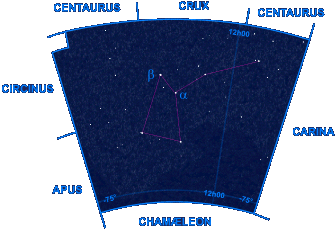
The Fly Derivation
The origins of Musca are difficult to discern. Like its neighbour Crux, this region of the sky was originally included within the bounds of the large constellation Centaurus. Most sources suggest that Johann Bayer added the Fly to the heavens, though some hold Jacob Bartsch responsible. Whomever was responsible, they have left us with a faint star-group containing little of interest.
Stars
Musca lies almost centrally on the band of the Milky Way, and so presents a rich starfield when viewed through binoculars or a telescope. To the unaided eye, though, its stars are rather dim. The brightest, the blue Alpha Muscae, is only of magnitude +2.7, while the Beta star, which is also blue and lies within a few light years of Alpha, is slightly fainter at magnitude +3.0.
This image of MyCn18, a young planetary nebula located about 8,000 light-years away, reveals the true shape of MyCn18 to be an hourglass with an intricate pattern of "etchings" in its walls. This picture has been composed from three separate images taken in the light of ionized nitrogen (represented by red), hydrogen (green), and doubly-ionized oxygen (blue). The results are of great interest because they shed new light on the poorly understood ejection of stellar matter which accompanies the slow death of Sun-like stars. In previous ground-based images, MyCn18 appears to be a pair of large outer rings with a smaller central one, but the fine details cannot be seen.
According to one theory for the formation of planetary nebulae, the hourglass shape is produced by the expansion of a fast stellar wind within a slowly expanding cloud which is more dense near its equator than near its poles. What appears as a bright elliptical ring in the center, and at first sight might be mistaken for an equatorially dense region, is seen on closer inspection to be a potato shaped structure with a symmetry axis dramatically different from that of the larger hourglass. The hot star which has been thought to eject and illuminate the nebula, and therefore expected to lie at its center of symmetry, is clearly off center. Hence MyCn18, as revealed by Hubble, does not fulfill some crucial theoretical expectations.
Hubble has also revealed other features in MyCn18 which are completely new and unexpected. For example, there is a pair of intersecting elliptical rings in the central region which appear to be the rims of a smaller hourglass. There are the intricate patterns of the etchings on the hourglass walls. The arc-like etchings could be the remnants of discrete shells ejected from the star when it was younger (e.g. as seen in the Egg Nebula), flow instabilities, or could result from the action of a narrow beam of matter impinging on the hourglass walls. An unseen companion star and accompanying gravitational effects may well be necessary in order to explain the structure of MyCn18.
BACKGROUND: PLANETARY NEBULAE
When Sun-like stars get old, they become cooler and redder, increasing their sizes and energy output tremendously: they are called red giants. Most of the carbon (the basis of life) and particulate matter (crucial building blocks of solar systems like ours) in the universe is manufactured and dispersed by red giant stars. When the red giant star has ejected all of its outer layers, the ultraviolet radiation from the exposed hot stellar core makes the surrounding cloud of matter created during the red giant phase glow: the object becomes a planetary nebula. A long-standing puzzle is how planetary nebulae acquire their complex shapes and symmetries, since red giants and the gas/dust clouds surrounding them are mostly round. Hubble's ability to see very fine structural details (usually blurred beyond recognition in ground-based images) enables us to look for clues to this puzzle.
NGC 4372 is a rather faint globular cluster one degree SW of gamma Muscae.
NGC 4372 is a fairly large and somewhat faint globular cluster in Musca. In a small telescope it appears as a hazy patch of light that can be difficult if there is much light pollution. In an 8" telescope it is easy to observe and to resolve.
Explanation: After a Sun-like star can no longer support fusion in its core, the center condenses into a white dwarf while the outer atmospheric layers are expelled into space and appear as a planetary nebula. This particular planetary nebula has a quite strange and chaotic structure. The inner part of this nebula contains an unusual expanding ring of gas that we see nearly edge-on. The exact mechanism that expels the planetary nebula gas is a current topic of astronomical speculation and research.
Other Objects in Musca:
NGC 4833 is a fairly bright (8th mag) globular cluster one degree north of delta Muscae.
Planetary Destinations In Musca
MAPPING TECHNIQUE
VISUAL EXERCISE : Two Person Exercise.
DESTINATION : Your Choice
STEP ONE
Traveller : Get comfortable and relax.
STEP TWO
Traveller : Charge your physical body with light energy.
STEP THREE
Traveller : See your visual body standing in front of your physical body and prepare your visual body for interstellar travel with a Interstellar Protection Shield.
STEP FOUR
Traveller : See your visual body filling with light energy.
STEP FIVE
Traveller : Focus your mind on teleporting your visual body to the Your Destination.
STEP SIX
Traveller : Then see your visual body teleporting to the Your Destination.
STEP SEVEN
Traveller : When you arrive in the destination Look around can you see any planets or moons in the System? If not use the Interstellar Planetary Detection Rapid and see if you can detect any planets or moons in that system.
STEP EIGHT
Traveller : If you can see or detect a planet or moon using Telekinesis or Teleportation move towards the planetary body.
STEP NINE
Traveller : When you arrive at the outer atmosphere of the planet or moon stop and ask your spiritual guide to tell you the name of this planet or moon.
Traveller : Tell the mapper the name of the planet or moon. Also tell the mapper all you can about the planet or moon.
STEP TEN
Then us the Core Comparison Crystal Technique to perform a core reading on this planet or moon and give the mapper your reading on this planet or moon
STEP ELEVEN
Traveller : Then levitate or Teleport your visual body to the surface of the planet or moon.
STEP TWELVE
Mapper : When the traveller arrives on the surface ask the following questions.
Is there any plant life or water on the surface of the planet or moon that you can see? Is there an atmosphere around this planet or moon? Is the atmosphere an match with earths atmosphere?
Mapper : Write down the answers to these questions.
PLANETARY DATA FILE 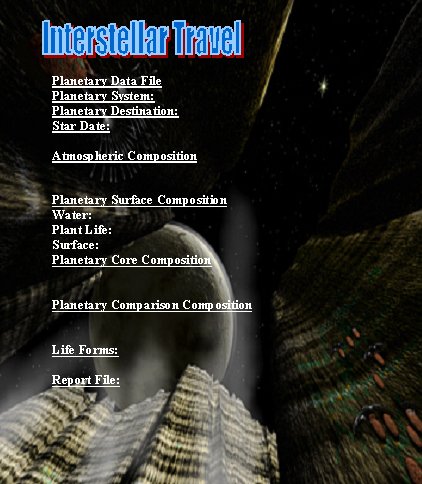
STEP THIRTEEN
Traveller : When you are finished on the surface teleport your visual body to the nearest planetary body that you can see in that Galaxy.
STEP FOURTEEN
Traveller and Mapper : Follow steps nine through to twelve again till you have mapped out the whole Galaxy.
STEP FIFTEEN
Traveller : When you have finished mapping the Galaxy teleport your visual body back to your physical body back on earth.
REMEMBER
When you are travelling if you come across an alien race that you think may be friendly feel free to make contact with that alien race.
IMPORTANT
When you are contacting alien races always be ready to teleport if there is trouble.
MAPPER
Make a note of any planets or moons with an atmospheric match with earths. That way you both know which planets can support human life forms.
MAPPER & TRAVELLER
To check that your mapping of that Galaxy is correct by changing roles and do this exercise again. Also remember to check for life force energy around the planets or moons that you visit on your journeys. Because if you can feel life force energy that means the planet or moons is a real planet or moon.