← The Wingmakers Ways · Astronomy & Exoplanets
Archived page · Checkable
Norma
Norma.html · captured from wingmakers.co.nz
Norma 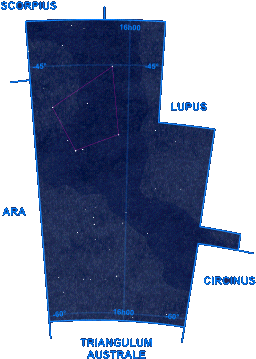
The Level, The Rule
A small constellation lying in the central regions of the Milky Way, and in fact giving its name to one of our Galaxy's minor spiral arms. It contains a number of distant star clusters, but little of interest is visible to the naked eye.
The so-called "ant nebula" (Menzel 3, or Mz 3) resembles the head and thorax of a garden-variety ant. "ant's" body as a pair of fiery lobes protruding from a dying, Sun-like star.
By observing Sun-like stars as they approach their deaths, the Hubble image of Mz 3 � along with pictures of other planetary nebulae � shows that our Sun's fate probably will be more interesting, complex, and striking than astronomers imagined just a few years ago.
Though approaching the violence of an explosion, the ejection of gas from the dying star at the center of Mz 3 has intriguing symmetrical patterns unlike the chaotic patterns expected from an ordinary explosion. Scientists using Hubble would like to understand how a spherical star can produce such prominent, non-spherical symmetries in the gas that it ejects.
One possibility is that the central star of Mz 3 has a closely orbiting companion that exerts strong gravitational tidal forces, which shape the outflowing gas. For this to work, the orbiting companion star would have to be close to the dying star, about the distance of the Earth from the Sun. At that distance the orbiting companion star wouldn't be far outside the hugely bloated hulk of the dying star. It's even possible that the dying star has consumed its companion, which now orbits inside of it, much like the duck in the wolf's belly in the story "Peter and the Wolf."
A second possibility is that, as the dying star spins, its strong magnetic fields are wound up into complex shapes like spaghetti in an eggbeater. Charged winds moving at speeds up to 1000 kilometers per second from the star, much like those in our Sun's solar wind but millions of times denser, are able to follow the twisted field lines on their way out into space. These dense winds can be rendered visible by ultraviolet light from the hot central star or from highly supersonic collisions with the ambient gas that excites the material into florescence.
No other planetary nebula observed by Hubble resembles Mz 3 very closely. M2-9 comes close, but the outflow speeds in Mz 3 are up to 10 times larger than those of M2-9. Interestingly, the very massive, young star, Eta Carinae, shows a very similar outflow pattern.
NGC 6067 is a cluster of about a hundred tenth-magnitude stars. This cluster is in the same field as kappa Normae, just to the north of this star.
NGC 6087 is another cluster, some 3500 light years away, comprised of forty or so stars, ranging from 7-10 magnitude. The group is two degrees east of iota1; it includes the cepheid variable S Normae.
NGC 6165 is a planetary nebula, rather bright and perfectly circular with a 13 magnitude star in its centre. The planetary nebula is five degrees west-southwest of gamma2 Normae.
MAPPING TECHNIQUE
VISUAL EXERCISE : Two Person Exercise.
DESTINATION : Your Choice
STEP ONE
Traveller : Get comfortable and relax.
STEP TWO
Traveller : Charge your physical body with light energy.
STEP THREE
Traveller : See your visual body standing in front of your physical body and prepare your visual body for interstellar travel with a Interstellar Protection Shield.
STEP FOUR
Traveller : See your visual body filling with light energy.
STEP FIVE
Traveller : Focus your mind on teleporting your visual body to the Your Destination.
STEP SIX
Traveller : Then see your visual body teleporting to the Your Destination.
STEP SEVEN
Traveller : When you arrive in the destination Look around can you see any planets or moons in the System? If not use the Interstellar Planetary Detection Rapid and see if you can detect any planets or moons in that system.
STEP EIGHT
Traveller : If you can see or detect a planet or moon using Telekinesis or Teleportation move towards the planetary body.
STEP NINE
Traveller : When you arrive at the outer atmosphere of the planet or moon stop and ask your spiritual guide to tell you the name of this planet or moon.
Traveller : Tell the mapper the name of the planet or moon. Also tell the mapper all you can about the planet or moon.
STEP TEN
Then us the Core Comparison Crystal Technique to perform a core reading on this planet or moon and give the mapper your reading on this planet or moon
STEP ELEVEN
Traveller : Then levitate or Teleport your visual body to the surface of the planet or moon.
STEP TWELVE
Mapper : When the traveller arrives on the surface ask the following questions.
Is there any plant life or water on the surface of the planet or moon that you can see? Is there an atmosphere around this planet or moon? Is the atmosphere an match with earths atmosphere?
Mapper : Write down the answers to these questions.
PLANETARY DATA FILE 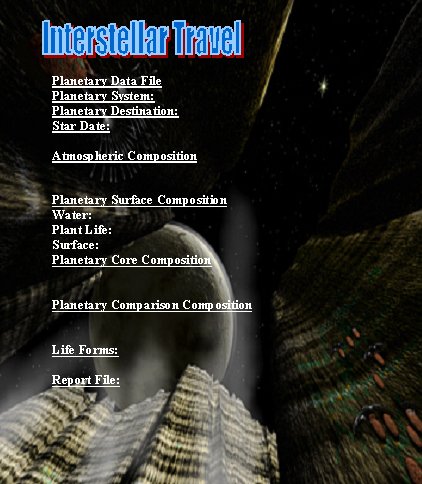
STEP THIRTEEN
Traveller : When you are finished on the surface teleport your visual body to the nearest planetary body that you can see in that Galaxy.
STEP FOURTEEN
Traveller and Mapper : Follow steps nine through to twelve again till you have mapped out the whole Galaxy.
STEP FIFTEEN
Traveller : When you have finished mapping the Galaxy teleport your visual body back to your physical body back on earth.
REMEMBER
When you are travelling if you come across an alien race that you think may be friendly feel free to make contact with that alien race.
IMPORTANT
When you are contacting alien races always be ready to teleport if there is trouble.
MAPPER
Make a note of any planets or moons with an atmospheric match with earths. That way you both know which planets can support human life forms.
MAPPER & TRAVELLER
To check that your mapping of that Galaxy is correct by changing roles and do this exercise again. Also remember to check for life force energy around the planets or moons that you visit on your journeys. Because if you can feel life force energy that means the planet or moons is a real planet or moon.