← The Wingmakers Ways · Astronomy & Exoplanets
Archived page · Checkable
2003-BLG-235
OGLE_2003-BLG-235.html · captured from wingmakers.co.nz
OGLE 2003-BLG-235
Planetary System 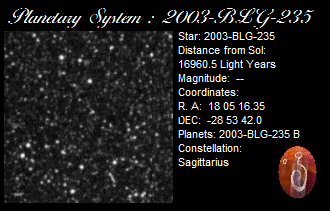
Introduction
The discovery was made possible through cooperation between two international research teams -- Microlensing Observations in Astrophysics, or MOA, and Optical Gravitational Lensing Experiment, or OGLE. The newly discovered star-planet system is 17,000 light years away, in the constellation Sagittarius. The planet, orbiting a red dwarf parent star, is most likely one-and-a-half times bigger than Jupiter. The planet and star are three times farther apart than Earth and the Sun.Together, they magnify a farther, background star some 24,000 light years away, near the Milky Way center.
Magnification map of the lensing system in OGLE 2003-BLG-235/MOA 2003-BLG-53 .
Magnification map of the lensing system in OGLE 2003-BLG-235/MOA 2003-BLG-53 (projected on the sky). The dark to bright regions show progressively higher magnifications. The source star moves from left to right along the trajectory shown as the series of dots. Each dot represents a single measurement from either OGLE (red) or MOA (blue). The magnification is locally greatest when the source star crosses the boundary of the caustic region. The definitions of the parameters u0 and ? are shown along with the positions, on the map, of the star and planet components of the lens
The Virtues of Microlensing
The detection of an extrasolar planet by means of microlensing is certainly a cause for celebration in planet hunting circles. The technique was first proposed by Dr. Boghdan Paczynski of Princeton University in 1991, but all previous claims of a successful detection have proved inconclusive. �I am thrilled to see the prediction come true with this first definite planet detection through gravitational microlensing� said Paczynski, now a member of the OGLE team.
The location in the sky where OGLE 2003-BLG-235 was detected.
Due to the rarity of microlensing events, the new technique is unlikely to detect planets orbiting any specific known stars. It does, nevertheless, offer important advantages over other detection methods. First there is the matter of its range, which makes it possible to detect planets at unheard-of distances, and potentially even in other galaxies. A second advantage is that microlensing searches detect planets by constantly imaging specific regions of the sky. While the microlensing events are rare, they are nevertheless statistically consistent, and could make it possible for astronomers to extrapolate from planetary detections and estimate how common planets really are in the galaxy. Finally, in the words of Dr. Ian Bond of the Institute for Astronomy at the University of Edinburgh, who is also lead author of the recent paper, �the real strength of microlensing is its ability to detect low mass planets.� In other words, microlensing just might give us the first clues to the existence of Earth-like planets outside our Solar System.
The detection of distant planets through microlensing is made possible by combining the high theory of Einstein�s relativity with the cutting edge technology of digital CCD cameras. Neither the theory nor the technology would be sufficient by itself, but together they offer us a glimpse of worlds thousands of light-years away. OGLE 2003-BLG-235 is the first planet discovered by microlensing, but many are sure to follow, giving us a new and deeper understanding of our place in the universe.
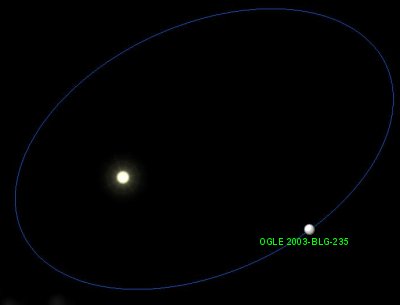
Planetary Orbit Of OGLE 2003-BLG-235