← The Wingmakers Ways · Astronomy & Exoplanets
Archived page · Checkable
Ophiuchus
Ophiuchus.html · captured from wingmakers.co.nz
Ophiuchus 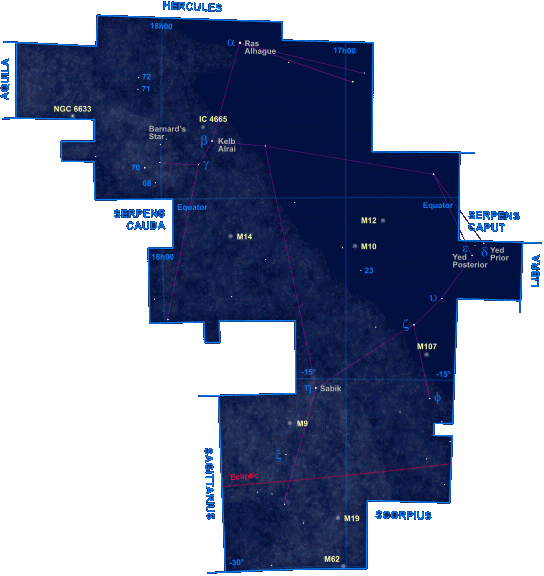
The Serpent Holder
Derivation:
The group of stars has been known by the name Ophiuchus for two thousand years or more. What is not known, though, is why the name 'Serpent Holder' was assigned to them. Some suggest that the constellation represents Asclepius or Aesculapius, the healer of Greek myth whose cult was closely associated with serpents. This identification is by no means certain.
Stars:
Ophiuchus is a large constellation (the eleventh largest in the sky), and contains a number of bright stars. The star designated Alpha Ophiuchi is Ras Alhague, a fairly nearby star with a name that means 'Head of the Serpent Holder'. There are four other stars above third magnitude: in descending order of brightness, these are Sabik, Zeta Ophiuchi, Yed Prior and Kelb Alrai.
More famous than any of these is Barnard's Star, which lies just under six light years from Earth, and is one of the Sun's closest neighbours. It is a very small and faint red star of the type known as subdwarfs, so that despite being so nearby, it is invisible to the naked eye.
Star Clusters:
Ophiuchus abounds with Globular Clusters, and though none can be seen with the naked eye, Messier 10 is quite easy to make out with even a small telescope. Other similar star clusters in this constellation are M12, M19, M62 and M107.
These Globular Clusters are very distant objects, with the nearest (M10) being more than 14,000 light years from Earth. Nearer to home, at just 1,000 light years, a bright open cluster can be seen near Ophiuchus' border with Serpens Cauda. This is NGC 6633.
The Thirteenth Sign of the Zodiac:
When the zodiac was first delineated by the ancients, it consisted of twelve 'houses', each associated with one of twelve constellations that lay along the Ecliptic: Aries, Taurus, Gemini, Cancer, and so on. Since that time, gravitational effects on the orbit of the Earth, known as 'precession', have caused the line of the Ecliptic to change slightly. Specifically, it now passes through thirteen constellations, with Ophiuchus being the new addition. Where the Sun once passed directly from Scorpius into Sagittarius, it now spends nineteen days each year, from 30 November to 18 December, in the new 'house' of the Serpent Holder. 
In combination with its neighbour Sagittarius, the constellation of Ophiuchus encloses the central regions of our Milky Way Galaxy.
The Star
A very cool and dim, main sequence red dwarf (M3.8 Ve), Barnard's Star may have less than 17 percent of Sol's mass (RECONS estimate), 15 percent of its diameter (Ochsenbein and Halbwachs, 1982, page 529), around 4/10,000th of its luminosity, and between 10 and 32 percent of its abundance of elements heavier than hydrogen -- "metallicity" (John E. Gizis, 1997, page 820). According to calculations by Dr. Sten Odenwald, substituting Barnard's Star for Sol would give the Earth such a dim and very red Sun that it would only be 100 times brighter than the Full Moon, and so the planet would freeze solid at the surface.
Unlike Sol, Barnard's appears to be an old disk star that formed before the galaxy became much enriched with heavy elements (Monet et al, 1992, page 655). While the star may already be around 10 billion years old, it may last another another 40 billion years or more before cooling into a black dwarf. A small star spot that was shrinking in size may have been observed on Barnard's recently with the Hubble Space Telescope (Benedict et al, 1998). Barnard's is a New Suspected Variable star designated NSV 9910. Some other useful star catalogue numbers include: Gl 699, Hip 87937, BD+04 3561a, LHS 57, LTT 15309, LFT 1385, G 140-24, Vys/McC 799, and Munich 15040.
M9 is a compact globular cluster floating in the Milky Way about 3.5 degrees southeast of zeta Oph around underfoot of Serpent holder. Although the globular cluster has not so high stellar density, it has a diameter of at most 6 arc minutes. Small scopes cannot show you individual member stars although you will be able to appreciate a bright light spot like a nebula. This image shows you dark region without stars just southwest side of the cluster, it's a part of huge dark nebulosities distributed around the Milky Way.
M10 (NGC6254) is a small globular cluster found out at body of Ophiuchus. It looks like tiny explosions of star with dense core; large telescopes are needed to resolve the individual stars.
The cluster has real size of about 85 light years, and about 16 thousand light years away.
M12 is a medium-sized globular cluster found in the pentagon of a constellation of Ophiuchus. The cluster is positioned at 3.5 degrees northwest of another globular of M10, and C. Messier discovered M12 just next day when he found M10. M12 is a globular that member stars are gathering very sparse, and you will be able to understand the fact if you compare that with M10. You can appreciate several star-chains are extending outward from the center with about 5 inches telescopes. Although the Ophiuchus pentagon contains three Messier's Globular clusters, it can be said that you can enjoy the M12 most easily in those.
M14 is a small sized globular cluster, easternmost in three globulars with Messier's number (M10, M12 and M14) in a pentagon of Ophiuchus. M14 is lying at the west coast of the Milky Way in summer; so uncountable fine stars surround the cluster.
The cluster has a fairly stellar density, you might need a telescope over 4" to resolve the individual stars. The cluster has a real size of about 55 light years and a distance of 23 thousand light years.
This image shows you a small globular cluster of M19 lying around boundary between Ophiuchus and Scorpius. Although M19 belongs to a constellation of Ophiuchus, you can find out the cluster by tracing about 7.5 degrees east from Antares, alpha Scorpii. The cluster has very low density of member stars; only compact binocular can show you a nebula like image with a bit coarse impression, and you can recognize individual stars on outskirts only with small telescopes.
Almost all of globular clusters have round shapes, some of those look like ellipse. This M19 has very long and narrow oval shape, you can see the cluster stretched in north south direction clearly.
M62 is a tine globular cluster positioned almost on the boundary line between Scorpius and Ophiuchus. Another globular cluster of M19, lying about 4 degrees north of M62, has almost same declination with that of Antares, so you can find M62 by tracing from Antares via M19 easily. The globular cluster has a visual magnitude of 6.6 and a diameter of about 4.3 arc minutes, almost same as those of M19. But M19 has fairly smashed oval while this M62 has circular appearance. Furthermore by adding another bright globular of M4 lying just west of Antares, you will become aware of that globular clusters have unexpectedly variety of impressions.
A tiny globular cluster of M107 is positioned at 2.6 degrees SSW of zeta Oph. The cluster has an apparent diameter of a bit larger than 2 arc minutes and a visual brightness of about 9, you can able to see it like a nebula only with binoculars. M107 has a concentration class of the tenth in twelve levels, fairly sparse globular. But the cluster is very small, so it's difficult to resolve member stars even if you see it through telescopes. There are various globular clusters around the field of Scorpius to Ophiuchus. M107 has a fairly poor appearance in those.
This image shows you a compact but easy-to-seeing planetary nebula of NGC6572, which is positioned in eastern region of Ophiuchus. You can find it around 11 degrees SE of alpha Oph, Ras Alhague. The nebula has an apparent size of about 15 arc seconds, you can distinguish NGC6572 from other stars and detect the nebula having bluishcolor only with compact telescopes, but no striking structures detected. NGC6572 is a remnant of star 2500 light years away.
IC4665 is a very sparse open cluster scattered at about a degree north of beta Oph. The cluster has a apparent diameter of about 40 arc minutes, you can enjoy that with a portable binocular. This IC4665 has only 13 member stars. Outward looks of the cluster would be almost same as the Milky Way flowing just next on east. But the cluster has a sufficient big size; we can take it only with small photo lenses easily
This Milky Way field image shows you very complicated dark nebulae around between Sagittarius and Scorpius. Especially it's noticeable a striking dark flow from the Milky Way to north of Antares, alpha Sco. You can find rho Ophiuchi at the western end of the flow and dimmed bluish light is being emitted. This diffused nebula has a number of IC4603-4, just a tiny part of the vast dark nebula stream. And there are many other red and orange diffused nebulae around Antares, one of most colorful, beautiful, and photogenic star fields in heavens. You can detect a huge lump of dark nebula stretched in east-west direction on the left-hand side of picture. The dark nebula has a span of about 7 degrees and real length is estimated about 100 light years. You can appreciate the nebula as a big hole in the Milky Way only with binoculars under conditioned sky. This patch in the Milky Way has a catalogue number of "LDN 1773" and a nickname of "Pipe Nebula" from its shape.
A gigantic and round diffused nebula is spread around zeta Oph, which marks a foot of Serpent Holder. Of course the nebula is invisible for our naked eyes. We can see the nebula only on long exposed films under good conditioned sky with medium-ranged telephoto lenses like the Angelfish nebula in Orion. Many sky atlases have forgotten to record the shape of this nebula, it can be said that the nebula is not well known. And the nebula was discovered after astrophotography has been developed, has no major catalogue numbers. Though it's getting harder and harder to capture it under recent terrible light pollution year after year, this picture shows you some complicated structures of lanes of dark nebulae and various shading.
MAPPING TECHNIQUE
VISUAL EXERCISE : Two Person Exercise.
DESTINATION : Your Choice
STEP ONE
Traveller : Get comfortable and relax.
STEP TWO
Traveller : Charge your physical body with light energy.
STEP THREE
Traveller : See your visual body standing in front of your physical body and prepare your visual body for interstellar travel with a Interstellar Protection Shield.
STEP FOUR
Traveller : See your visual body filling with light energy.
STEP FIVE
Traveller : Focus your mind on teleporting your visual body to the Your Destination.
STEP SIX
Traveller : Then see your visual body teleporting to the Your Destination.
STEP SEVEN
Traveller : When you arrive in the destination Look around can you see any planets or moons in the System? If not use the Interstellar Planetary Detection Rapid and see if you can detect any planets or moons in that system.
STEP EIGHT
Traveller : If you can see or detect a planet or moon using Telekinesis or Teleportation move towards the planetary body.
STEP NINE
Traveller : When you arrive at the outer atmosphere of the planet or moon stop and ask your spiritual guide to tell you the name of this planet or moon.
Traveller : Tell the mapper the name of the planet or moon. Also tell the mapper all you can about the planet or moon.
STEP TEN
Then us the Core Comparison Crystal Technique to perform a core reading on this planet or moon and give the mapper your reading on this planet or moon
STEP ELEVEN
Traveller : Then levitate or Teleport your visual body to the surface of the planet or moon.
STEP TWELVE
Mapper : When the traveller arrives on the surface ask the following questions.
Is there any plant life or water on the surface of the planet or moon that you can see? Is there an atmosphere around this planet or moon? Is the atmosphere an match with earths atmosphere?
Mapper : Write down the answers to these questions.
PLANETARY DATA FILE 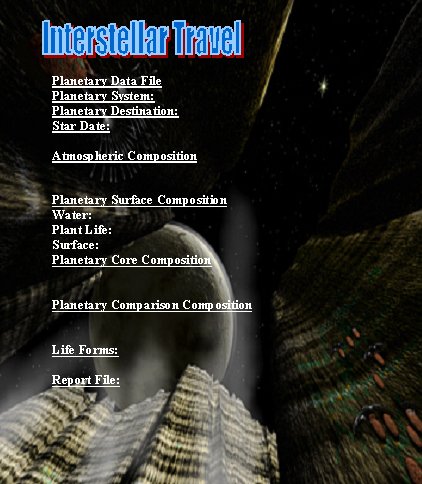
STEP THIRTEEN
Traveller : When you are finished on the surface teleport your visual body to the nearest planetary body that you can see in that Galaxy.
STEP FOURTEEN
Traveller and Mapper : Follow steps nine through to twelve again till you have mapped out the whole Galaxy.
STEP FIFTEEN
Traveller : When you have finished mapping the Galaxy teleport your visual body back to your physical body back on earth.
REMEMBER
When you are travelling if you come across an alien race that you think may be friendly feel free to make contact with that alien race.
IMPORTANT
When you are contacting alien races always be ready to teleport if there is trouble.
MAPPER
Make a note of any planets or moons with an atmospheric match with earths. That way you both know which planets can support human life forms.
MAPPER & TRAVELLER
To check that your mapping of that Galaxy is correct by changing roles and do this exercise again. Also remember to check for life force energy around the planets or moons that you visit on your journeys. Because if you can feel life force energy that means the planet or moons is a real planet or moon.