← The Wingmakers Ways · Astronomy & Exoplanets
Archived page · Checkable
Perseus
Perseus.html · captured from wingmakers.co.nz
Perseus 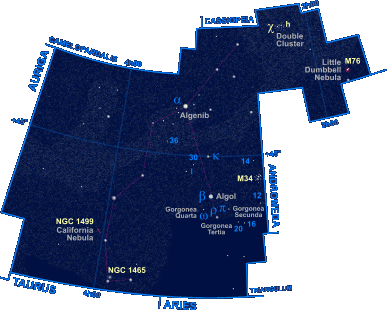
Perseus is a hero in the myth of ancient Ethiopian story; he rescued Princess Andromeda from the monster Tiamat (constellation of Cetus). He holds a sword in his left hand and a head of Medusa in right one. The asterism consists of plenty of bright and faint stars because of being just bathed in the Milky Way. Beta Persei "Algol", that marks the Medusa's eye is a noticeable eclipsing binary system, changing from 2.2 to 3.5 every about 3 days. The name itself means "The Demon's head". And the constellation is also famous for a major meteoric swarm, the Gamma Persei, it has the peak of appearance in the middle of August every year, you can appreciate from 60 to 120 meteors per hour.
At just center of the Milky Way between Perseus and Cassiopeia, you'll be fascinated with a splendid pair of open clusters well known as "The Double Cluster". They're drawing close side by side, easily seen by naked eye or binoculars.
West (right-hand side) and east (left-hand side) ones are NGC884 and NGC869 respectively, and there is one more pair-name of "h" and "kai", this is traces that Bayer, a German amateur astronomer, had named these clusters as stars in 1603. Distances of these clusters are 7330 light years, and are both considered babies about 4 or 5 million years old.
The Double Cluster is the kernel of "The Perseus 1st Association", one of the inner-Galaxy fields include rich inter-stellar matter, and a Galaxy's arm includes the association is called "The Perseus arm".
NGC1499, The California Nebula, is a faint diffused red nebula one-degree north of zeta Persei, and stretching itself in an east-west direction. It's about 2000 light-years away, and you can see zeta Persei as a bright star just south of the nebula. This nickname has came from its figure resembles the California in USA. Plenty of dark filaments crossing over the nebula are captured into films with larger telescopes, and you'll know that this object has very complicated structure. Unfortunately it's extremely faint and difficult to view with naked eyes.
M34 (NGC1039) is a fine open cluster about five degrees NW of a famous variable star, Algol (beta Persei). You can detect the cluster with naked eye as a dimmed lump of light. It's containing about 60 stars, about 10 bright stars are noticeable with lots of faint stars as a background through binoculars. Its distance is about 1400 light-years.
M76 is a tiny planetary nebula at around the midway of alpha Cas and gamma And. Though M76 belongs to the constellation of Perseus, you can find the nebula easily by using of 51 Andromedae (tip of right toe of Princess) as pilotage. The nebula lies about 3 degrees NNE from it.
M76 has a nickname of "Little Dumb-bell Nebula" because the shape is very similar to shrinked Dumb-bell Nebula (M27) in Vulpecula. The nebula is very dimmed, so it might be needed large-sized telescope to enjoy the shape of M76.
The nebula is estimated about 8000 light years from the solar system.
The Perseus is an autumn constellation bathed in the Milky Way. Therefore uncountable fine stars are scattered in the area of the constellation. You can see alpha Persei, Mirfak, with the second magnitude in the center of this picture. And you might notice that many bright stars are getting together around alpha Persei with binoculars, actually those stars form an open cluster, has been given a number of Mel.20, the cluster is spread about three degrees.
The splendid cluster can be enjoyed with small binoculars, and you can appreciate several stellar-lines stretching outward from the central star of alpha Persei. Some ones are straight, and some others are warped, it should be extremely impressive views.
NGC1023 is a medium-sized galaxy lying near boundary on Andromeda. You can find out just 3.5 degrees south of an open cluster of M34. The galaxy has an apparent shape of ellipse stretching in east west direction, and has a bright nucleus and surrounding dimmed light. The galaxy has a long axis of about 9 arc minutes and a brightness of about 10.4 in magnitude.
Around the southern region of Perseus, this compact open cluster can be found about 4 degrees west of California Nebula (NGC1499). The cluster is sandwiched in two major scenic spots in the winter skies of California Nebula (in east) and the Pleiades (in north). But NGC1342 is a very commonplace object with a diameter of 14 arc minutes and a magnitude of 6.7; it can hardly be paid attention.
Although this photo shows the cluster is fairly sparse because that was taken with a focal length of 1200mm, you will be able to appreciate a pretty group of stars with binoculars.
You can appreciate an attractive open cluster of NGC1528 about 8 degrees east of alpha Persei. The constellation of Perseus is ornamented by some superb clusters of The Double Cluster, M34 etc. And of course the cluster of NGC1528 should be included in those splendid objects.
The cluster is just bathed in the Milky Way; it's easy to detect snuggling members of the cluster only with portable binoculars. You'll be able to count about 80 fine stars spreading into 24 arc minutes or so. And this picture shows you another reddish nebula of NGC1491 about 2 degrees west of NGC1528. We cannot appreciate the H-alpha emission nebula with naked eyes. The minor nebula has a diameter of about 3 arc minutes, being nearly a perfect circle.
A compact reflection nebula of IC348 lies just south of omicron Persei, glittering around center of this picture. IC348 has an apparent diameter of about 10 arc minutes; this field is about midway between the California nebula and the Pleiades. And this image includes an extraordinary faint reddish diffused nebula around right of IC348 and a vast dark nebulosity in south of the reflection nebula. It's considered that these faint gaseous clouds are single lump floating in the inner-galactic space; IC348 is emitting white light by reflecting the light of neighbored star.
At the star field about 2 degrees ENE of Algol, you can find out a galactic cluster of Perseus I (Abell 426) containing several tens small galaxies. All dimmed lights captured in this image with a span of 1 degree are member galaxies belonging to the cluster.
You can recognize some fairly large galaxies of NGC1272, 1275 and 1278 in central region of cluster. And it's estimated that the galactic cluster is about 230 millions light years away.
MAPPING TECHNIQUE
VISUAL EXERCISE : Two Person Exercise.
DESTINATION : Your Choice
STEP ONE
Traveller : Get comfortable and relax.
STEP TWO
Traveller : Charge your physical body with light energy.
STEP THREE
Traveller : See your visual body standing in front of your physical body and prepare your visual body for interstellar travel with a Interstellar Protection Shield.
STEP FOUR
Traveller : See your visual body filling with light energy.
STEP FIVE
Traveller : Focus your mind on teleporting your visual body to the Your Destination.
STEP SIX
Traveller : Then see your visual body teleporting to the Your Destination.
STEP SEVEN
Traveller : When you arrive in the destination Look around can you see any planets or moons in the System? If not use the Interstellar Planetary Detection Rapid and see if you can detect any planets or moons in that system.
STEP EIGHT
Traveller : If you can see or detect a planet or moon using Telekinesis or Teleportation move towards the planetary body.
STEP NINE
Traveller : When you arrive at the outer atmosphere of the planet or moon stop and ask your spiritual guide to tell you the name of this planet or moon.
Traveller : Tell the mapper the name of the planet or moon. Also tell the mapper all you can about the planet or moon.
STEP TEN
Then us the Core Comparison Crystal Technique to perform a core reading on this planet or moon and give the mapper your reading on this planet or moon
STEP ELEVEN
Traveller : Then levitate or Teleport your visual body to the surface of the planet or moon.
STEP TWELVE
Mapper : When the traveller arrives on the surface ask the following questions.
Is there any plant life or water on the surface of the planet or moon that you can see? Is there an atmosphere around this planet or moon? Is the atmosphere an match with earths atmosphere?
Mapper : Write down the answers to these questions.
PLANETARY DATA FILE 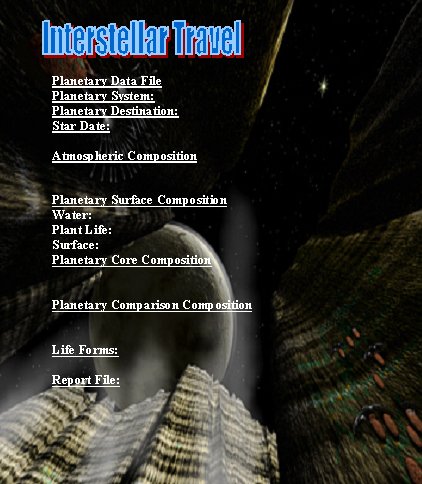
STEP THIRTEEN
Traveller : When you are finished on the surface teleport your visual body to the nearest planetary body that you can see in that Galaxy.
STEP FOURTEEN
Traveller and Mapper : Follow steps nine through to twelve again till you have mapped out the whole Galaxy.
STEP FIFTEEN
Traveller : When you have finished mapping the Galaxy teleport your visual body back to your physical body back on earth.
REMEMBER
When you are travelling if you come across an alien race that you think may be friendly feel free to make contact with that alien race.
IMPORTANT
When you are contacting alien races always be ready to teleport if there is trouble.
MAPPER
Make a note of any planets or moons with an atmospheric match with earths. That way you both know which planets can support human life forms.
MAPPER & TRAVELLER
To check that your mapping of that Galaxy is correct by changing roles and do this exercise again. Also remember to check for life force energy around the planets or moons that you visit on your journeys. Because if you can feel life force energy that means the planet or moons is a real planet or moon.