← The Wingmakers Ways · Astronomy & Exoplanets
Archived page · Checkable
Pisces
Pisces.html · captured from wingmakers.co.nz
Pisces 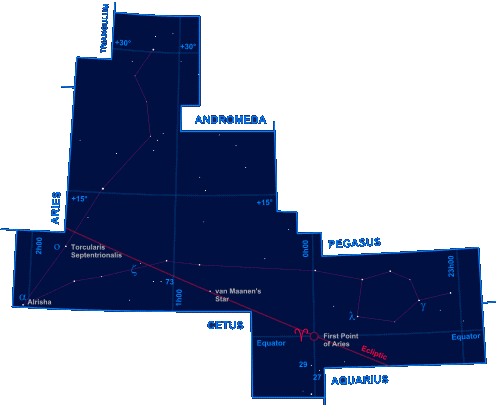
The Fishes
Pisces seems to be one of the oldest constellations in the sky. The ancient Syrians saw this region as representing two fishes bound by a cord, one fleeing toward the western horizon and one fleeing northward. This peculiar image was adopted by the Egyptians, who saw the fish as swimming from Set, the evil brother of Osiris. The Greeks adapted the story again - for them, one fish was Aphrodite, the other her son Eros, and both were escaping the giant Typhon.
Stars
Despite its fame, its size, and its prominence as a zodiacal constellation, the stars of Pisces are largely disappointing. Alpha Piscium is a star otherwise known as Alrisha, 'the Cord', which represents the point where the two fishes' cords meet.
Alrisha is the not the brightest of Pisces' stars, though: that honour goes to Gamma Piscium, which lies in the westward 'fish'. This is an irregular hexagon of stars which, though dim, are recognisable by their characteristic shape. The northern fish is much less well defined, being a faint straggle of stars in the direction of Andromeda.
Pisces and the Ecliptic
The Ecliptic passes through Pisces for some 37° (about a tenth) of its length, though at one point it passes within less than 9 arc minutes of the neighbouring constellation Cetus. The Sun enters this constellation on 12 March each year, and remains within it for 37 days, crossing the border into Aries on 18 April.
These dates mean that the Vernal Equinox occurs while the Sun is within the boundaries of Pisces, on or about 20 March each year. The exact point in the sky where the Sun is located when this happens is, for historical reasons, termed the First Point of Aries. This point marks the Celestial Meridian (that is, zero hours Right Ascension), and is the starting point for the mapping of the celestial sphere. 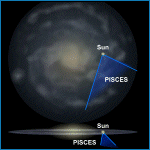
Pisces is a large constellation, but one that falls somewhat outside the plane of the Milky Way Galaxy.
Constellation of Pisces is an autumnal zodiac positioned at next to Aquarius. The constellation is depicted as two fishes connected their tails at alpha Picium, "Al Rischa" meaning of a knot. It's rather faint, and is hard to follow the series of dimmed stars. The sun crosses the celestial equator just around the tail of the western fish; in fact the vernal equinox is included in Pisces now. The vernal equinox is established as the right ascension of zero, and Pisces must be the first zodiac. But in the times of ancient Babylonia, the vernal equinox was lied in east neighbored Aries, so Pisces is registered as the last zodiac in the astrology even now.
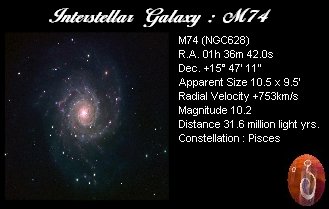
M74 (NGC628) is only Messier's object in the constellation of Pisces. You can find that at about 1 degree east of eta Piscium. The galaxy has a size of 10 arc minutes and about 10th magnitude, it's a very faint spiral galaxy being face on, one of the faintest in Messier's catalogue. It's fairly difficult work to recognize the galaxy with a medium-sized telescope unless you have extremely good-conditioned night.
Long exposure photographs show two loosely-wound spirals out from a tiny bright nucleus. The galaxy is 31 million light years away.
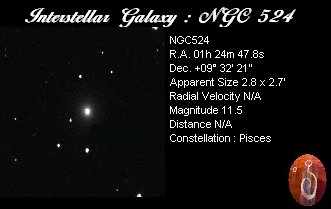
NGC524 is a small lenticular galaxy positioned around midway of two fishes of the constellation of Pisces. It has a circular form with a diameter of less than 3 arc minutes. We can detect a bright central bulge through telescopes. This star field around NGC524 contains ten or more small, but comparatively easy-to-see galaxies. They're forming a small scaled galaxy group in real space. NGC524 is a principal member of this group; this image shows you some other member galaxies.
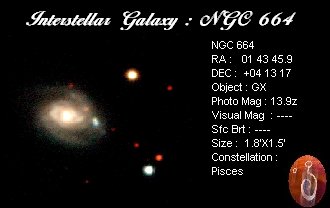
Long ago in a galaxy far, far away, locked in their final desperate struggle against the force of gravity ... two stars exploded! stellar explosions - Supernovae - are among the most powerful events in the Universe, estimated to release an equivalent energy of up to 1 million trillion trillion (1 followed by 30 zeros) megatons of TNT. After the explosion, an expanding supernova envelope is observed to brighten over a a period of days to a maximum light output which rivals that of an entire galaxy before fading from view over the following months. Triggered by the collapsing core of a massive star or the nuclear demise of a white dwarf supernovae occur in average spiral galaxies only about once every 25-100 years. But a recent observation of NGC 664, a spiral galaxy about 300 million light years distant, captured a rare and colorful performance - two supernovae from the same galaxy. In this monitoring exposure the two supernovae, one reddish yellow and one blue, form a close pair just below the image center (to the right of the galaxy nucleus). The color difference is due to temperature - blue is hotter.
Planetary Destinations In Pisces
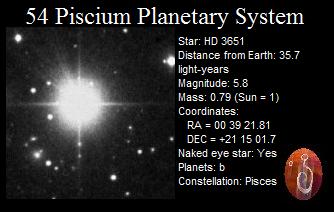
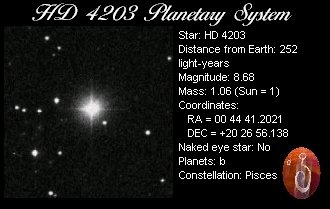
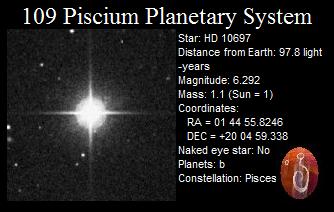
MAPPING TECHNIQUE
VISUAL EXERCISE : Two Person Exercise.
DESTINATION : Your Choice
STEP ONE
Traveller : Get comfortable and relax.
STEP TWO
Traveller : Charge your physical body with light energy.
STEP THREE
Traveller : See your visual body standing in front of your physical body and prepare your visual body for interstellar travel with a Interstellar Protection Shield.
STEP FOUR
Traveller : See your visual body filling with light energy.
STEP FIVE
Traveller : Focus your mind on teleporting your visual body to the Your Destination.
STEP SIX
Traveller : Then see your visual body teleporting to the Your Destination.
STEP SEVEN
Traveller : When you arrive in the destination Look around can you see any planets or moons in the System? If not use the Interstellar Planetary Detection Rapid and see if you can detect any planets or moons in that system.
STEP EIGHT
Traveller : If you can see or detect a planet or moon using Telekinesis or Teleportation move towards the planetary body.
STEP NINE
Traveller : When you arrive at the outer atmosphere of the planet or moon stop and ask your spiritual guide to tell you the name of this planet or moon.
Traveller : Tell the mapper the name of the planet or moon. Also tell the mapper all you can about the planet or moon.
STEP TEN
Then us the Core Comparison Crystal Technique to perform a core reading on this planet or moon and give the mapper your reading on this planet or moon
STEP ELEVEN
Traveller : Then levitate or Teleport your visual body to the surface of the planet or moon.
STEP TWELVE
Mapper : When the traveller arrives on the surface ask the following questions.
Is there any plant life or water on the surface of the planet or moon that you can see? Is there an atmosphere around this planet or moon? Is the atmosphere an match with earths atmosphere?
Mapper : Write down the answers to these questions.
PLANETARY DATA FILE 
STEP THIRTEEN
Traveller : When you are finished on the surface teleport your visual body to the nearest planetary body that you can see in that Galaxy.
STEP FOURTEEN
Traveller and Mapper : Follow steps nine through to twelve again till you have mapped out the whole Galaxy.
STEP FIFTEEN
Traveller : When you have finished mapping the Galaxy teleport your visual body back to your physical body back on earth.
REMEMBER
When you are travelling if you come across an alien race that you think may be friendly feel free to make contact with that alien race.
IMPORTANT
When you are contacting alien races always be ready to teleport if there is trouble.
MAPPER
Make a note of any planets or moons with an atmospheric match with earths. That way you both know which planets can support human life forms.
MAPPER & TRAVELLER
To check that your mapping of that Galaxy is correct by changing roles and do this exercise again. Also remember to check for life force energy around the planets or moons that you visit on your journeys. Because if you can feel life force energy that means the planet or moons is a real planet or moon.