← The Wingmakers Ways · Astronomy & Exoplanets
Archived page · Checkable
Puppis
Puppis.html · captured from wingmakers.co.nz
Puppis 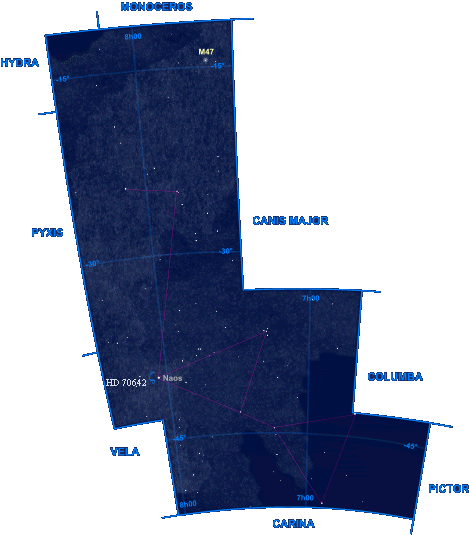
The Stern
Formerly, the lower southern sky in winter was occupied by a gigantic constellation "Argo Navis", the Argonauts' ship. The constellation had a span of over 70 degrees in east-west direction, and was the largest asterism in the heavens exceeding Hydra, which is presently the largest one. In the mid-18th century, Lacaille divided the older constellation into four smaller constellations: Carina, Pyxis, Vela, and Puppis.
The constellation of Puppis represents the Stern of the Argo Navis. You can find it just southeast of Canis Major as a large and a bit warped square formed by 2nd or 3rd magnitudes. Puppis crosses the meridian at fairly lower sky in Japan, it might need clear sky to recognize the entire constellation.
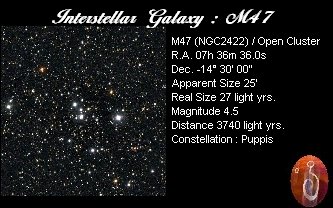
This picture shows two open clusters about 13 degrees east of Sirius (alpha CMa), and with an interval of about 1.5 degree between them. East Side one is M46 (NGC2437), and another one is M47 (NGC2422). Scenery of those are extremely contrary, to say, M46 consists of plenty of fine stars, but M47 is the brighter and sparse, includes several fifth magnitude stars.
Distances of M46 and M47 are about 5930 and 3740 light years respectively, they have no relation each other in the Galaxy space, we can appreciate these two in the almost same field by chance. 
The image shows a tiny planetary nebula of NGC2438 floating in M46 with a diameter of about 68". The nebula is a remnant of star emitting gaseous matter in front of M46.
At east of Canis Major, M93 (NGC2447) is an open cluster 2 degrees NW of zeta Puppis. The cluster looks like a dimmed nebula with binoculars, and comes to triangle-shaped stars being gathered through telescopes with medium-ranged magnification. Perhaps you'll have impression like a comet with a short tail.
The cluster is positioned at galactic latitude of zero, to say, just in center of the Milky Way in winter, there are plenty of faint stars around the cluster. M93 contains about 60 stars, and about 3600 light years away.
NGC2467 is an open cluster and surrounding nebulosity in the Milky Way of Puppis east neighbor of Canis Major. The nebula can be found out about 9.5 degrees just east from delta CMa at the waist of great dog. You can appreciate only sparse cluster with telescope, reddish nebula comes to sight only on the long exposed photographs. The nebula shows us a round and bright part in west region with a diameter of about 16 arc minutes, but actually the nebula has stretched very dimmed filaments eastward. In case of including this faint part, the nebula has a span of over 30 arc minutes.

A winter constellation of Puppis in which the Milky Way crosses includes many open clusters. This pair of NGC2451 and NGC2477 lies at the most southern position in the constellation.
A very sparse cluster on the right hand side is NGC2451 and another one fine stars crowded is named NGC2477. NGC2451 contains about 50 member stars in about 45-arc minutes diameter, you can easily enjoy this cluster only with compact binoculars. The cluster has a visual magnitude of 3, so maybe some of member stars can be detected by naked eyes. NGC2477 is found at about 1.5 degrees ESE of NGC2451. You can see the cluster like nebulosity through binoculars, and you need a medium sized telescope to resolve individual stars. NGC2477 has a brightness of about 6th magnitude, it hardly can be seen by your eyes.

The constellation of Puppis has one more pair of open clusters of M46 and M47 in northern region. Both pairs has very different stellar density each other, it may be interesting to compare the impressive contrast of these cluster couples.
NGC 2440 is another planetary nebula ejected by a dying star, but ithas a much more chaotic structure than NGC 2346. The central star ofNGC 2440 is one of the hottest known, with a surface temperature near200,000 degrees Celsius. The complex structure of the surrounding nebula suggests to some astronomers that there have been periodicoppositely directed outflows from the central star, somewhat similar to that in NGC 2346, but in the case of NGC 2440 these outflows have been episodic, and in different directions during each episode. The nebula is also rich in clouds of dust, some of which form long, dark streaks pointing away from the central star. In addition to the bright nebula, which glows because of fluorescence due to ultraviolet radiation from the hot star, NGC 2440 is surrounded by a much larger cloud of cooler gas which is invisible in ordinary light but can be detected with infrared telescopes. NGC 2440 lies about 4,000 light-years from Earth in the direction of the constellation Puppis.

In lower southern sky in winter night, an extraordinary vast but dimmed ?gGum Nebula?h is spreading out with a size of 40 x 90 degrees. The nebula is positioned in the Milky Way of Puppis to Vela. The nebula with name of an astronomer, who investigated about the nebula, is considered a supernova remnant exploded about from 10 to 30 thousand years ago.
MAPPING TECHNIQUE
VISUAL EXERCISE : Two Person Exercise.
DESTINATION : Your Choice
STEP ONE
Traveller : Get comfortable and relax.
STEP TWO
Traveller : Charge your physical body with light energy.
STEP THREE
Traveller : See your visual body standing in front of your physical body and prepare your visual body for interstellar travel with a Interstellar Protection Shield.
STEP FOUR
Traveller : See your visual body filling with light energy.
STEP FIVE
Traveller : Focus your mind on teleporting your visual body to the Your Destination.
STEP SIX
Traveller : Then see your visual body teleporting to the Your Destination.
STEP SEVEN
Traveller : When you arrive in the destination Look around can you see any planets or moons in the System? If not use the Interstellar Planetary Detection Rapid and see if you can detect any planets or moons in that system.
STEP EIGHT
Traveller : If you can see or detect a planet or moon using Telekinesis or Teleportation move towards the planetary body.
STEP NINE
Traveller : When you arrive at the outer atmosphere of the planet or moon stop and ask your spiritual guide to tell you the name of this planet or moon.
Traveller : Tell the mapper the name of the planet or moon. Also tell the mapper all you can about the planet or moon.
STEP TEN
Then us the Core Comparison Crystal Technique to perform a core reading on this planet or moon and give the mapper your reading on this planet or moon
STEP ELEVEN
Traveller : Then levitate or Teleport your visual body to the surface of the planet or moon.
STEP TWELVE
Mapper : When the traveller arrives on the surface ask the following questions.
Is there any plant life or water on the surface of the planet or moon that you can see? Is there an atmosphere around this planet or moon? Is the atmosphere an match with earths atmosphere?
Mapper : Write down the answers to these questions.
PLANETARY DATA FILE 
STEP THIRTEEN
Traveller : When you are finished on the surface teleport your visual body to the nearest planetary body that you can see in that Galaxy.
STEP FOURTEEN
Traveller and Mapper : Follow steps nine through to twelve again till you have mapped out the whole Galaxy.
STEP FIFTEEN
Traveller : When you have finished mapping the Galaxy teleport your visual body back to your physical body back on earth.
REMEMBER
When you are travelling if you come across an alien race that you think may be friendly feel free to make contact with that alien race.
IMPORTANT
When you are contacting alien races always be ready to teleport if there is trouble.
MAPPER
Make a note of any planets or moons with an atmospheric match with earths. That way you both know which planets can support human life forms.
MAPPER & TRAVELLER
To check that your mapping of that Galaxy is correct by changing roles and do this exercise again. Also remember to check for life force energy around the planets or moons that you visit on your journeys. Because if you can feel life force energy that means the planet or moons is a real planet or moon.