← The Wingmakers Ways · Astronomy & Exoplanets
Archived page · Checkable
Pyxis
Pyxis.html · captured from wingmakers.co.nz
Pyxis 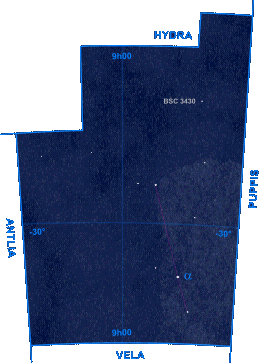
The (Mariner�s) Compass
Derivation
Pyxis was introduced by Abbé de la Caille, and associated with the giant 'superconstellation' of Argo Navis. In naming the constellation, though, de la Caille encountered a problem: there is no Latin word for 'compass', because the Romans did not have them. To solve this, he chose the word pyxis, which literally means 'little box'. The full name of the constellation, not now used, was Pyxis Nautica, meaning 'The Mariner's Box' or 'The Mariner's Compass'.
Stars
Though it lies on the plane of the Milky Way, there are few bright stars in this constellation. The brightest is Alpha Pyxidis, with a magnitude of just +3.7. It lies more than 800 light years away, but it is a highly luminous body and hence visible from Earth. The other stars of the constellation are a little closer, but all are fainter than magnitude +4.0.
Only one of the stars of Pyxis lies anywhere close to the Earth's solar system: BSC 3430 is a binary star, consisting of a pair of yellow dwarf stars, that lies 65 light years from the Sun.

Regular multiple spiral arm pattern is similar to M31, but more regular. Finc dust lanes on inside of the many arms. The largest HII regions will resolve at the 2 arcsec level and the two or three largest among the many smaller knots should be useful for the distance scale problem.

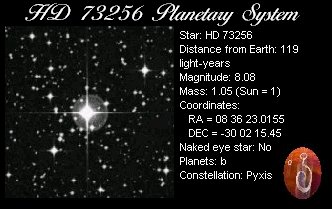
NGC 2627 is centered, its 15 stars loosely scattered across an 11' diameter area. 8.1 magnitude SAO 199825 is visible near the eastern edge of the field. Some 26' to the west-southwest, 8.1 magnitude HD 73256 guards the western field boundary. Ten arc minutes to the north-northwest, 9.0 magnitude HD 73201 marks the northwest edge of the field. This trio frames the cluster. A string of five 12th magnitude stars runs northeast from HD 73256 for a distance of 9', terminating near the brightest star in NGC 2627. That star is 10.7 magnitude Tycho 6582:601:1, which is visible adjacent to a 12th magnitude star. The pair stand a few arc minutes northwest of the center of the field. To find NGC 2627, center on 4.9 magnitude Zeta Pyxidis and slew 40' to the southwest.

NGC 2818 is an open star cluster without special Brillianz. Normally star clusters consist such as NGC 2818 of a combination of smaller and large stars. The small stars live longer than the large ones, there latter their hydrogen supply, because of the large gravitation pressure, faster burn. In NGC 2818 the large stars possibly already left the stage as Supernoven and the small stars to seem to likewise disintegrate. The planetary fog NGC 2818å, which is to be seen in the picture, supplies the reason for this acceptance. Both acceptance collected put the conclusion close that the star cluster is already very old. One assumes an age of approximately a billion years old.
Planetary Destination In Pyxis
MAPPING TECHNIQUE
VISUAL EXERCISE : Two Person Exercise.
DESTINATION : Your Choice
STEP ONE
Traveller : Get comfortable and relax.
STEP TWO
Traveller : Charge your physical body with light energy.
STEP THREE
Traveller : See your visual body standing in front of your physical body and prepare your visual body for interstellar travel with a Interstellar Protection Shield.
STEP FOUR
Traveller : See your visual body filling with light energy.
STEP FIVE
Traveller : Focus your mind on teleporting your visual body to the Your Destination.
STEP SIX
Traveller : Then see your visual body teleporting to the Your Destination.
STEP SEVEN
Traveller : When you arrive in the destination Look around can you see any planets or moons in the System? If not use the Interstellar Planetary Detection Rapid and see if you can detect any planets or moons in that system.
STEP EIGHT
Traveller : If you can see or detect a planet or moon using Telekinesis or Teleportation move towards the planetary body.
STEP NINE
Traveller : When you arrive at the outer atmosphere of the planet or moon stop and ask your spiritual guide to tell you the name of this planet or moon.
Traveller : Tell the mapper the name of the planet or moon. Also tell the mapper all you can about the planet or moon.
STEP TEN
Then us the Core Comparison Crystal Technique to perform a core reading on this planet or moon and give the mapper your reading on this planet or moon
STEP ELEVEN
Traveller : Then levitate or Teleport your visual body to the surface of the planet or moon.
STEP TWELVE
Mapper : When the traveller arrives on the surface ask the following questions.
Is there any plant life or water on the surface of the planet or moon that you can see? Is there an atmosphere around this planet or moon? Is the atmosphere an match with earths atmosphere?
Mapper : Write down the answers to these questions.
PLANETARY DATA FILE 
STEP THIRTEEN
Traveller : When you are finished on the surface teleport your visual body to the nearest planetary body that you can see in that Galaxy.
STEP FOURTEEN
Traveller and Mapper : Follow steps nine through to twelve again till you have mapped out the whole Galaxy.
STEP FIFTEEN
Traveller : When you have finished mapping the Galaxy teleport your visual body back to your physical body back on earth.
REMEMBER
When you are travelling if you come across an alien race that you think may be friendly feel free to make contact with that alien race.
IMPORTANT
When you are contacting alien races always be ready to teleport if there is trouble.
MAPPER
Make a note of any planets or moons with an atmospheric match with earths. That way you both know which planets can support human life forms.
MAPPER & TRAVELLER
To check that your mapping of that Galaxy is correct by changing roles and do this exercise again. Also remember to check for life force energy around the planets or moons that you visit on your journeys. Because if you can feel life force energy that means the planet or moons is a real planet or moon.