← The Wingmakers Ways · not in the site's own index
Archived page · Asserted
Q0957+561 Planetary System
Q0957_561_Planetary_System.html · captured from wingmakers.co.nz
Einstein Cross
Interstellar Galaxy Card
Print this card out and you can use this card with interstellar travel.
To use this card with interstellar travel just teleport your visual body into the card
The symbol on the right corner of the card is the light energy symbol for universal prana energy
and it links the image to the physical destination in the universe.
Comments
Einstein's cross is so difficult to observe successfully. some people believe that it can't be done in amateur instruments. Yet, the allure of seeing a gravitational lens with your own eyes -- a direct visual confirmation of Einstein's General Relativity -- is compelling.
Einstein's General Relativity is a modern description of gravity. Building on the work of Newton and Galileo before him, Einstein took our understanding of gravity one step further. He described gravity as an acceleration due to a curvature in spacetime rather than as a force. Yikes! That's a lot of big words. So what exactly, you say, does that mean?
Let's first begin with an analogy. Imagine a being for whom there was no up or down; only north-south and east-west. This being would have no height at all and no direct knowledge of the "3rd" up-down dimension. Now place this being on the surface of the earth and have him walk very far in one direction. After a long time he would completely circumnavigate the globe and return to where he started from. "How could this be?", he would rightly ask. After all, he never deviated from a straight line from his point of view. But from our point of view the solution is easy. The earth is curved in the 3rd dimension and this curvature eventually led the 2-D being back to where he started from.
The basic idea behind General Relativity is that there exists a 4th dimension that we cannot directly observe. Any object with mass, such as earth, will bend space around it -- cause it to curve -- in that unseen 4th dimension.
The moon, for instance, is actually going in a straight line as it orbits the earth. That is, when you take all four dimensions into account. That's why no rockets are needed to keep it up there. But from our point of view the moon follows a curved path around the earth. That's because we can't see the curvature around the earth in the 4th dimension. If you throw a ball it follows this curvature as well -- at least until it hits the ground. The beauty of this idea is that it alleviates the need for a "force" of gravity which somehow magically operates over a distance and without any sort of medium to carry it.
A key prediction of Einstein's theory is that light will also follow a curved path around massive objects. Classical gravity theory predicts that light, being massless, will not be affected by gravity. One test of this idea is to observe the position of a star near the edge of the sun. If the light does follow a curved path near the sun we will see it as a shift in the star's position. And in fact, this shift is observed in precisely the amount predicted.
In this same way the light from a distant quasar can be bent around a more nearby galaxy. The closer galaxy acts like a lens, bending the light to produce multiple images of the distant quasar.
Einstein's cross is one of the best examples of this effect.
Einstein's Cross, or G2237+0305 is perhaps the best known gravitational lens in the northern sky. A distant quasar is "split" into four parts by a closer foreground galaxy. The gravitation field of the galaxy bends and refocuses the light from the distant quasar into four roughly equal components. This galaxy has a designation CGCG 378-15, a 14th magnitude system in the constellation of Pegasus. This galaxy is not very difficult to view even with moderate aperture but the quasar is a different story. The southern component A has a magnitude of 17.36, component B (northern) is 17.39 magnitude, C (eastern) is 18.43 and D (western) is the most difficult at 18.72 magnitude. Barbara Wilson provided much of the information on this object. The key to seeing "the cross" is a combination of large aperture, very dark skies and excellent seeing conditions.
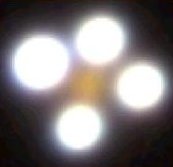
The light emited by Einstein's Cross is a lot colder then the sun at the centre of our solar system. We do not know why the cross is emiting cool light rather then heat like the sun in our solar system. So the temptures of the planets are cooler near the centre of the galaxy and id is possible to visit these planets with astral bi-loction or teleportation of the visual body.
System Components 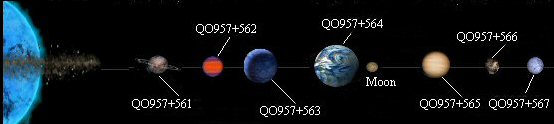
Statistics
Star System: Q 0957+561
Discovery Status: Confirmed - Detected via Microlensing
Mass: 3 Earths
Detection Method: Gravitational Microlensing
Discovered By: R. E. Schild
Year Discovered: 1996
Speculations
The possible earth sized planet in the foreground galaxy of Q0957+561 is the farthest of all detected extra solar worlds. And because of the unusual method used to detect it, we know virtually nothing about this planet, and probably will not get another chance to find out.
Q0957+561 is a quazar whose image is gravitationally lensed by a galaxy which lies directly in the line of sight between it and our own world. The foreground galaxy splits the quazar's image into two lobes, labeled A and B. The properties of this gravitational lens is that if both lobes fluctuate in some way, then the fluctuation is occurring in the quazar. If the fluctuation occurs only in one of the lobes, however, the fluctuation is due to the foreground galaxy.
What astronomers discovered was a minute fluctuation in the A lobe, but no corresponding fluctuation in the B lobe. The fluctuation was consistent with what is expected if a planet in the foreground galaxy passed in front of the quazar. The magnitude and duration of the fluctuation indicates that the planet is only a few times the mass of the earth.
Unfortunately that's all we know. We have no idea if the planet orbits a star, what kind of star it may be, or what kind of an orbit the planet is in. All we know is the galaxy and the mass.
Given this near total lack of knowledge, we cannot even begin to speculate about this world.
Position In The Sky
Views
Lensing Galaxy (Einstein Cross)
Most galaxies have a single nucleus -- does this galaxy have four? The strange answer leads astronomers to conclude that the nucleus of the surrounding galaxy is not even visible in this image. The central cloverleaf is rather light emitted from a background quasar. The gravitational field of the visible foreground galaxy breaks light from this distant quasar into four distinct images. The quasar must be properly aligned behind the center of a massive galaxy for a mirage like this to be evident. The general effect is known as gravitational lensing, and this specific case is known as the Einstein Cross. Stranger still, the images of the Einstein Cross vary in relative brightness, enhanced occasionally by the additional gravitational microlensing effect of specific stars in the foreground galaxy.
The New Solar System
Lensing Galaxy - Einstein Cross
Their seem to be seven planets and one moon orbiting around Einstein Cross in the lensing galaxy.
QO957+561 Has been confirmed by Nasa and the other 6 planets and moon were found using interstellar travel mapping technique on the 24 January 2003
The Planet Imagery is a close match with the planets in this solar system
FIRST PLANET 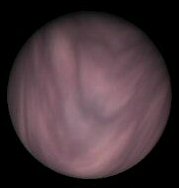
Planetary Destination: QO957+561
Atmospheric Composition
This planet has a toxic atmosphere which is definatly not suitable fro human life.
Planetary Surface Composition
There was no plant life or trees and there was no water or rivers on this planet.
There were small pools of some sort of slime on the surface of this planet.
Planetary Comparison Composition
Not suitable for humans
Life Forms
There were no signs of life forms at this visit.
Report File
No report
Report File Data
No report
SECOND PLANET
Planetary Destination: QO957+562
Atmospheric Composition
This planet has a gassy atmosphere to it.
Planetary Surface Composition
This planet has a warm temprature on the surface and there were small volcanoes on the surfaceof this planet. There was no plant life or water detected on this visit.
Planetary Comparison Composition
Not suitable for humans
Life Forms
There were no signs of life forms at this visit.
Report File
No report
Report File Data
No report
THIRD PLANET 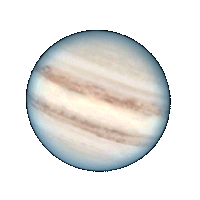
Planetary Destination: QO957+563
Atmospheric Composition
This planet is a close atmosphere with earths.
Planetary Surface Composition
This planet has a barren surface with no plant life and no water. It was very windy and cold.
Planetary Comparison Composition
No match with earth
Life Forms
There were no life forms detected on this visit.
Report File
No report
Report File Data
No report
FOURTH PLANET
P
Planetary Body : QO957+564
Atmospheric Composition
This planet is a close match with earth but there was no cloud formations.
Planetary Surface Composition
There is plant life on this planet. Plants, bushes and trees. There is water on this planet in the form of lakes and rivers. The water is a match with earth's water.
Planetary Comparison Composition
This planet is a close match with earth.
Life Forms
There were life forms detected on this visit but i didn't have a chance to explore this fully at this time.
Report File
No
Report File Data
No
MOON OR PLANET 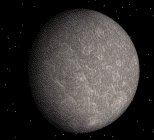
Planetary Destination: QO957+564 Moon
Atmospheric Composition
This moon has no comparison with earth and there was no atmosphere present on this moon.
Moon Surface Composition
This moon has a crater filled landscape covering the surface.
Moon Comparison Composition
No match with earth
Life Forms
No Life Forms
Report File
No
Report File Data
No
no
FIFTH PLANET 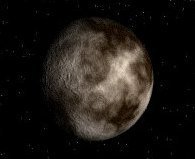
Planetary Destination: QO957+565
Atmospheric Composition
This planet has no match with earth.
Planetary Surface Composition
There were no plants or trees on this planet. There was no signs of water on this planet. There seemed to be remanets of plant life from before the planet started to die.
Planetary Comparison Composition
No match with earth
Life Forms
No
Report File
No
Report File Data
No
SIXTH PLANET
Planetary Destination: QO957+566
Atmospheric Composition
This planet was not match with earth
Planetary Surface Composition
This planet consisted mostly of ice and hills. Amost 95% of the planet was covered in ice. Whatever hills there were they were covered in ice the only normal ground i saw looked to be small paths leading through the hills.
Planetary Comparison Composition
No match
Life Forms
There were no life forms detected on this visit but by the small paths on this planet i would have to assume that there is some form of life on this planet. I will go back for a closer look at a later date.
Report File
No report
Report File Data
No report
SEVENTH PLANET
Planetary Destination: QO957+567
Atmospheric Composition
This planet was not match with earth
Planetary Surface Composition
This planet has a fully barren surface there was no plant life or trees and there was no signs of water present.
Planetary Comparison Composition
No Match with earth
Life Forms
There were no life forms detected at this time.
Report File
No
Report File Data
No