← The Wingmakers Ways · Astronomy & Exoplanets
Archived page · Checkable
Scorpius
Scorpio.html · captured from wingmakers.co.nz
SCORPIO 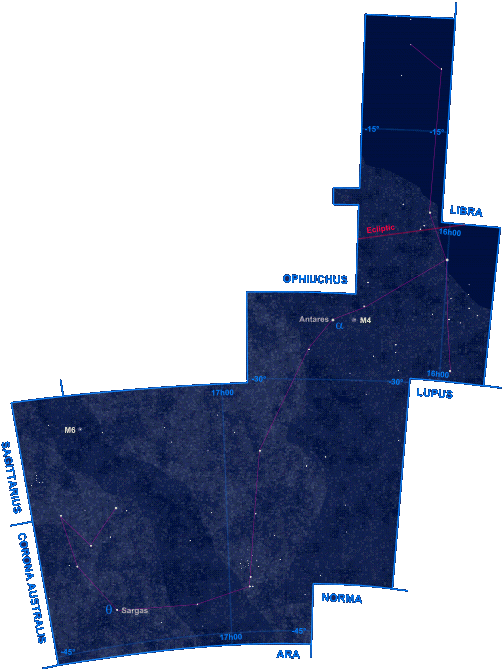
The Scorpion
The constellation of Scorpius is a large and includes many bright stars, that of the lower half of body is bathed in the summer's Milky Way. The asterism of a vast skewed shape of "S" was taken an attention in many ancient cultures, for an example, it was regarded as a gigantic fishhook in Japanese fishing villages.
Alpha Scorpii is well known as Antares meaning of "Rival of Mars", emitting pale red light at the heart of Scorpion. The star is considered as a supergiant and estimated to be about 230 sun diameters. It's about 600 light years away.
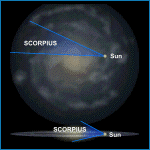
Scorpius includes a broad region of the Galaxy, in the general direction of the Core. This explains the density of the Milky Way in the constellation, and the large number of star clusters found here.
Fourth Cosmic Ray : Linking Through Mercury
"These subjects are motivated by a deep sense of harmony in all things. They act as the link between the separateness of things, creating unity and making all things equal by bridging apparent barriers. This harmonising effect comes from the inside, acting outwards, and is therefore totally selfless. Consequently, such subjects are opposed to selfishness and hold true brotherhood of man as their highest ideal. They are adept at co-ordinating various projects and, being able to see a common denominator in opposing people or ideals, have a good understanding of these paradoxes. Although they can take pleasure from this ability to see things from another's point of view, it can also lead to painful and disturbing experiences. They enjoy become involved with a lot of people, but are very aware of how others see them; this leads them to give only what they receive. These folk are easygoing, preferring to give way rather than upset a peaceful atmosphere.
You can see a reddish bright star, Antares, at the left side in the picture. And a globular cluster located just one degree west of Antares is M4 (NGC6121). It's very close from the Antares, so we can find easily the cluster with binoculars, but without a larger telescope it will not appear very spectacular.
M4 is characteristic as its reddish color although we cannot detect the peculiar colors in almost all of other globular clusters.
The cluster consists of about 10 thousand stars, and about seven thousand light years away.
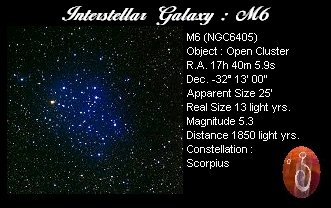
At around the tail of the Scorpion, we can enjoy two open clusters of M6 and M7. M6 (NGC6405) is the second-best cluster of the constellation after M7. Distance of appearance between these clusters is just 3 degrees, so we can appreciate clusters simultaneously with binoculars. M7 (See next page) can be detected as a group of bright stars easily, but this one needs more magnification.
The cluster is about 1850 light years away, about 600 light years farther than that of M7.
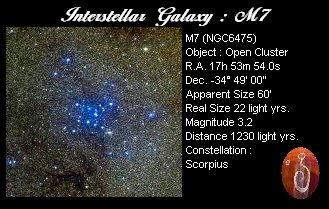
M7 (NGC6475) is clearly the best open cluster of the constellation. This magnificent object is extremely large (about a size of 1 degree) and quite bright, being visible even to the naked eye at a viewpoint far from urban area. You will be impressed the splendid scenery of about 50 stars scattered in the Milky Way with binoculars.
In fact, in the Messier's catalogue, M7 is positioned at the southest point in the sphere, the culminate latitude of that is only about 20 degrees at Tokyo.
And M7 is one of rare objects known before the telescope was invented, the cluster was found out by an ancient astronomer Ptolemy in 2nd century. This cluster has another name of "Ptolemy's Cluster".
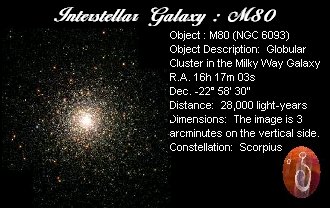
This stellar swarm is M80 (NGC 6093), one of the densest of the 147 known globular star clusters in the Milky Way Galaxy. Located about 28,000 light-years from Earth, M80 contains hundreds of thousands of stars, all held together by their mutual gravitational attraction.
Globular clusters are particularly useful for studying stellar evolution, since all of the stars in the cluster have the same age (about 15 billion years), but cover a range of stellar masses. Every star visible in this image is either more highly evolved than, or in a few rare cases more massive than, our own Sun. Especially obvious are the bright red giants, which are stars similar to the Sun in mass that are nearing the ends of their lives.
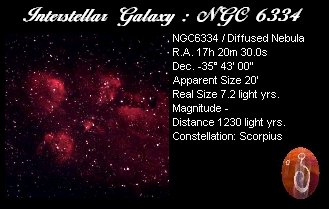
NGC6334 is a red diffused nebula with a size of about 20 arc minutes positioned at around a tail of scorpion. It consists of several segments of three round red lights and a dimmed vast region, only appears clearly on long-exposure photos. The nebula has a nickname of "The Telescope Goldfish Nebula" in Japan, it looks like a kind of goldfish with its eyes sticked out. The nebula has a median transit with an altitude of lower than 20 degrees at Tokyo, it's hard to photograph the nebula in good condition at Japan.
Distance of the nebula is estimated approximately 1230 light years.
NGC6357 is one of vast hydrogen gaseous nebulae spread around the tail of Scorpius. The nebula and NGC6334 are paralleled just 2 degrees apart, it should be easily able to capture these attractive objects in a single frame by using of medium-ranged telephoto lenses. Additionally, you can gaze at two noticeable open clusters of M6 and M7 being next to the nebula, one of the extraordinary photogenic celestial fields.
NGC6357 has an apparent size of about 50 arc minutes, and is often called "The Cluster Amaryllis Nebula" at Japan (in Japanese "Higan-bana Nebula"), because the shape of it looks like a huge reddish flower.
Planetary Systems In Scorpius
Three unlikely companions - two burned-out stars and a planet - orbit each other near the crowded core of an ancient globular cluster of more than 100,000 stars. Only one companion, however, is visible in the image a burned-out white dwarf star. Radio astronomers discovered the white dwarf and the other burned-out star - a rapidly spinning neutron star, called a pulsar - a decade ago. The third companion's identity was a mystery. Was it a planet or a brown dwarf? The object was too small and too dim to image. The green Ring will help you with marking your Destination.
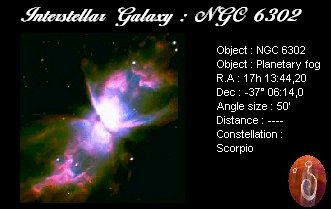
Description to the picture: NGC 6302 The picture was taken up at the 22.Mai1998 by the European Southern Observatory with the 8,2m VL telescope of the Paranal Observatory. At the end of their life stars blow themselves, far beyond their past size up and push off, with the following collapse, large parts of their outside gas covering into space. After this collapse the stars remain first for some thousand years very hot and become brighter, by the reduction of their surface. Their ultraviolet radiation ionizes thereby the gas repelled before, which begins to shine thereby. The above butterfly fog developed in this way. The star hp 155520, which brings the fog to shining, is covered by the diagonal view on the fog, is good however by the brightness in the center of the fog to suspect. The gas of this fog is to out-flow with 400km/s into the universe.
MAPPING TECHNIQUE
VISUAL EXERCISE : Two Person Exercise.
DESTINATION : Your Choice
STEP ONE
Traveller : Get comfortable and relax.
STEP TWO
Traveller : Charge your physical body with light energy.
STEP THREE
Traveller : See your visual body standing in front of your physical body and prepare your visual body for interstellar travel with a Interstellar Protection Shield.
STEP FOUR
Traveller : See your visual body filling with light energy.
STEP FIVE
Traveller : Focus your mind on teleporting your visual body to the Your Destination.
STEP SIX
Traveller : Then see your visual body teleporting to the Your Destination.
STEP SEVEN
Traveller : When you arrive in the destination Look around can you see any planets or moons in the System? If not use the Interstellar Planetary Detection Rapid and see if you can detect any planets or moons in that system.
STEP EIGHT
Traveller : If you can see or detect a planet or moon using Telekinesis or Teleportation move towards the planetary body.
STEP NINE
Traveller : When you arrive at the outer atmosphere of the planet or moon stop and ask your spiritual guide to tell you the name of this planet or moon.
Traveller : Tell the mapper the name of the planet or moon. Also tell the mapper all you can about the planet or moon.
STEP TEN
Then us the Core Comparison Crystal Technique to perform a core reading on this planet or moon and give the mapper your reading on this planet or moon
STEP ELEVEN
Traveller : Then levitate or Teleport your visual body to the surface of the planet or moon.
STEP TWELVE
Mapper : When the traveller arrives on the surface ask the following questions.
Is there any plant life or water on the surface of the planet or moon that you can see? Is there an atmosphere around this planet or moon? Is the atmosphere an match with earths atmosphere?
Mapper : Write down the answers to these questions.
PLANETARY DATA FILE 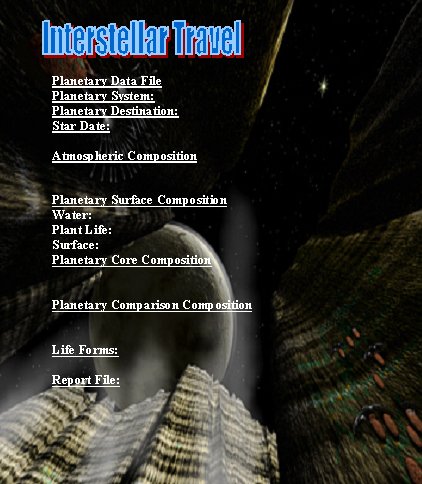
STEP THIRTEEN
Traveller : When you are finished on the surface teleport your visual body to the nearest planetary body that you can see in that Galaxy.
STEP FOURTEEN
Traveller and Mapper : Follow steps nine through to twelve again till you have mapped out the whole Galaxy.
STEP FIFTEEN
Traveller : When you have finished mapping the Galaxy teleport your visual body back to your physical body back on earth.
REMEMBER
When you are travelling if you come across an alien race that you think may be friendly feel free to make contact with that alien race.
IMPORTANT
When you are contacting alien races always be ready to teleport if there is trouble.
MAPPER
Make a note of any planets or moons with an atmospheric match with earths. That way you both know which planets can support human life forms.
MAPPER & TRAVELLER
To check that your mapping of that Galaxy is correct by changing roles and do this exercise again. Also remember to check for life force energy around the planets or moons that you visit on your journeys. Because if you can feel life force energy that means the planet or moons is a real planet or moon.