← The Wingmakers Ways · Astronomy & Exoplanets
Archived page · Checkable
Sculptor
Sculptor.html · captured from wingmakers.co.nz
Sculptor 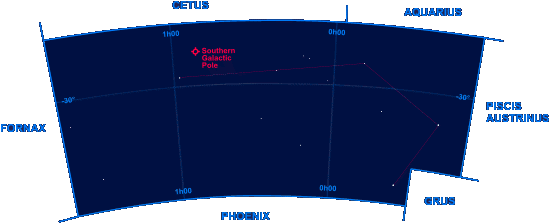
The Sculptor, The Sculptor�s Workshop A minor constellation of sculptor can be found just east of Fomalhaut, alpha PsA. The constellation has only stars finer than fifth magnitude. In 1763, Lacaille has established it with some constellations in the southern hemisphere. Though the constellation has the Latin name of "Sculptor", it has translated to "Sculptor's studio" in English.
The Sculptor is lying at the farthest region from the Milky Way. Say, the constellation is positioned around the Galactic South Pole. And it's the Coma Berenices occupying the opposite point in the celestial sphere, i.e., the Galactic North Pole. Both constellations contain plenty of outer galaxies because inner-Galactic gaseous matter doesn't obstruct faint light from them. Especially a middle-sized galaxy of NGC253 lying northern region in Sculptor can be enjoy through binoculars.
The constellation of Sculptor is a very minor one just south of Cetus. Though Sculptor includes no bright stars, but NGC253 is a large and bright galaxy in autumnal southern skies, and the galaxy is more popular than the constellation in that the galaxy is included.
The galaxy can be found easily by following about 7 degrees south from beta Ceti that marks the tail of Cetus. You'll notice a large dimmed light being an ellipse only with portable binoculars. NGC253 has a length of 27 arc minutes, a bit shorter than the apparent diameter of full-moon, looks like a shrinked Andromeda Galaxy (M31).
The central nucleus is brightening, and the parts of spirals are stretched clearly toward NE and SW, it should be a very splendid view through small scopes.
And you can find a Globular Cluster of NGC288 about 2 degrees SE of NGC253, visible like a dimmed oval light paralleled with the galaxy via binoculars.
NGC300 (Bennett 6, Caldwell 70) is a spiral galaxy in south-eastern Sculptor located 7.2° north-east of Ankaa (Alpha Phoenicis). Dreyer describes it as fairly bright (mag. 9), very large (20'x15'), with an irregular, elongated shape that brightens slowly toward its nucleus. Larger scopes should see two sprawling, S shaped arms. The tiny mag.
In central region of Sculptor, a popular colliding galactic pair of "Cartwheel galaxy" is positioned. A larger one with shape of cartwheel has been registered as ESO350-40, and eastern another dwarf galaxy collided head on is ESO350-40A.
These galaxies have visual brightness of about 19th magnitude, and size of smaller than 1 arc minutes, very very dimmed celestial objects difficult to detect with amateur telescopes. I have displayed an image captured by the Hubble Space Telescope (HST) in this page. I think you can recognize outlines of these galaxies by comparing with HST's clear picture.
NGC 55, an edge-on galaxy in the Sculptor Group
The nearest galaxy to the Milky Way is the Large Magellanic Cloud (LMC), which we see from a distance of 170,000 light years. It is inclined to our line of sight by about 40 degrees. Magellanic-type galaxies are quite rare, so we are lucky to have such a close view of such an unusual specimen. For purely statistical reasons edge-on galaxies are also rare, so we are especially fortunate to have in NGC 55 an example of a Magellanic-type galaxy seen edge-on which is also nearby.
NGC 55 is at a distance of about 5 million light years, which is close enough for us to see it resolved into individual stars. With a big telescope like the AAT, the central regions look very much like the Milky Way seen with an ordinary camera. NGC 55 is a member of the Sculptor group, where the galaxies are few in number and well separated in space. It is probably for this reason that NGC 55 is not rich in star forming regions, because it is not interacting with any nearby companion galaxy, unlike the LMC, which is istirred up by interactions with both the Milky Way and the Small Magellanic Cloud.
NGC7793 (Bennett 130) is a spiral galaxy located in the middle of the Sculptor lozenge, and described as "like a comet." It shines at mag. 9.6, and measures 9.4'x6.3'. Larger telescopes might detect structure, such as mottling and what appears to be concentric shells.
NGC613 (Bennett 8) is a barred spiral galaxy located 7.8° west of Alpha Sculptoris. Dreyer describes it as very bright (mag. 10), very large (6'x4'), very moderately extended (118°), with an abruptly brighter middle, and a 10th magnitude star to the northeast. The brighter core is much more pronounced in larger amateur instruments (13"), as is the curvature of the galaxy's arms.
Planetary Destinations In Sculptor
MAPPING TECHNIQUE
VISUAL EXERCISE : Two Person Exercise.
DESTINATION : Your Choice
STEP ONE
Traveller : Get comfortable and relax.
STEP TWO
Traveller : Charge your physical body with light energy.
STEP THREE
Traveller : See your visual body standing in front of your physical body and prepare your visual body for interstellar travel with a Interstellar Protection Shield.
STEP FOUR
Traveller : See your visual body filling with light energy.
STEP FIVE
Traveller : Focus your mind on teleporting your visual body to the Your Destination.
STEP SIX
Traveller : Then see your visual body teleporting to the Your Destination.
STEP SEVEN
Traveller : When you arrive in the destination Look around can you see any planets or moons in the System? If not use the Interstellar Planetary Detection Rapid and see if you can detect any planets or moons in that system.
STEP EIGHT
Traveller : If you can see or detect a planet or moon using Telekinesis or Teleportation move towards the planetary body.
STEP NINE
Traveller : When you arrive at the outer atmosphere of the planet or moon stop and ask your spiritual guide to tell you the name of this planet or moon.
Traveller : Tell the mapper the name of the planet or moon. Also tell the mapper all you can about the planet or moon.
STEP TEN
Then us the Core Comparison Crystal Technique to perform a core reading on this planet or moon and give the mapper your reading on this planet or moon
STEP ELEVEN
Traveller : Then levitate or Teleport your visual body to the surface of the planet or moon.
STEP TWELVE
Mapper : When the traveller arrives on the surface ask the following questions.
Is there any plant life or water on the surface of the planet or moon that you can see? Is there an atmosphere around this planet or moon? Is the atmosphere an match with earths atmosphere?
Mapper : Write down the answers to these questions.
PLANETARY DATA FILE 
STEP THIRTEEN
Traveller : When you are finished on the surface teleport your visual body to the nearest planetary body that you can see in that Galaxy.
STEP FOURTEEN
Traveller and Mapper : Follow steps nine through to twelve again till you have mapped out the whole Galaxy.
STEP FIFTEEN
Traveller : When you have finished mapping the Galaxy teleport your visual body back to your physical body back on earth.
REMEMBER
When you are travelling if you come across an alien race that you think may be friendly feel free to make contact with that alien race.
IMPORTANT
When you are contacting alien races always be ready to teleport if there is trouble.
MAPPER
Make a note of any planets or moons with an atmospheric match with earths. That way you both know which planets can support human life forms.
MAPPER & TRAVELLER
To check that your mapping of that Galaxy is correct by changing roles and do this exercise again. Also remember to check for life force energy around the planets or moons that you visit on your journeys. Because if you can feel life force energy that means the planet or moons is a real planet or moon.