← The Wingmakers Ways · Astronomy & Exoplanets
Archived page · Checkable
Scutum
Scutum.html · captured from wingmakers.co.nz
Scutum 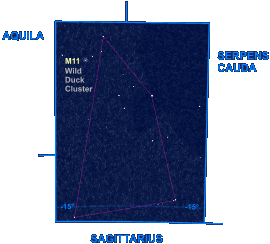
The Shield
Scutum, the Shield, is a minor constellation found just north of Milky Way in Sagittarius. Although the shape of constellation itself is not very obvious, you can be fascinated with the beauty of the Milky Way in that with binoculars. J. Hevelius, a Polish astronomer, invented the constellation. The constellation had the proper name of Scutum Sobieskii. Jan Sobieski was the king of Poland. He repulsed the Turks that tried to attack Vienna in 1683. Hevelius commemorated this event with the inclusion of Scutum Sobieskii in summer sky in 1690.
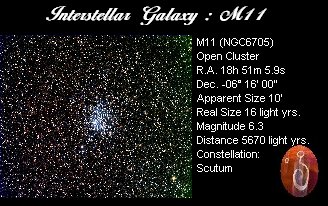
The Scutum is a tiny constellation just North of Sagittarius, and M11 (NGC6705) is a fine open cluster found out in this minor constellation. This object has no name in Japan, but it's called "Wild Duck Cluster" in English.
M11 is positioned in the Milky Way where fine stars are extremely crowded, but it's unexpectedly easy to find the cluster because M11 is much denser than the Milky Way of a background.
Each open cluster has one of five types of "c" to "g" classified with its density, and M11 has the highest index of "g", so it looks like a globular cluster. The cluster consists of about 200 stars and 5600 light years away.
M26 is a small open cluster bathed in the Small-Star Cloud of Scutum that is a bright and noticeable part of the summer's Milky Way. It may be interesting to compare the cluster with another bright one of M11 in same constellation. M26 is much more indistinct than M11, only 20 or more fine stars can be counted. You need conditioned night sky to enjoy its pretty view through binoculars or small telescopes. But there is a lump of dark cloud stretched toward the cluster so you can recognize M26 without buried under the light of Milky Way. M26 is lying about 5000 light-years away, a bit closer than M11.
Planetary Destinations In Scutum
MAPPING TECHNIQUE
VISUAL EXERCISE : Two Person Exercise.
DESTINATION : Your Choice
STEP ONE
Traveller : Get comfortable and relax.
STEP TWO
Traveller : Charge your physical body with light energy.
STEP THREE
Traveller : See your visual body standing in front of your physical body and prepare your visual body for interstellar travel with a Interstellar Protection Shield.
STEP FOUR
Traveller : See your visual body filling with light energy.
STEP FIVE
Traveller : Focus your mind on teleporting your visual body to the Your Destination.
STEP SIX
Traveller : Then see your visual body teleporting to the Your Destination.
STEP SEVEN
Traveller : When you arrive in the destination Look around can you see any planets or moons in the System? If not use the Interstellar Planetary Detection Rapid and see if you can detect any planets or moons in that system.
STEP EIGHT
Traveller : If you can see or detect a planet or moon using Telekinesis or Teleportation move towards the planetary body.
STEP NINE
Traveller : When you arrive at the outer atmosphere of the planet or moon stop and ask your spiritual guide to tell you the name of this planet or moon.
Traveller : Tell the mapper the name of the planet or moon. Also tell the mapper all you can about the planet or moon.
STEP TEN
Then us the Core Comparison Crystal Technique to perform a core reading on this planet or moon and give the mapper your reading on this planet or moon
STEP ELEVEN
Traveller : Then levitate or Teleport your visual body to the surface of the planet or moon.
STEP TWELVE
Mapper : When the traveller arrives on the surface ask the following questions.
Is there any plant life or water on the surface of the planet or moon that you can see? Is there an atmosphere around this planet or moon? Is the atmosphere an match with earths atmosphere?
Mapper : Write down the answers to these questions.
PLANETARY DATA FILE 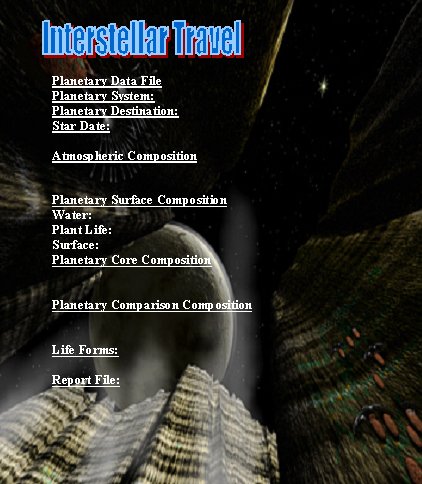
STEP THIRTEEN
Traveller : When you are finished on the surface teleport your visual body to the nearest planetary body that you can see in that Galaxy.
STEP FOURTEEN
Traveller and Mapper : Follow steps nine through to twelve again till you have mapped out the whole Galaxy.
STEP FIFTEEN
Traveller : When you have finished mapping the Galaxy teleport your visual body back to your physical body back on earth.
REMEMBER
When you are travelling if you come across an alien race that you think may be friendly feel free to make contact with that alien race.
IMPORTANT
When you are contacting alien races always be ready to teleport if there is trouble.
MAPPER
Make a note of any planets or moons with an atmospheric match with earths. That way you both know which planets can support human life forms.
MAPPER & TRAVELLER
To check that your mapping of that Galaxy is correct by changing roles and do this exercise again. Also remember to check for life force energy around the planets or moons that you visit on your journeys. Because if you can feel life force energy that means the planet or moons is a real planet or moon.