← The Wingmakers Ways · not in the site's own index
Archived page · Asserted
Serpens & Ophiuchus
Serpens_Caput~2004.html · captured from wingmakers.co.nz
Serpens Caput 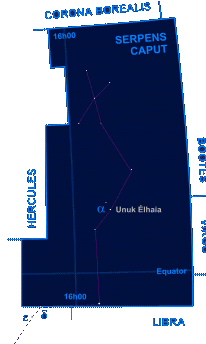
Serpens, or the Serpent, is held by the Serpent Holder, Ophiuchus, and is the only constellation to consist of two separate parts - Serpens Caput (the Head) and Serpens Cauda (the Tail).
Derivation
Though the stars of this region have been seen as a serpent for thousands of years, their symbolic meaning remains uncertain. It is thought likely that the Serpent and its bearer Ophiuchus are related to the Greek healer-god Asclepius. The Greeks believed that the serpents of Asclepius could cure diseases, and so belong a long association between serpents and medicine that continues to our own time.
Stars
The stars of Serpens form the shape of a long writhing snake that starts near the Northern Crown, passes southward through Serpens Caput, then through the body of Ophiuchus. When the shape emerges into Serpens Cauda, it turns northward again, and carries on to reach its end into the Milky Way. The tip of the Serpent's nose is the faint star Rho Serpentis, while the tip of its tail is marked by the similarly faint Alya. A number of the stars that form part of the serpent's body actually belong to the constellation Ophiuchus. Yed Prior, Yed Posterior, Upsilon Ophiuchi, Zeta Ophiuchi and Sabik are all Ophiuchan stars that lie along the star-snake's body.
Though its shape is well-defined, Serpens is lacking in bright stars. The brightest is Unuk Élhaia (the 'serpent's neck') an orange giant about seventy light years away, with a magnitude of +2.6. Beta Serpentis, the next brightest star, is more than a magnitude fainter at +3.7.
Star Clusters and Nebulae
Serpens contains no deep-sky objects that are visible to the naked eye, but it is not without points of interest. One of these is the very distant Globular Cluster M5, in the southern parts of Serpens Caput. About 25,000 light years away, this gigantic ball of stars is close to the Nucleus of the Milky Way.
M5 (NGC5904) is a spectacular globular cluster in the constellation of Serpens Caput (head), with a size of about 13 arc minutes. There is a star "5 Serpentis" with magnitude of 5 just 30' SE of M5, the star is a good mark to search the cluster with telescopes. You can see the star at the lower left hand side in this photograph. The cluster has nearly similar size with M13 in Hercules; it's one of representative globular clusters in summer sky.
M5 is a globular cluster with the largest real size of 130 light years in Messier's catalogue. Distance is 27 thousand light years away.
so small binoculars are most suitable for appreciating those clusters. Because background Milky Way is fairly striking, good conditioned skies might be needed to enjoy fine and beautiful individual member stars in those clusters.
A small-bared galaxy in center of Serpent Caput is NGC5921. The galaxy is positioned about 3 degrees north of M5, a striking and bright globular. NGC5921 has a diameter of about 5 arc minutes, two arms are coiled up loosely from a dimmed central nucleus.
HD 136118 Position
MAPPING TECHNIQUE
VISUAL EXERCISE : Two Person Exercise.
DESTINATION : Your Choice
STEP ONE
Traveller : Get comfortable and relax.
STEP TWO
Traveller : Charge your physical body with light energy.
STEP THREE
Traveller : See your visual body standing in front of your physical body and prepare your visual body for interstellar travel with a Interstellar Protection Shield.
STEP FOUR
Traveller : See your visual body filling with light energy.
STEP FIVE
Traveller : Focus your mind on teleporting your visual body to the Your Destination.
STEP SIX
Traveller : Then see your visual body teleporting to the Your Destination.
STEP SEVEN
Traveller : When you arrive in the destination Look around can you see any planets or moons in the System? If not use the Interstellar Planetary Detection Rapid and see if you can detect any planets or moons in that system.
STEP EIGHT
Traveller : If you can see or detect a planet or moon using Telekinesis or Teleportation move towards the planetary body.
STEP NINE
Traveller : When you arrive at the outer atmosphere of the planet or moon stop and ask your spiritual guide to tell you the name of this planet or moon.
Traveller : Tell the mapper the name of the planet or moon. Also tell the mapper all you can about the planet or moon.
STEP TEN
Then us the Core Comparison Crystal Technique to perform a core reading on this planet or moon and give the mapper your reading on this planet or moon
STEP ELEVEN
Traveller : Then levitate or Teleport your visual body to the surface of the planet or moon.
STEP TWELVE
Mapper : When the traveller arrives on the surface ask the following questions.
Is there any plant life or water on the surface of the planet or moon that you can see? Is there an atmosphere around this planet or moon? Is the atmosphere an match with earths atmosphere?
Mapper : Write down the answers to these questions.
PLANETARY DATA FILE 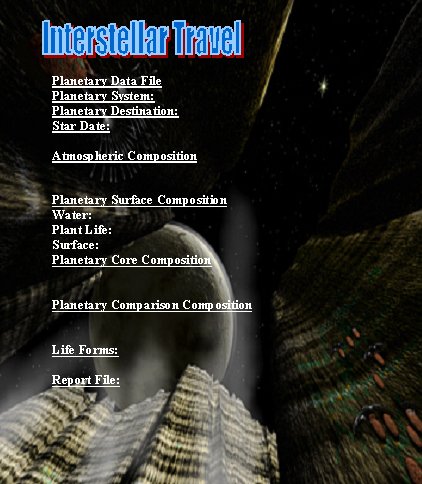
STEP THIRTEEN
Traveller : When you are finished on the surface teleport your visual body to the nearest planetary body that you can see in that Galaxy.
STEP FOURTEEN
Traveller and Mapper : Follow steps nine through to twelve again till you have mapped out the whole Galaxy.
STEP FIFTEEN
Traveller : When you have finished mapping the Galaxy teleport your visual body back to your physical body back on earth.
REMEMBER
When you are travelling if you come across an alien race that you think may be friendly feel free to make contact with that alien race.
IMPORTANT
When you are contacting alien races always be ready to teleport if there is trouble.
MAPPER
Make a note of any planets or moons with an atmospheric match with earths. That way you both know which planets can support human life forms.
MAPPER & TRAVELLER
To check that your mapping of that Galaxy is correct by changing roles and do this exercise again. Also remember to check for life force energy around the planets or moons that you visit on your journeys. Because if you can feel life force energy that means the planet or moons is a real planet or moon.