← The Wingmakers Ways · Astronomy & Exoplanets
Archived page · Checkable
Taurus
Taurus.html · captured from wingmakers.co.nz
TAURUS 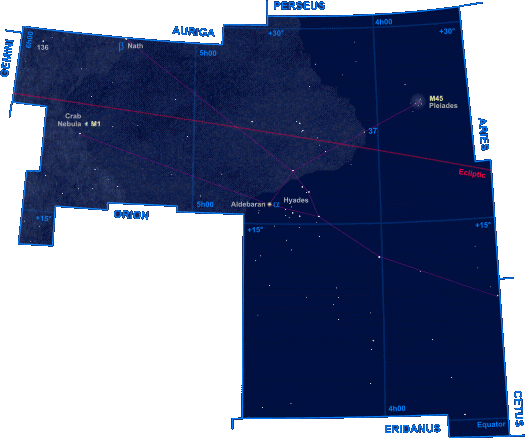
The Bull
Midnight in late autumn, you can appreciate constellations of winter at eastern sky. You'll pay attention a group of several stars gathering cozy and a "V" shaped asterism a bit looser. They are open clusters of the Pleiades and the Hyades respectively, and the cluster of Hyades forms the face of Bull, the Taurus. The Hyades includes a bright and reddish star of Aldebaran that looks like bull's eye being bloodshot.
The constellation shows mainly the horns of bull, The southern horn starts from Hyades and extends to zeta Tauri, and another one of north lifts up just north of the Hyades, through to beta Tauri, that is part of Auriga. The rest of the bull is rather faint, a slight body and two spindle legs.
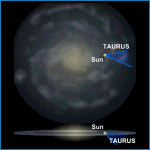
Taurus lies in exactly the opposite direction to the Galaxy's Core. At a point in this constellation not far from the star Nath is the mathematically nearest approach of the Galaxy's rim, roughly 17,000 light years away.
Derivation
This region of the sky has been seen as a bull's head and forelegs since classical times, and perhaps even earlier. The Greeks identified the bull form as none other than Zeus himself, in the shape he took to pursue Europa.
Stars
The brightest and best known of Taurus' stars is the orange giant Aldebaran, an irregular variable star that forms the 'eye' of the bull, and is relatively close to the Solar System at a distance of 65 light years. Also prominent in this constellation is first magnitude Nath, a blue star that forms the tip of Taurus' northern horn.
Star Clusters
Taurus is home to two of the most important star clusters in the sky, both of which are clearly visible to the naked eye. The most famous of these is the Pleiades cluster, named after the daughters of Atlas and Pleione (who each have their own star within the cluster). The Pleiades is a relatively young cluster, whose blue stars are still emerging from their nursery of shimmering gas and dust. It contains about one hundred stars in total, but only a few of these are visible without a telescope. The Pleiades are more than 400 light years from Earth.
Less than half as far away (150 light years to be precise), is a cluster named for the half-sisters of the Pleiades, the Hyades. The Hyades cluster is so close that it covers a significant area of the sky: its diameter of 8° is about fourteen times that of the full Moon. The Hyades is very easy to locate, because its stars form the triangular 'face' of the bull, behind the unrelated 'eye' star Aldebaran.
Nebulae
Near Zeta Tauri, the star marking the tip of Taurus' southern 'horn', is the first object in Messier's catalogue, better known as the Crab Nebula. This is the rapidly expanding remnant of a supernova seen from Earth in the year 1054. The Nebula itself represents the material thrown out from the outer layers of a dying star, but what remains of the star's core still lies at the heart of the nebulous region. This is a neutron star spinning on its axis thirty times a second, of the type categorised as a pulsar.
Myth
The Greek deity Zeus lusted after the beautiful maiden Europa, the daughter of Telephassa and Agenor (the king of Phoenicia). One morning, she and other maidens went to pick flowers in the meadow by the sea. Zeus wanted her so badly, he disguised himself as a beautiful, innocent looking white bull, and roamed the meadow where the women lingered. Europa soon noticed Bull's presence and approached him. She admired his beauty and gentleness, and on a whim mounted him. Zeus, the Bull, leaped up and carried her over 600 miles across the water to the Island of Crete in the Mediterranean Sea. There she became the mother of King Minos of Crete, King Rhadamanthus of the Cyclades Islands, and Prince Sarpedon of Lycia. Another story about Taurus involves the seven daughters of Atlas, or in other versions, Pleione. The great hunter Orion took more than a passing interest in them. Atlas felt a rather old fashioned concern for his daughters, and asked Zeus to protect them. Zeus transformed the seven sisters into doves and placed them in the sky. When Orion followed them, Zeus placed a large bull between him and the seven new stars.
M1, The Crab Nebula is positioned just Northwest of zeta Tauri, with a size of about 6 arc minutes. The nebula has lots of stripes spreading outward visible with larger telescopes, this figure gives the name. The distance is about 7200 light years.
The Crab Nebula is a remnant of a supernova, exploded in July 1054. Chinese and Japanese astronomers(?) recorded this event in the ancient literary works. The exploded star, that produced the nebula, brightened up with the visual magnitude of about -5, bright enough to be seen in the daytime for nearly a month. Now, astronomers have discovered a neutron star, an optical pulsar in the center of the nebula.
A planetary nebula lying near a boundary on Taurus is NGC1514. You will be able to find out the nebula to trace about 8 degrees northeast from the Pleiades. The nebula has a diameter of about 2 arc minutes, high-powered view of telescopes shows you a bright central star and very dimmed nebulosity spread out on the outskirts. The dimmed gaseous matter exposes films in greenish color, suggesting the matter is emitting light from ionized oxygen atoms. The central star still looks bright; it's considered that the planetary nebula just starts to release gas, fairly newly nebula formed from a dead star. The gaseous region will spread out increasingly within several ten thousand years, and evolve into a splendid planetary nebula like the Ring Nebula (M57) or Dumb-bell Nebula (M27).
M45, The Pleiades is the most popular Open Cluster seen in the constellation of Taurus. We can see bright six or seven stars with naked eyes, and these seven go under the name "The Seven Sisters".
The Pleiades is one of the closest star clusters with 410 light-years away, we can detect as a size of about 2 degrees. It has a huge size, so binoculars are suitable for appreciating this attractive object rather than telescopes. This cluster is visible easily, so it has various names from ancient times. For example, the cluster is called "Subaru" in Japan meaning of "bind" or "tie", this name can be found out in a Japanese ancient literary work, "Makurano-Soushi" in 10th century.
The Pleiades has been covered by bluish reflection nebula. Especially there is a bright part around Melope, a southern star of Pleiades, called "The Melope Nebula". And the nebula has an ID number of NGC1435. The nebula has a span of about 30 arc minutes in north-south direction, and has stripe structures looks like being sweeped with paintbrush. The nebula is particularly striking around Melope, you can appreciate it with your own naked eyes aided with binoculars or small scopes under good-conditioned night sky.
Ghostly Reflections in the Pleiades
Wispy tendrils of a dark interstellar cloud being destroyed by the passage of one of the brightest stars in the Pleiades star cluster. Like a flashlight beam shining off the wall of a cave, the star is reflecting light off the surface of pitch black clouds of cold gas laced with dust. These are called reflection nebulae.
The famous cluster is easily visible in the evening sky during the winter months as a small grouping of bright blue stars, named after the "Seven Sisters" of Greek mythology. Resembling a small dipper, this star cluster lies in the constellation Taurus at a distance of about 380 light-years from Earth. The unaided eye can discern about half a dozen bright stars in the cluster, but a small telescope will reveal that the Pleiades contains many hundreds of fainter stars.
This visible-light picture, taken by the Hubble telescope, reveals an intergalactic "pipeline" of material flowing between two battered galaxies that bumped into each other about 100 million years ago. The pipeline [the dark string of matter] begins in NGC 1410 [the galaxy at left], crosses over 20,000 light-years of intergalactic space, and wraps around NGC 1409 [the companion galaxy at right] like a ribbon around a package. The galaxies reside about 300 million light-years from Earth in the constellation Taurus.
Two medium-sized open clusters lie between the horns of Taurus. NGC1647 is positioned about 5 degrees east of the Hyades. The cluster and the Hyades can be appreciated in the same view frame of binoculars. It's very easy to resolve individual stars in low magnification, you may get the impression that several fine stars are distributed sparse.
The cluster of NGC1746 can be found 5 degrees north east of NGC1647. The cluster looks spacer than NGC1647. Many of members are sufficiently bright, you can enjoy the full of stars blinking in the field of binoculars.
Around between Taurus and Orion, you can see two small open clusters lined up with an interval of 20 arc minutes. This couple is positioned at a bit south of the midway of Taurus's southern horn. The cluster at the right-hand side (west) is NGC1807,
And the other one is called NGC1817.
Both clusters have apparent diameters of 16 arc minutes; they should be classified in small-sized group. But it'll be sufficiently worth seeing with binoculars that two pretty clusters are snuggled up just above the head of Orion.
You can see a vast, but extraordinary faint supernova remnant of Sh2-240 (Simeis 147) between the constellations of Auriga and Taurus. The remnant has an apparent diameter of over 3 degrees, but this image has captured only southern part, actually the entirety of Sh2-240 is spread out beyond the field of this image. The Sh2-240 is a remnant of supernova that exploded about 200 thousand years ago, and the nebula is extending with a terrific speed yet. Of course we cannot detect the nebula with our naked eyes. It's one of features that the nebula has fine filament structures, looks like a very dimmed Veil nebula in Cygnus.
We can detect the various shaped flows of dark nebulae in the winter's Milky Way by taking photographs. The dark nebula is mainly consists of the cold hydrogen gas and/or the dust floating in the inner-galaxy space. A noticeable vast dark nebula spreading around the constellation of Taurus and Auriga is named Barnard's 7.
We can hardly recognize the existence of dark nebula until that conceals the background stars like a silhouette. The Milky Way in winter is much fainter than that in summer, so the dark nebulae in winter sky are fairy indistinct. Most of them are photographed, we can appreciate clearly in films.
The Hyades is the one of the largest open clusters in skies, with a size of about 5 degrees. The cluster forms the Bull's face, shaped like a "V", consists of approximately 100 stars. You'll be able to enjoy the splendid view with binoculars. The Hyades is about 140 light years away, one of the closest clusters. The Aldebaran (alpha Tauri) is much closer (68 light years) than that, and has no relation with the cluster. There is a tiny open cluster of NGC1647 at the left-hand side, seemingly it seems like being sent forth from the Hyades.
Planetary Destinations In Taurus
Some people say that TMR-1C is a planet and some have said that is not. Well i say. Obviously there is something out there. So here's the interstellar card if you want to know the truth.
Located in the sky within a star-forming region in the constellation Taurus, the object, called TMR-1C, appears to lie at the end of a strange filament of light that suggests it has apparently been flung away from the vicinity of a newly forming pair of binary stars.
At a distance of 450 light-years, the same distance as the newly formed stars, the candidate protoplanet would be ten thousand times less luminous than the Sun. If the object is a few hundred thousand years old, the same age as the newly formed star system which appears to have ejected it, then it is estimated to be 2-3 times the mass of Jupiter, the largest gas giant planet in our Solar System.
Also possible is that the object is up to ten million years old, the same age as other young stars nearby, in which case it may be a giant protoplanet or a brown dwarf star. A brown dwarf star is a small star that has failed to sustain nuclear fusion.
The candidate protoplanet is now 130 billion miles from the parent stars and predicted to be hurtling into interstellar space at speeds up to 20,000 miles per hour (10 kilometers/sec) � destined to forever drift among the Milky Way's starry population.
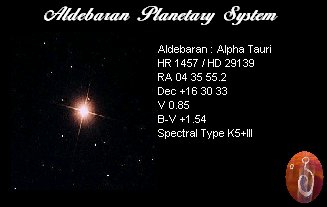
Aldebaran is by far the brightest, and therefore the Alpha, star of the constellation Taurus. The ancient name, from Arabic, means "the Follower," as the star seems to follow the Pleiades, or Seven Sisters star cluster, across the sky. Aldebaran, 60 light years away, is positioned in front of the sprawling Hyades star cluster (in mythology, half-sisters to the Pleiades) that make the face of Taurus the Bull, but is not a part of it, the cluster over twice as far away. In most renderings of the constellation, Aldebaran makes the celestial Bull's eye. As part of a constellation of the zodiac, Aldebaran is close to the Sun's path, the Sun passing to the north of it about June 1, the star also regularly covered, or occulted, by the Moon. This class K star, of first magnitude and 13th brightest in the sky, is a low- level irregular variable star that fluctuates erratically and to the eye unnoticeably by about two-tenths of a magnitude. Aldebaran's surface temperature of just under 4000 degrees Kelvin (compared to the Sun's 5800 degree temperature) gives it a distinct orangy color. It is a giant star, a star in an advanced state of evolution in which the interior hydrogen fuel has run out, the star now running on the fusion of helium into carbon. Some 350 times more luminous than the Sun, it has expanded to a radius about 40 times solar, making it big enough to enable astronomers to measure its small angular diameter of only 0.021 seconds of arc (the apparent size of a US nickel seen at a distance of 50 kilometers). This large star is an extremely slow rotator, taking almost two years to make a full spin. If placed at the position of the Sun, Aldebaran would extend halfway to the planet Mercury and would appear 20 degrees across in our sky, making life on Earth quite impossible. Yet Aldebaran may have its own "solar system." Recent, though still-unconfirmed, observations show that the star may be slightly shifting back and forth in response to a small body with a mass at least 11 times that of Jupiter and a two-year orbital period. We do not yet know if the body -- if it exists at all -- is a massive planet or a low-mass "brown dwarf," a failed star that is too small to run supporting thermonuclear reactions in its core.
MAPPING TECHNIQUE
VISUAL EXERCISE : Two Person Exercise.
DESTINATION : Your Choice
STEP ONE
Traveller : Get comfortable and relax.
STEP TWO
Traveller : Charge your physical body with light energy.
STEP THREE
Traveller : See your visual body standing in front of your physical body and prepare your visual body for interstellar travel with a Interstellar Protection Shield.
STEP FOUR
Traveller : See your visual body filling with light energy.
STEP FIVE
Traveller : Focus your mind on teleporting your visual body to the Your Destination.
STEP SIX
Traveller : Then see your visual body teleporting to the Your Destination.
STEP SEVEN
Traveller : When you arrive in the destination Look around can you see any planets or moons in the System? If not use the Interstellar Planetary Detection Rapid and see if you can detect any planets or moons in that system.
STEP EIGHT
Traveller : If you can see or detect a planet or moon using Telekinesis or Teleportation move towards the planetary body.
STEP NINE
Traveller : When you arrive at the outer atmosphere of the planet or moon stop and ask your spiritual guide to tell you the name of this planet or moon.
Traveller : Tell the mapper the name of the planet or moon. Also tell the mapper all you can about the planet or moon.
STEP TEN
Then us the Core Comparison Crystal Technique to perform a core reading on this planet or moon and give the mapper your reading on this planet or moon
STEP ELEVEN
Traveller : Then levitate or Teleport your visual body to the surface of the planet or moon.
STEP TWELVE
Mapper : When the traveller arrives on the surface ask the following questions.
Is there any plant life or water on the surface of the planet or moon that you can see? Is there an atmosphere around this planet or moon? Is the atmosphere an match with earths atmosphere?
Mapper : Write down the answers to these questions.
PLANETARY DATA FILE 
STEP THIRTEEN
Traveller : When you are finished on the surface teleport your visual body to the nearest planetary body that you can see in that Galaxy.
STEP FOURTEEN
Traveller and Mapper : Follow steps nine through to twelve again till you have mapped out the whole Galaxy.
STEP FIFTEEN
Traveller : When you have finished mapping the Galaxy teleport your visual body back to your physical body back on earth.
REMEMBER
When you are travelling if you come across an alien race that you think may be friendly feel free to make contact with that alien race.
IMPORTANT
When you are contacting alien races always be ready to teleport if there is trouble.
MAPPER
Make a note of any planets or moons with an atmospheric match with earths. That way you both know which planets can support human life forms.
MAPPER & TRAVELLER
To check that your mapping of that Galaxy is correct by changing roles and do this exercise again. Also remember to check for life force energy around the planets or moons that you visit on your journeys. Because if you can feel life force energy that means the planet or moons is a real planet or moon.