← The Wingmakers Ways · not in the site's own index
Archived page · Asserted
The Milky Way Galaxy
The_Milky_Way_Galaxy.html · captured from wingmakers.co.nz
The Milky Way Galaxy
Interstellar Card 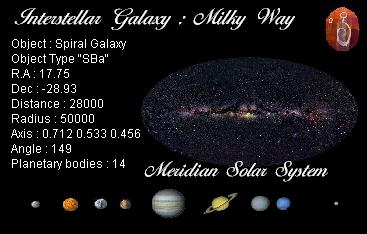 Introduction
The Milky Way Galaxy is a spiral galaxy; our sun and solar system are a small part of it. Most of the stars that we can see are in the
Milky Way Galaxy. The main plane of the Milky Way looks like a faint band of white in the night sky. The Milky Way is about 100,000
light-years in diameter and 1,000 light-years thick. There are about 2 x 10 11 stars in the Milky Way. This spiral galaxy formed about 14
billion years ago. It takes the sun roughly 250 million years to orbit once around the Milky Way. The Earth is about 26,000 light-years
from the center of the Milky Way Galaxy. The major arms of the Milky Way galaxy are the Perseus Arm, Sagittarius Arm, Centaurus
Arm, and Cygnus Arm; our Solar System is in a minor arm called the Orion Spur.
This panoramic view of the entire sky has been assembled from 51 wide-angle photographcs. The individual images were transformed to
a cartesian frame based on galactic coordinates prior to assembly, thus eliminating the distortions introduced by the wide-angle lens.
360°x45° panorama with constellations
The Milky Way galaxy is the spiral galaxy we call home, as do roughly 100 billion other stars. It looks very much like other spiral
galaxies when viewed from above. There are spiral arms and a bright central part. The Sun is far from the center of the Galaxy, halfway
to the edge of the Galaxy along the Orion spiral arm.
The Sun is revolving around the center of the Galaxy at a speed of half a million miles per hour, yet it will still take 200 million years for
it to go around once. Do you feel like you are moving at that speed through space? If you did, you would certainly need a seat belt!
When we run, we feel the wind on our bodies because there are molecules which make up the air that push against our bodies. But there
are very few molecules in the space between the stars. So there is nothing to push against our planet so that we "feel" like we are rushing
around at half a million miles per hour.
Like other spiral galaxies, the Milky Way has a bulge, a disk, and a halo. Although all are parts of the same galaxy, each contains
different objects. The halo and central bulge contain old stars and the disk is filled with gas, dust, and young stars. Our Sun is itself a
fairly young star at only 5 billion years old. The Milky Way galaxy is at least 5 billion years older than that.
Our Solar System is part of a huge "community" of stars, the Milky Way Galaxy. This chapter discusses the discovery of the nature of
the Milky Way and its place in the larger cosmos.
THE DISCOVERY OF THE MILKY WAY GALAXY
The question of just how big our Universe is has been around since prehistory, but it wasn't until the development of the telescope and
modern astronomy in the 17th century that astronomers decided to actually try to get a measured value for the size of the Universe.
Before that time, early astronomers such as Hipparchus had of course made catalogues of the visible stars, with the count going up to a
few thousand. However, the telescope made far more many stars visible, and the number kept multiplying every time a new, more
powerful telescope was put into service.
There was a still a reason, a very logical one, for believing that there was a finite number of stars in the Universe. In 1826, a German
astronomer named Heinrich Wilhelm Matthaeus Olbers (1758:1840) pointed out that if there were an infinite number of stars in the sky,
no matter where we looked, we would see a star, and the sky would be uniformly bright. This became known as "Olbers' paradox".
There was a fallacy in it, one which Olbers could be easily forgiven for not seeing, but an explanation will have to be put off to a later
chapter.
If the number of stars in the Universe was finite, then the other question was to ask how these stars were arranged. The night sky gave a
big hint, in the form of a lovely pale band of light that cut across the heavens like a river. The Greeks called it the "Galaxias Kyklos
(Milky Circle)", and the Romans called it the "Via Lactea (Milky Way)". The Greek term survived as the modern name "Galaxy". Even
before the invention of the telescope some thinkers had wondered if it were made up of countless stars. This was basically confirmed by
the telescope.
In 1784, the energetic William Herschel decided to characterize the distribution of stars in the Milky Way. Counting them all would take
more than his lifetime, so he mapped out a set of 684 sampling regions over the sky, counted the stars in each one, and obtained the
statistics on the samples. Herschel concluded that the density of stars was a maximum along the central plane of the Milky Way through
the sky, and that it fell off gradually with the separation of stars from the plane, reaching a minimum at a right angle to that plane.
However, the average density of stars along that plane, and any plane parallel to it, seemed constant.
Herschel concluded from these facts that the stars in the sky were arranged in a disk, with our Sun inside that disk, in fact fairly near the
center of it. Based on the knowledge of stellar distances known at the time he even put together an estimate of the size of this disk,
judging it to be about 8,000 light-years across, 1,500 light-years from top to bottom, and containing 300,000,000 stars.
Herschel was right about the disk, wrong about the Sun being near its center, and way too small in his estimate of its size. The size
estimate was gradually increased into the early 20th century. In 1920, following exhaustive photographic sky surveys, the Dutch
astronomer Jacobus Cornelius Kapteyn (1851:1922) estimated the Galaxy to be 55,000 light-years across and about 11,000 light-years
from top to bottom. The notion that the Sun was at the center of the disk remained intact, but that notion was just about ready to fall
over.
As discussed in an earlier chapter, Charles Messier had published his list of Messier objects in 1781, and William Herschel studied them
carefully. Among the Messier objects were spherical puffballs of light, the brightest of them being "M13", located in the constellation
Hercules. There were similar but less spectacular spherical nebulas in the Messier list. Nobody was sure if they were just luminous
clouds of gas or collections of stars.
Herschel, using the excellent telescopes he had built himself, was able to get a better look at M13 and realized that it was in fact a dense
collection of stars. Such objects became known as "globular clusters", as opposed to the more irregular clusters such as the Pleiades,
which were eventually referred to as "open clusters". M13 became known as the "Great Hercules Cluster".
As telescopes and observations improved, more globular clusters were discovered. William Herschel's son, John Herschel (1792:1871),
inspected the map of globular clusters known at the time and found something puzzling: the globular clusters were heavily concentrated
in the sky in the direction of the constellation Sagittarius, and were absent in the opposite direction. There had to be some significance to
this distribution, but he did not know what it might be.
It wasn't until the 1920s, with the discovery of the period-luminosity relationship of Cepheid variables, that the reason for this
distribution of globular clusters was understood. The American astronomer Harlow Shapley (1885:1972) used the relationship to obtain
distances to the globular clusters, and his analysis showed they were arranged in a sphere whose center was in the direction of the
Sagittarius.
A simple understanding of the law of gravity suggested that the globular clusters were orbiting around the center of mass of the Milky
Way. This meant that the Earth wasn't at the center of the Galaxy after all. Shapley's analysis showed that this center of mass was about
50,000 light-years away. As mentioned, the Cepheid yardstick had to be adjusted to compensate for reddening by the interstellar medium
later, but that still gave a distance of about 27,000 light-years to the Galactic center. The Milky Way appeared to be about 100,000
light-years in diameter, and was presently estimated to contain about 100,000 million stars.
Astronomers were puzzled because star counts of the Milky Way gave about the same density at any place along its central plane. The
answer to the puzzle came from the dark molecular clouds such as the Coal Sack. Their nature was not clearly understood at the time
and they were simply known as "dark regions".
In 1919, the American astronomer Edward Emerson Barnard (1857:1923) published a list of 182 such dark regions. Barnard and the
German astronomer Max Wolf (1863:1932) correctly suspected that these regions were not empty of stars, they were actually cold dark
clouds that blocked out the light of stars behind them. Given that realization it didn't take too much imagination to realize that the
presence of such "dark nebulas" in the plane of the Milky Way would create a curtain to hide the center of the Galaxy from view, at least
in the visible region of the electromagnetic spectrum.
THE DISCOVERY OF THE ANDROMEDA GALAXY 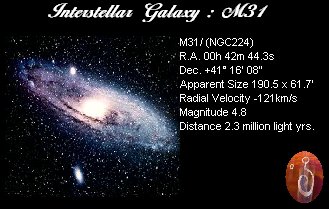
In the meantime, astronomers were discovering that the Milky Way was not alone. To be sure, the Milky Way had long been known to
have small satellite galaxies, in the form of the two Magellanic Clouds visible from the Southern Hemisphere, but they were part of the
Milky Way system and could not be regarded as "island universes" in themselves.
However, the Messier list of nebulas also included a few odd-shaped objects that looked like lenses or spirals, the most spectacular being
the "Andromeda Nebula" in the constellation Andromeda, which is so bright that its central region can be seen on a dark night with the
naked eye. Of course, the question arose again: were they structures of luminous gas, or communities of stars?
In 1755, the great German philosopher Immanuel Kant (1724:1804) published a work that suggested the Andromeda Nebula and its like
were actually "island universes" of their own, or in other words they were other Milky Ways. The great French astrophysicist Pierre
Simon de Laplace (1749:1827) suspected that the Andromeda Nebula was a young planetary system in the process of formation. The
matter was debated back and forth for a century until 1907, when a report was published that claimed a parallax measurement of the
Andromeda Nebula showed it was only 19 light-years away, right next door in cosmic terms.
That might have ended the argument, except that in 1899 the first spectroscopic measurements were made of the Andromeda Nebula
and showed it to have a continuous spectrum. This was consistent with a star or mass of stars, not a cloud of glowing gas. Promoters of
the "local" theory for the Andromeda Nebula suggested that it was reflecting light from nearby stars and pointed out that no individual
stars could be made out in the nebula.
The second observation wasn't entirely true. In 1885, a bright starlike object appeared in the central region of the Andromeda Nebula,
and then faded out. The notion of a nova was understood at the time, and it was plausible to believe that the object that had been
observed, which was named "S Andromedae", was a nova.
Nobody was exactly sure just how bright a nova was at the time, but in 1901 a nova was observed in the constellation Perseus. "Nova
Persei", as it was logically named, was close enough to permit parallax measurements, and it turned out to be about 100 light-years away.
An analysis was published in 1911 that assumed S Andomedae was about as bright as Nova Persei, giving a distance to the Andromeda
nebula of about 1,600 light-years.
This threw the parallax measurement of distance to the Andromeda Nebula into doubt, and of course now we know it was completely
mistaken. However, 1,600 light-years still put the Andromeda Nebula well inside our Milky Way. There was plenty of good cause to
doubt that distance as well. The assumption behind the calculation that gave 1,600 light-years was that Nova Persei and S Andromedae
were roughly as bright, and in fact it was an assumption that S Andromedae was actually in the Andromeda Nebula. For all anyone
knew, S Andromedae could have been much closer than the Andromeda Nebula and just happened to be on the same line of sight.
The analysis was still a step in the right direction. The sciences, like any other activity grounded in the real world, work by steps, using
available knowledge to acquire improved insights that can then be validated or discarded, like working through a maze by checking out
and discarding branches that come to dead ends.
The way to resolve such questions is to acquire more and better data. The American astronomer Heber Doust Curtis (1872:1942)
decided to see if he could track more novas in the Andromeda Nebula and managed to discover about a hundred from archival
photographic plates and observations. The observations covered a very short period of time, a few decades, and novas are a fairly rare
phenomenon. The finding of so many novas meant that the probability that they weren't associated with the Andromeda Nebula and just
happened to lie in the line of site was vanishingly small. Novas simply didn't happen at that rate over the entire sky. In fact, novas were
rare enough to suggest to Curtis that the Andromeda Nebula was not only composed of stars, it had to composed of a lot of stars to
account for such a rate of nova explosions.
In addition, the novas that Curtis found in the Andromeda Nebula were much fainter than S Andromedae. In 1918, Curtis suggested that
the novas he had found were in a league with Nova Persei, and that if S Andromedae had actually occurred in the Andromeda Nebula it
was much brighter than an ordinary nova.
Many astronomers, including Harlow Shapley, were skeptical. Since so little was known about novas, any assumptions about their actual
properties were hard to take seriously. Then the American astronomer Edwin Powell Hubble (1889:1953) figured out an unarguable way
to break the impasse.
The world's most powerful telescope had come on line on Mount Wilson in southern California in 1917. The "Hooker telescope", funded
by donations by a Mr. John D. Hooker, was a reflector with a mirror 2.54 meters (100 inches) in diameter, making it the most powerful
telescope in the world until after World War II. Hubble used the Hooker telescope to resolve stars in the Andromeda Nebula, proving
that it was not a cloud of gas, and in 1923 he spotted a Cepheid variable that allowed him to estimate its distance as 800,000 light-years.
Of course, what he had actually spotted was an RR Lyrae variable, and it wasn't until well after World War II that astronomers realized
that they had their own, brighter, period-luminosity curve. That led to readjusting the distance to the Andromeda Nebula to 2,500,000
light-years.
However, even the short value of 800,000 light-years made the Andromeda Nebula an "island universe" in its own right, much like our
own Milky Way Galaxy. Hubble wanted to call it an "extragalactic nebula", but Harlow Shapley, who had come around with almost
everyone else, thought this was inadequate. It was something much like the Milky Way, so it might as well be called the "Andromeda
galaxy".
Of course, many other similar objects had been catalogued to that time, including a goodly number in the Messier list, most particularly
"M51", the spectacular "Whirpool Nebula". By the time of the discovery that the Andromeda Nebula was another galaxy, tens of
thousands had been catalogued. About 75% were spiral in form, with some of these seen edge-on and appearing as spindles, while 20%
were spherical or elliptical, and the other 5% were irregular in shape.
Now it was realized that most of these objects were actually galaxies as well. It must have been a mind-boggling revelation, showing that
the Milky Way was not the entire Universe but just one island universe among vast numbers of them.
Simulating the Fate of Our Milky Way
When cars collide, it�s an accident. When galaxies collide, it�s Nature at work. Many astronomers believe such crashes are part of the
natural evolution in the lives of galaxies and galaxy clusters, now scientists are blending scientific research and high-powered computer
visual effects into vivid models of how they occur.
Astrophysicist Frank Summers, of the Space Telescope Science Institute (STScI), produced a simulated galaxy collision, using a
combination of computer modeling research and the same special effects software used to make computer-generated movies.
The resulting animation shows a crash between two large spiral galaxies roughly the size of our own Milky Way and its larger neighbor
Andromeda, themselves slated to collide in a few billion years.
Our Future: A simulation of what might happen when the Andromeda Galaxy hits ours shows tidal forces of gravity creating long plumes
of material. The central regions will relatively quickly fall back together and merge into a single remnant galaxy.
Rip and tear 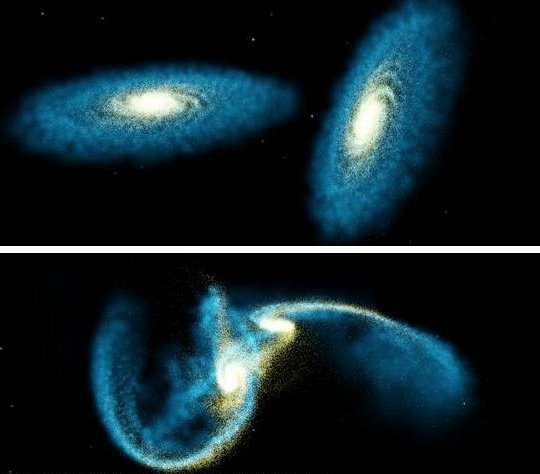
In his animation, Summers shows two galaxies at different planes of position, then documents their collision at a rate of about 10 million
years per second. The entire sequence covers some 500 million years.
As the galaxies approach each other, they keep their spiral shapes up to the point of impact, where so-called "tidal forces" of gravity
result in the formation of long plumes of stars, gas and dust called tidal tails. The centers of each galaxy then merge into one remnant
core. The scenario is a likely preview for the expected interaction between the Milky Way and Andromeda galaxies, which some
astronomers have already mapped out with computers models.
Summers used research data produced by astronomy professors and galactic modelers Chris Mihos, of Case Western Reserve
University, and Lars Hernquist, of Harvard University. The researchers used a supercomputer to depict the collision in a project for the
National Air and Space Museum's newly renovated Einstein Planetarium.
Dark matter
Astronomers who study galaxy structure spend most of their time modeling the effects of dark matter, that ubiquitous but unseen stuff
that makes up most of a galaxy�s mass, Summers said. Only between 10 percent and 30 percent of a galaxy�s mass is visible, so
astronomers study its rotation to determine the dark matter content, material that must be there based on known gravitational effects.
They also look at how clusters of galaxies appear glued together by gravity.
By simulating collisions between galaxies, theorists can study the structures of galaxies and the architecture behind galactic clusters
without having to wait the millennia it takes for such crashes to occur.
In the early days of the universe, the rate of collisions was about 10 to 100 times higher, simply because things were closer together.
Although individual stars may not physically hit each other during a collision -- the space between them is still vast -- the gravitational
effects of the encounter are enough to twist and distort galaxies beyond recognition.
Colliding spiral galaxies can become one elliptical galaxy, for example, which is the likely destiny for our Milky Way, astronomers say.
Galaxy building
"Mergers and interactions between galaxies are an essential part of their dynamical evolution," said John Dubinksi, an astronomy
professor at University of Toronto who has modeled the eventual clash between the Milky Way and Andromeda galaxies. "The elliptical
galaxies which represent around 10 percent of the galaxy population are most likely the product of a merger of two or more galaxies of
nearly equal mass."
MAPPING THE MILKY WAY / GALACTIC CORE
For years astronomers had no clear idea of the structure of the Milky Way Galaxy, and many believed nobody ever would. It was like
being inside a box and trying to figure out what the box looked like from the outside. Fortunately, there turned out to be a way to see
through the walls of the box.
In 1931, an American radio engineer named Karl Jansky (1905:1950) of Bell Telephone Laboratories was investigating natural sources of
radio interference. He managed to determine that some interference was coming from the sky, and that the interference was particularly
strong in the direction of the constellation Sagittarius, in the direction of the core of the Milky Way.
Jansky's efforts were focused on improving radio communications, not performing astronomy. He reported his findings and went on
about his work. Most astronomers didn't notice the report, but another American radio engineer named Grote Reber decided to perform
his own investigation of cosmic radio sources. He built a crude radio telescope in 1937 and located a number of sources, publishing his
results in 1940.
World War II was in progress at the time. Most formal astronomy work went onto the back burner for the duration, but the war had a
profound effect on the history of radio astronomy. New radio technologies were developed, mostly for radar, that could be used in more
peaceful times to probe the radio sky, and there was also more need to understand natural sources of radio interference.
Some astronomical work was done during the war that would also have a major influence on the future of radio astronomy. In 1944, a
Dutch astronomer named Hendrik Christoffel van de Hulst, living in Nazi-occupied Holland, decided for want of anything better to do
under the circumstances to perform some analyses in theoretical physics. He got to tinkering with the characteristics of cold monatomic
hydrogen, the most common constituent of the interstellar medium, and found that it could occupy two energetic states. It could drop
from the more energetic state by emitting a photon of 21 centimeter (1.4 gigahertz) electromagnetic radiation, in the microwave band of
the spectrum, or jump up to the more energetic state by absorbing such a photon.
Such events were rare in the life of any one hydrogen atom, maybe taking place once every 11 million years or so, but the Milky Way
contains a lot of hydrogen atoms. Dense regions of cold hydrogen, known as "H-I regions" in contrast to the much less common "H-II
regions" of hot ionized hydrogen, could be expected to be radiate strongly enough at 21 centimeters. They would be singing the "song of
hydrogen" as it was called, to allow detection by sufficiently sensitive receivers. The 21-centimeter radiation could also penetrate through
the Milky Way's dark clouds with relatively little attenuation, allowing astronomers to create a map of the distribution of cold hydrogen
clouds that would be difficult to make at optical wavelengths.
Astronomers had been trying to build such maps at optical wavelengths, but with the development of workable radio telescopes in the
1950s, observations were finally able to cut through the murk and create a useful map. The Milky Way had been thought to be a spiral
galaxy, and the radio map of H-I regions showed that it seemed to have three spiral arms.
The cold hydrogen observations were somewhat ambiguous and provided relatively limited detail. However, beginning in the early
1960s, astronomers began to find that interstellar space contains a wide range of molecules, such as carbon monoxide, ammonia,
acetylene, and formaldehyde, which had their own distinctive spectral signatures.
These interstellar molecules were interesting in themselves, but they also helped provide a better map of the Galaxy. Although
monatomic hydrogen emitted radio waves on the 21-centimeter wavelength, the diatomic hydrogen molecule, or "H2", which can form in
the opaque molecular clouds, has no strong radio signature. However, carbon monoxide does, and it is associated with H2 clouds,
providing a "tracer" that helps to map out the location of the large molecular clouds.
About half the interstellar gas in our Galaxy resides in such molecular clouds, with giant clouds of this type are concentrated along the
Milky Way's spiral arms. The carbon monoxide in these clouds makes them perfectly and distinctly visible in the radio sky.
* The radio mappings revealed the structure of the Milky Way. It is disk-shaped, about 100,000 light-years in diameter, with the Sun
about 25,000 light-years from the core and performing an orbit around the core about once ever 250 million years. There is a
concentration of stars and mass at the center of the disk, in the direction of the constellation Sagittarius, with about 150 globular clusters
in wide orbits around the galactic core.
Within the galactic plane there are vast numbers of stars. Old stars shed planetary nebulas into the galactic medium, while supernovas
scatter out tortured masses of gas in a more spectacular fashion. Stars form in dark clouds of dust and gas, emerging into galactic
clusters.
Radio observations of the molecular clouds revealed the arm structure of the Galaxy. In the direction of the Galactic core lie the
Sagittarius arm and, closer to the core, the Carina arm, which merge into a single larger arm about 6,000 light-years from our Sun that
then curves around the Milky Way about two-thirds of its distance. Interesting sights in the Sagittarius arm include:
Destinations In The Milky Way Galaxy
Globular Cluster M4's Location in Milky Way
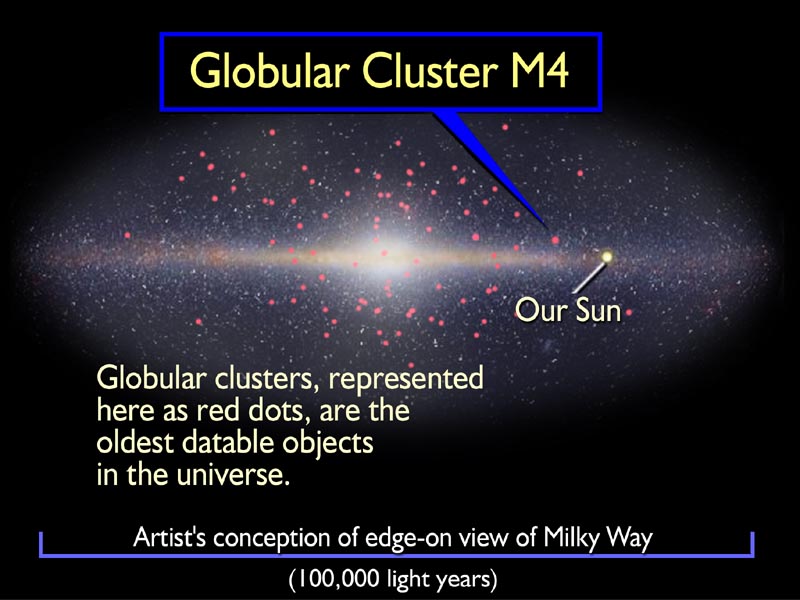
This illustration shows the location of the globular cluster M4 in our Milky Way Galaxy, which is depicted "edge-on" or from the side.
Globular clusters like M4 are the first pioneer settlers of the Milky Way. Many coalesced to build the hub of our galaxy and formed
billions of years before the appearance of the Milky Way's magnificent pinwheel disk. Today, 150 globular clusters survive in the galactic
halo.
Interstellar galaxy card 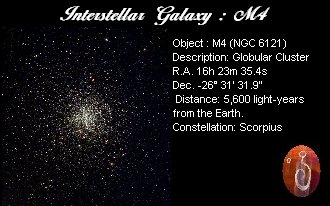
You can see a reddish bright star, Antares, at the left side in the picture. And a globular cluster located just one degree west of Antares is
M4 (NGC6121). It's very close from the Antares, so we can find easily the cluster with binoculars, but without a larger telescope it will
not appear very spectacular. M4 is characteristic as its reddish color although we cannot detect the peculiar colors in almost all of other
globular clusters. The cluster consists of about 10 thousand stars, and about seven thousand light years away.
Location of V838 Mon in the Milky Way Galaxy 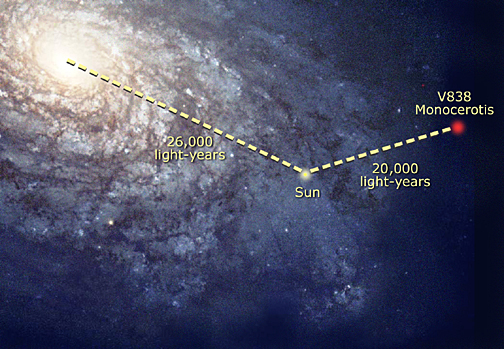
Interstellar galaxy card 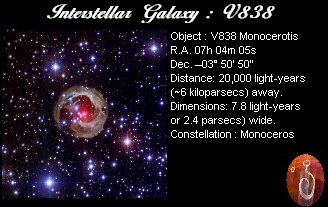
The star, named V838 Monocerotis for its location in the constellation of the same name, suddenly grew 600,000 times brighter than the
sun in January 2002. The flash temporarily made the star -- in the constellation also known as The Unicorn -- the brightest light in the
Milky Way.
Though not the result of a supernova -- a titanic explosion that blasts a giant star into oblivion -- V838 Mon's eruption nevertheless was
powerful enough to light up a considerable chunk of its neighborhood.
Interstellar galaxy card 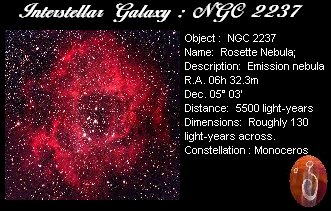
The Rosette Nebula is a beautiful large nebula complex in winter Milky Way in Monoceros.
Surrounding open Cluster NGC 2244 in Monoceros, the Rosette is a collection of emission and dark nebulae and Bok Globules.
The cluster is a distinctive group of a half dozen or so stars which some describe as appearing as a ladder. The cluster can be seen with the unaided eye in the winter Milky Way, but the entire nebula is difficult to view in a telescope because its large size can easily spill out of the field of view.
Interstellar galaxy card 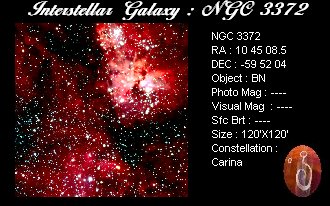
NGC 3372, The Keyhole Nebula. A diffuse nebula of great complexity and beauty. While the nebula is composed of brightly glowing gas, there are arker areas which serve to break the nebula into individual islands. The most dramatic of these darker areas has been labelled the Keyhole because of its shape. Eta Carina is found in this nebula.