← The Wingmakers Ways · not in the site's own index
Archived page · Asserted
Triangulum Australe
Triangulum_Australe~2004.html · captured from wingmakers.co.nz
Triangulum Australe 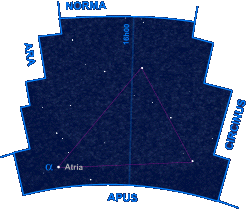
The Southern Triangle
Genitive : Trianguli Australis
Abbreviation : TrA
Right Ascension : 14h50 to 17h09
Declination : -60.3° to -70.3°
Area (sq deg) : 110
Brightest Star : Atria
Optimum Visibility : May.
Triangulum Australe, the Southern Triangle, is located east of Alpha Centauri, beyond the narrow constellation of Circinus. Its Alpha star is sometimes known as Atria. Despite lying mostly in the Milky Way, it is remarkably impoverished in deep sky objects. It seems that when clusters and nebulae were being distributed, Norma to the north got most of the goodies while the Triangle was left with some crumbs.
One of these "crumbs" is NGC 6025 (RA 16h 03.7m, Dec. -60 30") , an open cluster right next to the northern border and visible in finderscopes. It is a loose but pretty group of some two dozen moderately bright stars, and some fainter ones, mostly white with some pale yellow. The two brightest stars are located on the southern margin. The cluster is about 15' across in a N-S direction, but only half as wide E-W. There is no area of concentration.
Also in the far north, and just missed out from being included in Norma, is the planetary nebula NGC 5979 (15h 47.7m, -61 13'). With a 20 cm SCT and a suburban sky, it was a faint and difficult-to-find star-like point. I could not distinguish it from other faint stars nearby until an OIII filter was used, so that its brightness was undiminished while the nearby faint stars were all but blocked out. Returning to the unfiltered view, it could on close inspection be seen to be a bit fuzzier than a normal star. It lies about 15' W of a mag. 7 star, and is the leading apex of a flat isoceles triangle with two other stars. Supposedly it has a 15" disk, but this must be in photos or in a dark sky.
I tried for the two brightest galaxies in the constellation, NGC 6156 (16h 34.7m, -59 36') and NGC 5938 (15h 36.6m, -66 50'), but they were not bright enough to see in my viewing conditions.
The remaining telescopic objects in Trianglum Australe are double stars. Sellors 11 (15h 54.9m, -60 45') is half-way between NGC 6025 and NGC 5979, and consists of mag. 6.5 and 8.8 components 1.2" apart. Although theoretically resolvable with 20 cm aperture, I could not split them in only average seeing. The white star did begin to appear elongate with 235x power. On either side to the E and W are two wide companion field stars.
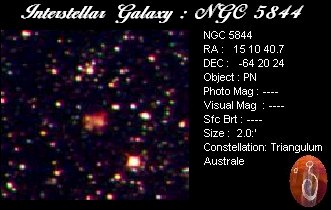
NGC 5844 at position 15h10'42.0"-64O41'00 is listed as nonexistent, while the planetary SA2-115 is positioned at 15h10'39.9" -64O40'19". The difference is a mere 52.8"sec.arc.- so likely that the two objects are really the same. (I will assume it is!) The original description by Dryer in the NGC was PB,PL,R,VGVLBM - Pretty Bright, Pretty Large, Round, Very Gradual and Very Little Brighter in Middle. A rather odd designation for this object, as it does not match its telescopic appearance. It has also been deleted from the revised NGC catalogue and no reason is given for this deletion. However, this difference has meant that most Star Atlases and Catalogues - including Sky Atlas 2000.0 and Sky Catalogue 2000.0, Uranometria 2000.0 (map 452.) etc. have not listed this fairly bright and interesting planetary. Recently, a Bowen Mountain all were surprised at the brightness of this object, especially as it lies close to the rear-end of Triangulum Australe and Beta Centauri. Using the 0.45 metre telescope at Bowen on the 23rd August 1997; Mick McCullagh and Don Whiteman (for their first time peek) took sometime to find this object among the brilliantly starry field of Triangulum Australe. When it was found, it was obvious. (Even some local visitors looked at this object, but as first timers I suppose they didn't understand the implications of what they were seeing. However, I did give an explanation the general nature of planetaries and their evolutions.)
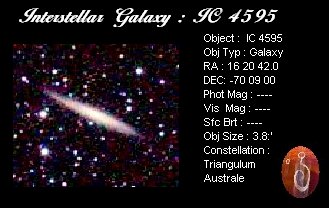
The interacting spiral-galaxy pair IC 4584/5 in Triangulum Australe, shown from a red-light exposure with an RCA CCD in the EFOSC system at the 3.6-meter telescope of the European Southern Observatory on Cerro La Silla, Chile. North is at the top and east to the left, for direct comparison with a chart or eyepiece view. The image uses a logarithmic intensity transformation to preserve information across a wide dynamic range. The field is 3.5 x 5.8 arcminutes. 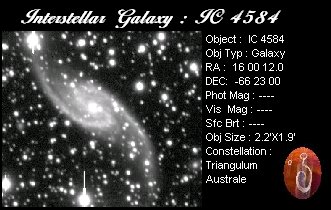
The northern galaxy (IC 4584) shows clear evidence of tidal distortion, in the form of a strong two-sided stretch to the spiral pattern and what looks like warping of the disk toward the southern galaxy, which appears still unscathed. The field wouldn't look so busy if we didn't see these at 11 degrees from the galactic plane... 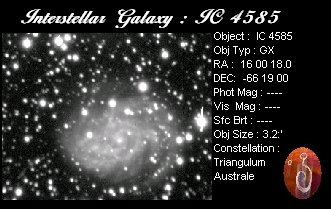
Triangulum Australe, the Southern Triangle, is located east of Alpha Centauri, beyond the narrow constellation of Circinus. Its Alpha star is sometimes known as Atria. Despite lying mostly in the Milky Way, it is remarkably impoverished in deep sky objects. It seems that when clusters and nebulae were being distributed, Norma to the north got most of the goodies while the Triangle was left with some crumbs. 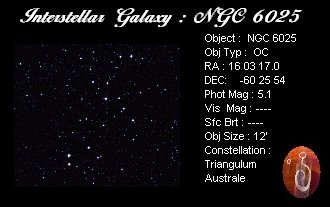
One of these "crumbs" is NGC 6025 (RA 16h 03.7m, Dec. -60 30") , an open cluster right next to the northern border and visible in finderscopes. It is a loose but pretty group of some two dozen moderately bright stars, and some fainter ones, mostly white with some pale yellow. The two brightest stars are located on the southern margin. The cluster is about 15' across in a N-S direction, but only half as wide E-W. There is no area of concentration.
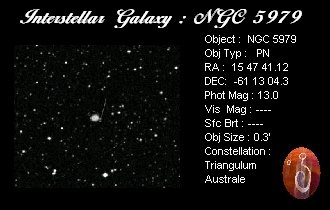
Also in the far north, and just missed out from being included in Norma, is the planetary nebula NGC 5979 (15h 47.7m, -61 13'). With a 20 cm SCT and a suburban sky, it was a faint and difficult-to-find star-like point. I could not distinguish it from other faint stars nearby until an OIII filter was used, so that its brightness was undiminished while the nearby faint stars were all but blocked out. Returning to the unfiltered view, it could on close inspection be seen to be a bit fuzzier than a normal star. It lies about 15' W of a mag. 7 star, and is the leading apex of a flat isoceles triangle with two other stars. Supposedly it has a 15" disk, but this must be in photos or in a dark sky.
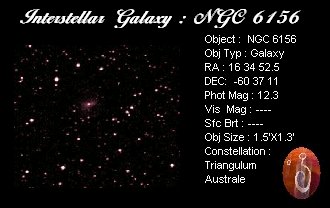
I tried for the two brightest galaxies in the constellation, NGC 6156 (16h 34.7m, -59 36') and NGC 5938 (15h 36.6m, -66 50'), but they were not bright enough to see in my viewing conditions.
MAPPING TECHNIQUE
VISUAL EXERCISE : Two Person Exercise.
DESTINATION : Your Choice
STEP ONE
Traveller : Get comfortable and relax.
STEP TWO
Traveller : Charge your physical body with light energy.
STEP THREE
Traveller : See your visual body standing in front of your physical body and prepare your visual body for interstellar travel with a Interstellar Protection Shield.
STEP FOUR
Traveller : See your visual body filling with light energy.
STEP FIVE
Traveller : Focus your mind on teleporting your visual body to the Your Destination.
STEP SIX
Traveller : Then see your visual body teleporting to the Your Destination.
STEP SEVEN
Traveller : When you arrive in the destination Look around can you see any planets or moons in the System? If not use the Interstellar Planetary Detection Rapid and see if you can detect any planets or moons in that system.
STEP EIGHT
Traveller : If you can see or detect a planet or moon using Telekinesis or Teleportation move towards the planetary body.
STEP NINE
Traveller : When you arrive at the outer atmosphere of the planet or moon stop and ask your spiritual guide to tell you the name of this planet or moon.
Traveller : Tell the mapper the name of the planet or moon. Also tell the mapper all you can about the planet or moon.
STEP TEN
Then us the Core Comparison Crystal Technique to perform a core reading on this planet or moon and give the mapper your reading on this planet or moon
STEP ELEVEN
Traveller : Then levitate or Teleport your visual body to the surface of the planet or moon.
STEP TWELVE
Mapper : When the traveller arrives on the surface ask the following questions.
Is there any plant life or water on the surface of the planet or moon that you can see? Is there an atmosphere around this planet or moon? Is the atmosphere an match with earths atmosphere?
Mapper : Write down the answers to these questions.
PLANETARY DATA FILE 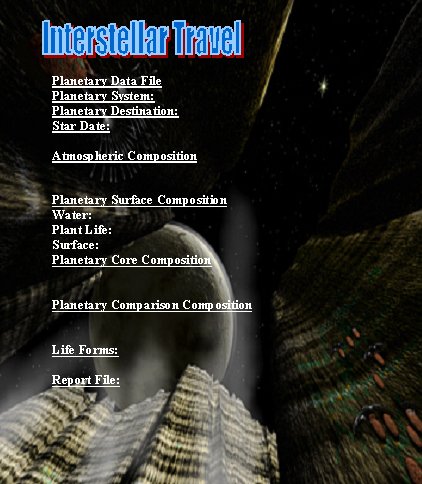
STEP THIRTEEN
Traveller : When you are finished on the surface teleport your visual body to the nearest planetary body that you can see in that Galaxy.
STEP FOURTEEN
Traveller and Mapper : Follow steps nine through to twelve again till you have mapped out the whole Galaxy.
STEP FIFTEEN
Traveller : When you have finished mapping the Galaxy teleport your visual body back to your physical body back on earth.
REMEMBER
When you are travelling if you come across an alien race that you think may be friendly feel free to make contact with that alien race.
IMPORTANT
When you are contacting alien races always be ready to teleport if there is trouble.
MAPPER
Make a note of any planets or moons with an atmospheric match with earths. That way you both know which planets can support human life forms.
MAPPER & TRAVELLER
To check that your mapping of that Galaxy is correct by changing roles and do this exercise again. Also remember to check for life force energy around the planets or moons that you visit on your journeys. Because if you can feel life force energy that means the planet or moons is a real planet or moon.